
record details.
| interview date(s). | March 17, 2026 |
| interviewer(s). | Gwen FretzGalen Koch |
| affiliation(s). | George Stevens Academy |
| project(s). | Blue Hill Peninsula Stories: Back to the Land |
| facilitator(s). | Phelan GallagherGalen Koch |
| transcriber(s). | Galen Koch |
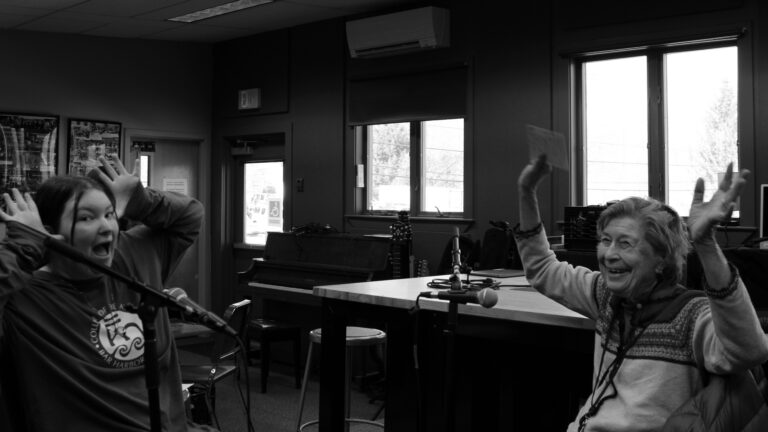
Blue Hill Peninsula Stories is a series of oral history interviews conducted by students in the George Stevens Academy “Audio Production 1” course, and archived and shared digitally on Maine Sound & Story as a community resource. Students interview local residents gathering stories about significant places and natural resources unique to the Blue Hill Peninsula community. Each year, a theme is identified to focus the stories and create cohesive narratives around important local issues such as sea level rise, food scarcity, changing weather patterns, and access to the working waterfront.
For 2026, the theme was “Back to the Land,” inspired by the movement in the ‘70s that brought a significant number of new residents to Blue Hill and the surrounding towns. Focusing on the unique experiences of homesteaders and “Back to the Landers” around the peninsula, these interviews reflect the subjects’ lives as they sought peace through self-sufficient living and working the land.
This project is a partnership between George Stevens Academy, the Blue Hill Public Library, and Maine Sound + Story, and was funded through a generous grant from the Maine Community Foundation.
[00:00:00] Gwen Fretz: So how would you describe the back to the land movement in your own words?
[00:00:07] Carole Beal: In the early seventies, we had been in Bolivia for two years in the Peace Corps, my husband of 20 years, Elmer Beal. And when we came back to this country, we went to the University of Texas to graduate school and just people were, it was in the air. But that’s not exactly why we were really – Elmer had been, was born in Maine on MDI [Mount Desert Island] grew up in Southwest Harbor. And so he always had this, wish to own a big piece of land and build his own house and homestead. After we were married and then we actually had already had a baby, our first daughter, as soon as we could, we came back to Maine to find a piece of land to be sure that it wasn’t all gone.
We looked on MDI and there wasn’t anything. Everything was expensive and we had no money. We’d been in Bolivia for two years. And we came – one of the people we came to see was Rufus Candage. I don’t know if you remember Rufus Candage but he was a realtor. He owned the hardware store in town and, he took us to walk on this piece of land up in North Blue Hill. It was on a ridge overlooking the mountain and it had – it was just gorgeous. It was February and there was snow on the ground and we fell in love with it. I understand that Rufuss didn’t sell land to everybody, he was watching – and we were just thrilled that we were able to buy it.
It had been cut over, all the trees had been cut off on the 130 acres in the back, but there were four fields and they were beautifully cleared with Stonewalls around. Anyway, it was very – it was magical. So I think being at a stage in our lives where we wanted to set up housekeeping and have a family. We wanted to build the house ourselves, we wanted- and we wanted to live off the land as much as we could.
[00:02:42] Gwen Fretz: Yeah. you said that It was just magical. So I know that like the Back to the Land movement and like building homes and everything comes with a lot of but you stayed and you’re here. What was it exactly about Maine that just like really captured you and made you fall in love and want to keep going?
[00:03:09] Carole Beal: We are here now and there are three generations of us living on that piece of land. That February day we came right now and my granddaughters both have been in high school all the way through school. They were born next door. And so it offered everything that we hoped for at the moment. There were no buildings, the previous owner was Fred Perkins, and I think he had Tamworth Farm Dairy or Tamworth Farm – cows anyway. And he had taken this land burned down the house because all he wanted was to plant hay on the fields for his cows on Tamworth farm. So when we arrived, there were these four fields with fabulous hay and this cellar hole. So we set up a tent as soon as we could in the spring. And actually, Elmer was teaching at College of the Atlantic part-time and in the summer he had free, so we set up tents and we started clearing out the cellar hole by hand and started building this house.
And the one thing about people who are from Maine, it seems like to me, at least men feel like they learn and believe they can do anything, like build a house. He had never built a house. The advantages were that his family were very enthusiastic about us being there, and his father and his brothers all came to help. And, on top of that, this beautiful piece of land had 18 inches of topsoil that the glacier left and it was up on a ridge overlooking the mountain and it was just, it was just a magical place. So we had- that whole summer, four months, we lived in a- through October – we lived in a tent and worked on the house, but we didn’t get the plumbing done in time to move in. So his parents wanted us to come live with them and my mother-in-law was very happy to have the baby come and live with them. And so that winter was fabulous because they own Beal’s Lobster Pier and we were able to – I was able to become familiar with their family more because we had been married for three years, but we had been in graduate school most of that time.
So we had many gifts. We had family here that made it easier. We had fabulous soil in North Blue Hill for us off of Ackley Farm Road for having a garden. We had an acre garden and we had pigs and we had chickens and we cut our firewood and we built this house, with his family and all of us worked on it. And, then, he built a barn and then we realized that maybe we could make – we needed to start making money so that there was people asking us about the hay on the fields.
So we were walking around with a farmer on Mount Desert Island and behind his barn there was this trash pile, and in it were all tractor parts but there was an old tractor and Elmer said, “What are you doing with that?” And he said, “Nothing. You want it?” So he went back with his truck and the farmer had some things – parts of it in his barn and Elmer got a manual for a John Deere tractor for that model and took it all apart and put it back together. And we used it for 15 years. We made 5,000 bales of hay every year and sold it and delivered to people, mostly on Mount Desert Island. So that was how we started being semi-farmers. But I was always a potter. And when we got here, the whole time, the first thing I did when we moved into our little house, the first thing was we had a second baby, another little girl. And in the cellar I set up a pottery studio and I started making pots as soon as I could.
[00:07:57] Gwen Fretz: That’s amazing.
[00:07:58] Carole Beal: It was all fun. It was it – there was many challenges, but it was, we really had it much easier than a lot of people because we had family that we could depend on.
[00:08:10] Gwen Fretz: Yeah, that sounds like everything fell into place and like you were called here, this is where you’re supposed to be.
[00:08:18] Carole Beal: My mother-in-law would say, in the middle of the winter, if you wanna go work on the house, Carol, I will keep the baby and. make fish chowder and bring it over for lunch. She was thrilled to have her there.
[00:08:34] Gwen Fretz: Just wanted time with her grand babies.
[00:08:36] Carole Beal: Yes, it was – and they have all – and they were always really, really close until she died. But we knew fairly soon that we weren’t going to make it on 5,000 bales of hay. So finding a job was, of course we had connections on the island, so immediately the first thing we found was in Bar Harbor. And, so for probably 20 something years, or more, we would go to Bar Harbor in the winter and then we would come back home for the summer. In early May, we would come and plant our garden. And we’d come some during the winter, but mostly, our kids were born – one was born over there and they went to school there and grew up. As far as making our living from the land, we pretty much did for the first seven years, but then, such as it was. Elmer had been working at the college part-time and, as a potter I was always interested in Making pots. I actually worked at the college and taught, some of the – it was an adult education class. With a group of 11 people we, and this had to do with my Peace Corps training, we together, we were unrelated, but we bought a building in downtown Bar Harbor and we spent probably six months organizing how this was going to work. I was one of the founders of Island Artisans Gallery, which is still there 44 years later. And it’s doing great and I was in charge of advertising for 28 years, but after that I retired.
So, a lot of Back to the Landers started a lot of businesses here in Blue Hill. I could sell all my pottery there. You may have been there before – Island Artisans. It’s only Maine craftspeople, I’m not part of it anymore. I sold my shares, but, just so many craftspeople have been able to sell their work in downtown Bar Harbor by doing it through Island Artisans. So it was a great success.
And as far as the land is concerned, that is what just kept calling us back. We never – we always considered this home and we always came home. Our kids, every summer they hung out with, the one neighbor kid, Ron Stanko used to teach here, and his daughter, Samantha, lived across the street.
And, so anyway, it was – it was a great – to this day, we are all just grateful to be on that land and to have so much history there. We just felt lucky to have found it and now we’re so happy we don’t live on Mount Desert Island and that we live in Blue Hill. And my granddaughters all went to – they’re at the Harbor School. Oh, one just graduated and she’s now at Kenyon College. But they’ve gone through school here all, all their years of school and we really love and happy to be in Blue Hill.
[00:12:41] Gwen Fretz: Yeah. Sounds like a really special experience.
[00:12:45] Carole Beal: Oh, it was. It was.
Yeah. Yeah. I think we did everything that we dreamed of doing. Building the house, building the barn. I now actually live in the barn, because the first couple when they were pregnant, they came and asked if they could have – if they could buy a field from us and because we had four or five acre fields. And of course I said, “No, you can have a field.” And so they came and lived in our little house for several years, two years, while they built their own house and then their baby was born and they moved there and then the other couple came and said, “We’re pregnant and we would like to live here as well.”
But they didn’t build houses. So, “Could we have the little house?” So I gave them the little house and an acre. And they will each have five acres and it all, we really were committed to saving the land and protecting it. So we put a conservation easement through the Blue Hill Heritage Trust on 137 acres and that was the acreage that had been cut over and now it’s all grown back. It’s been almost 50, 60 years. And so it has an easement and that’s part of the deed.
[00:14:24] Gwen Fretz: It sounds like community is a really big part of the whole movement and being successful in it. And I know that, at least recently, in more like developed areas and cities, community isn’t as much of a thing. Do you think that maybe that was starting back when you moved here and maybe that’s why other people were drawn to Maine because they wanted a community and they wanted people to be around and like share in this wonderful thing?
[00:15:05] Carole Beal: I think people were searching for a different kind of lifestyle. And I think you’re right. They were searching for community and we certainly found it here. When we moved here our first daughter was only eight months old, but, soon she was four and her sister was two, a little over than two and a half. I got to know Justine Snyder, who lived in town, and she remembered that there was an old preschool that had been in the Congregational Church years ago for little kids, for two and three and four year olds. And we decided that we would like for all the kids who go to the kindergarten, the consolidated school, that they would have experience with scissors and crayons.
And so we called a meeting and I said to, Justine, she lived right in town. Her husband was Ed Snyder. You’re either going to, at this meeting, you’re either going to have to be president, for us to get this going, or treasurer. She says, “Please let me be treasurer.” I said, “Okay.” So then we had a few people and we hired a teacher, Jean Warren, who had been a teacher and then got permission from the Congregational Church. And so three mornings a week for just, I think it was three hours, we had the four year olds and two mornings a week we had the younger ones, the smaller. I understand it went for quite a long time because by the time my daughter was, she was in first grade, we were living in Bar Harbor in the winter.
So that was – you could do things. You could start things. You could make things happen. And people were receptive and they were willing to – I think when the co-op started, I wasn’t here, but I think they were just buying things in bulk. We have to get someone to talk about the co-op in the beginning, but it was a food co-op. But everyone had ways of – and worked really hard to, to make it easy on each other and to be supportive in community. So I think you’re absolutely right, community was, is, and continues to be really important to – it was a great evening the other night to have 90 Back to the landers. Were you there?
[00:17:50] Gwen Fretz: I was not. I was not feeling well, unfortunately.
[00:17:53] Carole Beal: It was really amazing. It was a great evening. It was fun.
[00:18:00] Gwen Fretz: Yeah. It, seems like Maine offers a lot of opportunity, at least to a certain kind of people. I feel like many others would think that such kind of a rural place wouldn’t offer many opportunities, for creation or anything they’re interested in. But would you say it takes a certain type of person to see the potential and then go after it to make something here.
[00:18:41] Carole Beal: Wow. I think a lot of people prove you right! They came and they – and you’ll find as you interview more people, you’ll find that, there were just ideas all over the – and most of it had to come from our own needs. I had little girls and there was no preschool and so we got together and made it happen. It probably did call a certain kind of person to come that were searching for some kind of different lifestyle and, so many of them are still here that they certainly found it.
And I think Blue Hill has been enriched by their, I’m sure it was a clash in the beginning. Different ways of doing it. But I found people very welcoming. When we were digging out our cellar hole by hand and there was this Ron and Cherry Stanko who had just arrived at the same time and they had their family who had a construction company and they were – I kept saying – “We need to go talk to them. I think we could move ahead.” And they indeed were our friends forever and their daughter Samantha, as well, still to this day, we’re just had – we depended on each other a lot.
[00:20:18] Gwen Fretz: Yeah.
[00:20:19] Carole Beal: So it was great. I don’t know if there’s, I’m not sure if you have any other particular questions, but…
[00:20:37] Gwen Fretz: If there’s anything you would like to talk about, please go ahead.
[00:20:42] Carole Beal: We just – we always loved coming back in the spring and planting our garden. One year my daughter started chicken eggs in her bedroom in Bar Harbor and turned the eggs and then when we came, we brought the chickens to Blue Hill. She was there when they hatched and then she brought them in a cardboard box, that weekend we came to Blue Hill and we had built a chicken house and one of them she called Suzanne. Suzanne was with us for many years. It just, I don’t know, that kind of lifestyle is just great.
Your kids, when you’re making hay, when they were 10 and 12 and everybody pitched in. We even had summer people next door and their whole family would come and throw hay on, we had 40 pound squares of hay and bales and someone would be on the back of the truck and everyone else would be throwing the hay up and they would be stacking it. And even from a young age, our daughter would be – her dad would put her up in the front of the truck and tell her, it was an eight wheel drive, it was huge, and say just – she couldn’t touch the clutch and look out at the same time. So he sat her up and she would, he said, “So just,” it was in the lowest gear going slowly. Then he said, “As soon as you get to the end, just get down and push on the clutch and it’ll stop and I’ll come and get you and turn the truck around and then you can go back the other way. We’ll pick up the other side.” It was – we learned a lot. I had never gardened before and we had this acre garden and we would – when the girls were like four and five and six up to 12, they would have a pile of green beans on the this counter and we’d all be chopping green beans. And I remember one of them saying, “When I grow up, I’ll never eat another green bean again.” We had a root cellar and we had all the cabbages and onions, and I buried the carrots. It was a learning process, everything. One year I built – I planted a row of 50, what are they called? There’s – I can never remember. They’re like little cabbages on a stalk.
[00:23:27] Gwen Fretz: Brussel.
[00:23:27] Galen Koch: Brussel sprouts.
[00:23:28] Carole Beal: Brussel sprouts. That was it. I never ate brussel sprouts where I grew up, so I never can remember.
But so I planted a row of 50. Thinking there was just a few on each, and there were just tons on each. And in North Blue Hill with our soil everything grew, everything was just – we were, like I say, we were blessed with many, many gifts that made it – the fields were all spared of – of course rocks come up all the time and we were picking rocks all the time as well. But, but there were so many experiences like that. One time we were haying one field and there was a – one of the girls saw a fawn nestled in the hay, and he was coming along cutting it with the – I think he was using the baler, the conditioner, anyway, and she ran and her dad went with gloves and picked up the fawn and took it to the side of the field. But he would’ve run over it if she – I think he would’ve seen it, but she felt – anyway, and later we knew that it was gone so we knew that the mother had come back because we were worried that. It would be left there. We had bees one year. We had bears in our bees. We experienced everything that you could possibly do.
[00:25:04] Galen Koch: Gwen I have a question, if it’s okay. You’ve mentioned that it was a learning experience for you, and I’m just curious what, where, who was teaching you or were you reading books or was it community efforts or how did you get the knowledge?
[00:25:20] Carole Beal: It was trial and error a lot, but it was neighbors and we’d hang out with neighbors. Penny and Barty Boardman and all the neighbors in North Blue Hill, everybody was gardening. And, our neighbors were – we had elderly neighbors like, Ruth Bowden and her husband before, he died early on, but she was there for quite a long time. And I just think Mainers, even if they hadn’t grown a garden, their mothers had. We probably – and there was Fedco where we could get seed and there was, I mean there were all, a lot of ways that we were helped.
And College of Atlantic was helpful too. We were there in the winter and there were – we went to some – actually, I took some courses there, too. And anybody, there were people there who could answer every question.
We’d come over in the winter and cut firewood so we would have it for – we had wood stoves in both houses. And and it wasn’t until 2020 that, or 2019 that I moved back here year round. And both girls and their husbands already had set up household and both my granddaughters had been born by then, they were in the little house, with the same midwives. So maybe someday we’ll have four generations on the land. But we love – the land is just everything that we had could hope for. It was, it was great.
[00:27:26] Gwen Fretz: So a little bit of a different direction, but, do you think that the world events of today are at all reminiscent, what was happening back when the back to the land movement was happening? And if like they are similar, how do you think those influence people’s decisions to maybe have a simpler life and move to Maine or other areas that are less developed?
[00:28:02] Carole Beal: I think there’s no period at our 250 years that is like today. This has never, ever happened as it is today. And we have challenges that we all have to work to overcome, but there were challenges back then. There was the Vietnam War and people were moving to Canada and people were really – young people were really thinking about what kind of life they wanted to have. What kind of lifestyle. And young families were and that were cognizant of the challenges of living in cities and they wanted a kind of life that was meaningful. So the land called them. And also they were, I think a lot of creative people who, were willing to work really hard and create communities that were different from how they had grown up.
So I feel like yes, what was going on nationally and internationally did impact us, and our decisions and it’s very different from today. Today is very – we don’t know how it’s going to turn out today. And we just have, all of us, have to be dedicated to caring for our form of government and our democracy because it’s fragile and we could lose it. And I’m an optimist and I know a lot of people who are working really hard. That’s our hope that we can – but my heart goes out to young people who are – it’s a difficult time for people who’s just starting families and their lives. It’s a lot to worry about. A lot to of concern, but we have to – we have to be in touch with our community because that’s what will get us through it, partly.
[00:31:04] Gwen Fretz: Yeah.
[00:31:07] Carole Beal: I don’t know if you feel that pressure?
[00:31:11] Gwen Fretz: Oh, yes, definitely. Yeah, there’s a lot going on and with sort of the state of the government and everything, I know I’ve noticed lots of people will stand on the side of the street and protest. And I’ve seen yard signs up and everything and I’d be interested to hear how you think activism plays a role in these small communities?
[00:31:42] Carole Beal: I think it plays a huge role. And, on the 28th of this month will be the “No Kings III” protest. It’ll be in all the little towns from either 12 – 1 PM in Castine will be from 1 – 2 PM. But I always go to Ellsworth because, we started with 300 people there in the winter, a year ago, and then it went to 700 and then it went to over a thousand. And as far as nationwide, “No Kings III,” this is going to be the third one, and it’s – there are protests all over, including little villages up in, Alaska, everywhere there are these. And we’re hoping that there will be – there were 3000 nationwide in the first one. There were seven – I mean, three million -there were 7 million for the second one. And we’re hoping that there’ll be 9 million in this next one and that this will grow and at the midterms we’ll at least be able to have some of our – have some say in how things are going in our government by having some control either of the House or the Senate or both if we can. There are a lot of unknowns and it just, we have to just keep being active in and being well informed from reliable places to get information. Because we have technology now impacting what we know right now, and that’s very, very different. When I was growing up, there were three television stations. There was NBC, CBS, and they all reported the same thing so we all believed the same. Now there’s innumerable social media sites and it’s very hard to figure out what’s true and what’s not. And it takes a lot of work. And we have to be sure that we’re not passing information on that’s dishonest. We can do it in inadvertently if we don’t really work at it. So we have to be really careful.
[00:34:12] Gwen Fretz: Yeah. And I would say that, all of the misinformation that can be so easily spread, like through technology also ties back to a reason that someone might want to have a simpler life, maybe not be so connected to technology, and not be influenced by those sort of things.
[00:34:39] Carole Beal: You see there are a lot of young people now in North Blue Hill. We have – we had Paul Birdsall and. Molly Birdsall, maybe you knew some of the grandchildren, Birdsalls, in school. But Paul was – had graduated from Harvard and he came here and he had, he was farming with horses and he, over the seventies, eighties and nineties, he had a lot of young people come from all over the country to be interns and now a lot of – and he would buy land and put a conservation easement on it, which meant that the development rights – you couldn’t have a developer come in and build a slew of houses. You would have to, because it was a conservation easement is in the deed and it lasts forever, and there are some tax advantages if you have a conservation easement, but really the reason to have it is to be protected.
We have two farms on either side of us, as well as ourselves, that have conservation easements. We’re hoping, that development and houses will be closer to the center of Blue Hill and that all the farmland in North Blue Hill, which is so rich, will be left for farming. Because maybe with this warming, someday, we may be able to feed ourselves, if we don’t build a house in the middle of every field. I think a lot of young people, Bluesy Farm, Quills End Farm, all those people with their children who are born here and have grown up and graduated and are now working on the farms or have just brought a lot of younger people.
Because when we first moved here, there weren’t – everybody wanted to go to Boston or leave as soon as, or go to college as far away as possible. And then now we are seeing them come back. A lot of these people who worked with, Molly and Paul Birdsall – Paul Birdsall started MOFGA the Maine Organic Farmer’s Association and the Common Ground fair. He was on the board in the beginning. He was also on the board for the Blue Hill Heritage Trust, which protects land. Which is a phenomenal organization and really has done a lot for protecting different areas on the whole peninsula. I’m in a hiking group and we have their book and we hike, for years and years we’ve been hiking as many of the trails as we can. Anyway, so Gwen, I wish you well when you go to College at the Atlantic.
[00:37:44] Gwen Fretz: Thank you.
[00:37:45] Carole Beal: I know that it will be an experience and, I think that you’ll meet people there that were Back to the Land or living simply and using their skills to help themselves to live well. I wish you well.
[00:38:11] Gwen Fretz: Thank you. Yeah. thank you for meeting with me.
[00:38:12] Carole Beal: You’re very welcome, Gwen. Nice to meet you.
[00:38:14] Gwen Fretz: Nice to meet you, too. I really enjoyed our conversation.
[00:38:17] Carole Beal: Oh, thank you. Me too.
In this oral history interview, Carole Beal reflects on moving to North Blue Hill, Maine, in the early 1970s as part of the Back-to-the-Land movement. After serving in the Peace Corps in Bolivia, she and her husband, Elmer, returned to Maine to build their own home, raise a family, and live as self-sufficiently as possible. Beal recounts discovering their 130-acre property, living in a tent while constructing their house, and creating a homestead with gardens, livestock, hay fields, and a pottery studio.
Beal emphasizes the importance of community to their success. She describes the support of family and neighbors, her role in founding the Island Artisans cooperative gallery, and local efforts to establish a preschool and protect farmland through the Blue Hill Heritage Trust. Reflecting on both the 1970s and the present, she connects the Back-to-the-Land movement to enduring values of creativity, conservation, civic engagement, and living closely connected to the land and community.
