
record details.
| interview date(s). | March 25, 2026 |
| interviewer(s). | Galen KochPhelan Gallagher |
| affiliation(s). | George Stevens Academy |
| project(s). | Blue Hill Peninsula Stories: Back to the Land |
| facilitator(s). | Galen KochPhelan Gallagher |
| transcriber(s). | Annie Bennett |
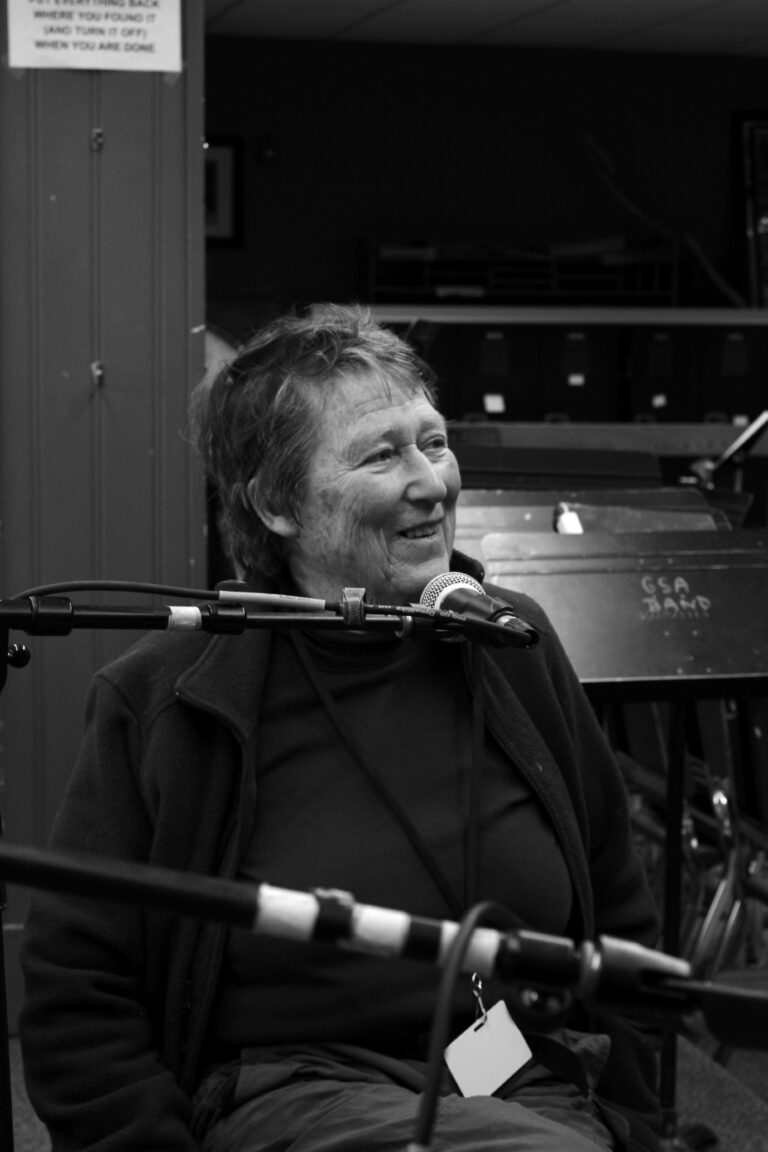
Blue Hill Peninsula Stories is a series of oral history interviews conducted by students in the George Stevens Academy “Audio Production 1” course, and archived and shared digitally on Maine Sound & Story as a community resource. Students interview local residents gathering stories about significant places and natural resources unique to the Blue Hill Peninsula community. Each year, a theme is identified to focus the stories and create cohesive narratives around important local issues such as sea level rise, food scarcity, changing weather patterns, and access to the working waterfront.
For 2026, the theme was “Back to the Land,” inspired by the movement in the ‘70s that brought a significant number of new residents to Blue Hill and the surrounding towns. Focusing on the unique experiences of homesteaders and “Back to the Landers” around the peninsula, these interviews reflect the subjects’ lives as they sought peace through self-sufficient living and working the land.
This project is a partnership between George Stevens Academy, the Blue Hill Public Library, and Maine Sound + Story, and was funded through a generous grant from the Maine Community Foundation.
[00:00:00] Chip Wadsworth: Well, my name is Chip Wadsworth. I live out on Cape Rosier. I came in November of 1974, long time ago. I was about 25 years old. I’ve been here ever since- pretty much in the same spot. And at this point, I’m “retired.” But, I still do an awful lot of work. Cause when you live on a homestead, the work never ends.
[00:00:26] Oguz Dincel: Oh yeah.
[00:00:26] Chip Wadsworth: And I also do some gardening and caretaking work for neighbors.
[00:00:30] Oguz Dincel: Oh, wow. That’s nice. Do you have any children?
[00:00:34] Chip Wadsworth: I have two kids. Well, they’re not kids anymore. They’re [in their] 50s.. They’re, technically my husband’s kids, but they’ve been there since I was there pretty much, so I’ve been there through their whole life.
[00:00:53] Oguz Dincel: Can you tell me about your decision to move to Maine? Why’d you move here?
[00:00:58] Chip Wadsworth: Well, sort of by chance. In 1974, when I came, I had just finished hiking the Appalachian Trail. I knew that I wanted to homestead and I went from Georgia to New York and then when I got to New York, I flipped and went to Katahdin and started walking south. And when that flip happened, I came up to Harborside, Maine because one of my college professors lived there, so he was supposedly gonna give me a ride up to Baxter Park, the northernmost point, and then I could walk south. And when I was visiting him, he took me over to Eliot Coleman’s to get vegetables, and I saw what Eliot and his wife Sue were doing, and I knew that was kind of what I wanted to do, so I wrote him a letter, and he said, “Well, we’ve never had people come starting in the winter. They usually come in the spring, but, you know, there’s a cabin here. If you want to come, you can come.” So that’s what I did and ended up showing up in November.
[00:02:06] Oguz Dincel: Oh, wow.
[00:02:07] Chip Wadsworth: That’s kind of a long story, but, didn’t really intend to come to Maine. It just kind of happened that way.
[00:02:13] Oguz Dincel: Oh, that’s really interesting.
[00:02:14] Chip Wadsworth: Yeah.
[00:02:15] Phelan Gallagher: Where were you living at that point, before you came up here?
[00:02:18] Oguz Dincel: Yeah.
[00:02:19] Chip Wadsworth: Well, I think immediately before that I was at my parents’ because I was putting food together and helping to figure out this trip, but after college I, I lived in a lot of different places. I moved all over.
[00:02:32] Phelan Gallagher: Cool.
[00:02:33] Chip Wadsworth: Worked at outdoor education places and just moved around.
[00:02:37] Phelan Gallagher: Yeah.
[00:02:38] Chip Wadsworth: Didn’t have any permanent connection.
[00:02:40] Phelan Gallagher: Where did you go to college?
[00:02:42] Chip Wadsworth: Springfield, Massachusetts.
[00:02:43] Oguz Dincel: So, can you tell me about a memory you have from the early days of the Back to the Land movement? Do you have any memories about it?
[00:02:52] Chip Wadsworth: Oh, I have lots. Let’s see, what should I pick out first? Well, clearing land to make garden space, deer hunting, butchering pigs. My husband somehow got in the business in the fall of butchering pigs. We’d go to people’s houses and drive around and we’d usually do about 200 in one fall. So, that made a big impression. Helping to cut firewood- we used a little sled we made out of skis to drag it out of the woods. Tanning deer hides. I sewed my husband a shirt at that time- never got anything made for me… raking blueberries, doing canoe trips up north on the Machias River. Planting a big garden, growing seedlings, working on the house, taking care of two kids. It goes on and on and on, everything you have to do to live.
[00:03:54] Oguz Dincel: Oh, yeah. Aw.
[00:03:57] Phelan Gallagher: After you showed up at Eliott’s farm, what happened next and (illegible) did you stay here?
[00:04:04] Chip Wadsworth: Of course this was back when he was in his early 30s, which is not at all what you saw in your interview. But he was diagnosed right about then with, I think it’s hyperthyroidism, and he needed to take some time off from farm work, not quite do as many things as he might have normally been doing over the winter.
So I still did help out there. I lived in this little tiny one room cabin that was part of his property. But, he said, “Since I can’t really keep you employed all the time,” and I wasn’t being paid anyway… “Why don’t you go talk to the neighbors and see if they could use some help.”
And this was a young couple- oh, two or three years older than me with a little girl that was just about a year old. So I went over there and of course they could use some help (laughs). So I just ended up working there primarily and I never really did that much more for Eliot. I think he pretty much just transferred me to someplace else and at the time, he had a lot of young people coming up- mostly right out of college, to work as apprentices and they’d stay anywhere from a week to the whole summer and live in this kind of place we called the campground, which my cabin was part of.
And they’d live in tents and I think the Colemans fed them maybe one meal a day and then they did their other meals. So, I mean, I was sort of part of that but I really worked at the neighbors instead of at their place so much. But they were still a big influence because they were right next door.
[00:05:56] Oguz Dincel: So as far as I understand, you came here because of a professor and you stayed at the farm because you wanted to work there.
[00:06:07] Chip Wadsworth: Mm-hmm..
[00:06:08] Oguz Dincel: But you said that you didn’t work there a long time. After that, why didn’t you leave? Because, you said that you worked for the farm’s neighbors and-
[00:06:25] Chip Wadsworth: Right.
[00:06:25] Oguz Dincel: It was a like different kind of job than what you did in-
[00:06:31] Chip Wadsworth: It was actually very similar because both the Colemans and the neighbor were what I would call ‘homesteading.’ They were both building their own houses, clearing their land, starting out with a few animals… They both had goats, the neighbors had chickens, both had little kids, both were trying to grow most of their own food. So, they were both very similar. It was a very similar situation, so …
[00:07:05] Oguz Dincel: Yeah, I misunderstand it. I’m sorry.
[00:07:07] Chip Wadsworth: Okay. No, I don’t think you misunderstood, but you just wanted to know why I didn’t leave after I-
[00:07:11] Oguz Dincel: Yeah.
[00:07:12] Chip Wadsworth: Yeah. Yeah, it’s because they were very similar.
[00:07:15] Oguz Dincel: Yeah. What did you do after your neighbors?
[00:07:19] Chip Wadsworth: Well, I’m still there.
[00:07:21] Oguz Dincel: Oh, really?
[00:07:22] Chip Wadsworth: Yeah, so I didn’t do anything else after. It turned out the neighbor couple split, divorced, so then I kind of became the woman on the farm and eventually we married. Life just continued there. So I didn’t ever leave. I’m still there. It doesn’t all, it doesn’t look necessarily exactly the same, but it’s still the same place.
[00:07:47] Oguz Dincel: Yeah, wow. It’s interesting.
[00:07:49] Chip Wadsworth: Yeah.
[00:07:50] Oguz Dincel: How would you describe the Back to the Land movement with your own words?
[00:07:55] Chip Wadsworth: I always thought of Back to the Land as kind of the same thing as homesteading, and it might not be. I mean, there’s probably some distinctions there, but, I think of it as people who come and want to be ‘do-it-yourselfers.’ I mean, they often build their own house, either clear land or have some land that’s already cleared that they bought where they have a garden. If they have woods, they might cut their own firewood. They often raise animals. If they’re gonna eat meat, they raise their own animals- try to make less of an imprint on the earth.
But, I don’t see it so much. I thought about this after that presentation at the library and that I don’t see it so much as… during COVID, a lot of people moved to Maine and they bought houses and they worked remotely and I don’t consider them as back to the land because they’re just moving into a situation that’s already all set up for them and not so much forming their life from the land, from the property.
[00:09:18] Oguz Dincel: Yeah. And most of the back to the land movement contenders built their house and they came here to change their life.
[00:09:29] Chip Wadsworth: Yeah.
[00:09:30] Oguz Dincel: They had like a nine to five job, an apartment, and stuff, right haha? ()
[00:09:36] Chip Wadsworth: See, I was never in that. Well, I mean, maybe when I grew up. But, once I went off to school I always wanted to do this and I don’t know where it came from, but it was just there.
I even made up a course and I don’t remember now even what it was called, but it was to do things like tanning and figuring out how to garden and-
[00:10:06] Oguz Dincel: Oh.
[00:10:06] Chip Wadsworth: There wasn’t a course you could take to learn that, but I just kind of (did) independent study, that’s what it is. So, I knew I wanted to do this anyway, and when I got out of school, I did hiking, I worked at different camps, I traveled around the country. So, I didn’t really come from a nine to five apartment job- which I think a lot of people did, at least from that film they showed.
[00:10:36] Oguz Dincel: Oh yeah.
[00:10:36] Chip Wadsworth: A lot of people did, but that wasn’t where I started out. Yeah.
[00:10:41] Phelan Gallagher: Can I ask you more too about that? Because I’m curious about what you studied in college, and I’m also curious about your family growing up, because I think for some people this was probably an ideology that was instilled in them, maybe at home, for other people it was like really something they came to on their own. Can you try to walk us through, like, how did you become this person?
[00:11:01] Chip Wadsworth: I don’t know. I think it was just there. Yeah. I don’t know. My grandparents were very interested in flowers and birds, flower gardening, not vegetables. Maybe I got some of this from them. We lived in a suburban situation.
My father was an extension veterinarian, my mother stayed at home, I did Girl Scouts. But I just always liked the outdoors, that was always like a major focus, even as a little kid. And then in school I started out doing biology and then switched to I think outdoor education and then ended up in natural resources because I didn’t like the education courses.
So it was always kind of heading in that direction. But, there wasn’t any kind of a major or a study that was homesteading. Maybe there was in later years, but there wasn’t at that point.
[00:12:08] Phelan Gallagher: That’s interesting. And I, one other question that I’m curious about… my parents were back-to-the-landers. They identify as such. And so, growing up in that community, for some people it felt very, like almost philosophical or like sometimes you can hear Eliot talk about that. Or, I know with the Nearings, there was this sort of larger sociocultural rationale and I think for other people it’s just, ‘I really wanna be with my hands and in that life.’ Where do you see yourself in that spectrum?
[00:12:45] Chip Wadsworth: The second one?
[00:12:45] Phelan Gallagher: Yeah.
[00:12:46] Chip Wadsworth: I mean, Nearings sold the land to my husband originally. The Nearings were here, we were here, and then Colemans were here. So we were right between Colemans and the Nearings. So, there was some of that philosophical stuff, but for me it was more just down to earth.
It’s just like- this is how I wanna live. I don’t think I cared about the philosophy so much and- Yeah. … all of that. I think I’m still kind of in that position so. .
[00:13:21] Oguz Dincel: Oh wow. So what made you identify with the back to the land movement?
[00:13:31] Chip Wadsworth: What made me identify with it?
[00:13:33] Oguz Dincel: Yeah.
[00:13:33] Phelan Gallagher: Yeah.
[00:13:34] Chip Wadsworth: I don’t think I really did identify with it. You go and do what you want to do and then years later people say, “Oh, you’re part of the Back to the Land movement.” I didn’t know it then, but then later, that’s kind of what people identified, all these people that went back and started doing this. But at the time, you didn’t know that you were a part of it.
[00:14:00] Phelan Gallagher: Yeah.
[00:14:01] Chip Wadsworth: So-
[00:14:01] Phelan Gallagher: Would you describe yourself as like a part of the Back to Land movement or a homesteader or?
[00:14:07] Chip Wadsworth: I’m not sure. I think you asked that- what is the distinction and I don’t know technically what the distinction is. I think it sort of overlaps. You can be both, you can be Back to the Land and a homesteader. So, I don’t know. I think I’m just there. I don’t assign labels.
[00:14:38] Oguz Dincel: Do I have to be able to work with my hands to be in Back to the Land?
[00:14:42] Phelan Gallagher: I think kind of, yeah. I mean, it’s pretty hard to garden if you don’t have hands. Haha, it’s pretty hard to build a house or whatever you’re gonna live in if you don’t have hands.
[00:14:57] Chip Wadsworth: So I think you do. You don’t necessarily have to have all the knowledge up in your head to start with, but you have to have hands. I mean, if you for some reason, you didn’t physically have hands or all you could do was write with a pencil or computer keys in these days- um, yeah, I don’t think you could do that.
[00:15:21] Oguz Dincel: Oh.
[00:15:21] Chip Wadsworth: Cause you can always learn, but you have to be willing to use your body to do it.
[00:15:28] Oguz Dincel: So, I have a question, Why do you think people are coming here from the big cities that they have some kind of lifestyle. They go to work, they go back to work, like they grab a coffee from street, they have apartment, they have kids, they live in big city. I mean, I also live in a big city. I live in Istanbul in Turkey, which is like a huge city.
[00:16:03] Chip Wadsworth: Yeah.
[00:16:04] Oguz Dincel: But, I’m happy to be here, but I’m saying I wouldn’t want to live here. I mean, it’s small.
[00:16:13] Chip Wadsworth: Yeah.
[00:16:13] Oguz Dincel: You have to have your car and it’s hard to reach everywhere, you know?
[00:16:19] Chip Wadsworth: Yep.
[00:16:20] Oguz Dincel: So why would you think that people are coming here?
[00:16:26] Chip Wadsworth: I think some of them just want to get away from those things that you mentioned that you have in the city, you know? They want more space, open space around them, or they wanna do, like what I said, they wanna do more things for themselves.
My son just moved, my son grew up here and went to GSA- well, my daughter too- but they lived in California for a while in the San Francisco area and he said finally that not only was the weather very bad. I mean, California’s known for fires, landslides, earthquakes, you know, all kinds of stuff.
But also they wanted a different sense of community and living in a smaller place- and especially where I moved to way back then- there was a community of like-minded people.
[00:17:21] Oguz Dincel: Oh.
[00:17:21] Chip Wadsworth: And neighbors would share equipment and tools. You’d share labor and your philosophy and, Eliot shared a lot of his garden ideas and techniques before he wrote all these books. And that’s how you learn. I mean, I didn’t come here knowing how to do everything, but the people around me helped teach me how to do some of those things. So I think sometimes part of it is just community.
[00:17:56] Oguz Dincel: Oh.
[00:17:58] Chip Wadsworth: And I think maybe during the COVID time, I’m not saying that these people came here as Back to the Landers, but I think they left the cities because they wanted more space. They didn’t want to be crowded in, where there’s so much more chance of disease spreading and that kind of thing. I don’t know. I’m not sure I’m the right person to ask about that, but I think that’s part of it because a lot of people did come from the cities even way back then. I didn’t, but a lot of people did, yes.
My husband came from Youngstown, Ohio, which is a big industrial steel area that was falling on hard times. They were closing places at that point, but… why people chose Maine? I don’t know.
[00:18:51] Oguz Dincel: Yeah.
[00:18:52] Chip Wadsworth: I know why he came, but I don’t know why … There were a lot of people that came from Ohio and I don’t know why they all came. But he started out with his first wife in Rhode Island and they wanted to homestead and so they started going north to look for a property and they looked around Rhode Island first and they said, “It’s just too crowded and too expensive.” So as you go north, things were a lot less expensive. And, you know, then they read the Nearings’ books and the rest of it all happened after that.
[00:19:27] Phelan Gallagher: All right. Did you have Maine on your radar? I mean, you came up here to meet this professor, but was it like already in your mind as a place-
[00:19:33] Chip Wadsworth: No.
[00:19:33] Phelan Gallagher: That you might like to live there?
[00:19:34] Chip Wadsworth: No, I wanted to go out west.
[00:19:36] Oguz Dincel: Oh.
[00:19:36] Chip Wadsworth: And I mean, I’ve traveled out there since, but I wanted to go out. I thought of West as being more open country, wilder. New England was all settled. So no, I didn’t have Maine on the radar.
[00:19:52] Phelan Gallagher: Interesting.
[00:19:52] Chip Wadsworth: No.
[00:19:53] Phelan Gallagher: I want to go back to that part of the story because I realized I had a follow up for you, which is that-
[00:19:57] Chip Wadsworth: Yeah.
[00:19:57] Phelan Gallagher: Did you ever finish hiking the trail?
[00:19:59] Chip Wadsworth: Yeah.
[00:20:00] Phelan Gallagher: You did. Yeah. So you came up, you stayed with Ali-
[00:20:06] Chip Wadsworth: I started down here in Georgia and went up to New York and then because if I had continued north, I would have gotten to Baxter in Oct- well, they closed in like mid-October, so I would have missed that.
So that’s why I kind of did a flip. And that professor just happened to live in Brooksville and I knew him and we’d been in touch, so that’s the way that worked.
[00:20:31] Phelan Gallagher: So you ended up finishing backwards from where…
[00:20:35] Chip Wadsworth: Yeah, I ended up in New York. Yeah.
[00:20:37] Phelan Gallagher: And then you came because you had established a relationship at that point with Eliot.
[00:20:41] Chip Wadsworth: Yeah.
[00:20:41] Phelan Gallagher: Like you knew them and you knew you could come back. Interesting, cool.
I’m wanting to ask about community- jump in with anything that you think about this, but she mentioned community and I just feel like that’s a theme that’s come up a lot and it’s like-
[00:20:55] Oguz Dincel: Yeah.
[00:20:56] Phelan Gallagher: What we’re trying to get at is just like, what did it mean to you? What could you not have done is one thing that I’m thinking of, right? How did you rely on community in those early days? How did it help you to have that community?
[00:21:16] Chip Wadsworth: I mean, it certainly helps in terms of labor.
[00:21:19] Phelan Gallagher: Yeah.
[00:21:20] Chip Wadsworth: If you have a big job to do- I’m not thinking so much of us- but we I had a next door neighbor who was putting up a studio barn type building. He was doing this post and beam, he had cut all the parts ahead of time so they should have all just fitted together and then he had a whole crew of people come down and help raise that building and in one day, the structure of the whole building went up.
When you have a project like that, it really helps to have some help. I’m trying to think of what else. We get together and played volleyball every Wednesday afternoon and then go swimming. This was on Walker Pond, we’d go swimming. We also had another thing that’s important in our neighborhood, and this really did build community. We have a weekly sauna on Wednesday nights, and at one time there were, I think, seven or eight saunas in the neighborhood. So every week, you’d go to a different house, have a sauna, and then share a potluck dinner, and that’s been going on pretty much since I got here. It’s still going on.
[00:22:34] Phelan Gallagher: I actually remember now that you mentioned that, I believe Stan-
[00:22:37] Chip Wadsworth: Yeah.
[00:22:38] Phelan Gallagher: I remember going to those at his house with my parents just as a little kid, but skating on the rink while the adults jumped into the river.
[00:22:45] Chip Wadsworth: Yeah. Yeah
[00:22:46] Phelan Gallagher: Interesting. So sauna has been a part of that.
[00:22:47] Chip Wadsworth: I think that’s a big part because that brings a certain community of people together once a week.
[00:22:53] Phelan Gallagher: Yeah. Right.
[00:22:54] Chip Wadsworth: I mean, you never know what you’re gonna talk about. It could be politics, it could be how your garden’s doing, or somebody went on a trip or … I mean, it just, it’s the whole gamut of different things, but it makes you connected to a community of people every single week. Yeah. And I really noticed for the first part of COVID, we didn’t do that or a few months. And it was a really difficult time. First of all, having it every Wednesday, it kind of puts a marker in the week. Without that, it was like, “What day of the week is it? ” You know, you couldn’t even keep track. And, you also get to eat other people’s cooking, which is a nice thing, because you get really tired of eating your own stuff. So it definitely made a community of our neighborhood.
[00:23:44] Phelan Gallagher: Yeah.
[00:23:47] Chip Wadsworth: We’re all really different people, kind of eccentric people, I’d say. But we’re all- there’s that connection there.
[00:23:58] Oguz Dincel: Yeah. Wow.
[00:24:00] Chip Wadsworth: And now after 50 years, I can count probably seven people out of that community who have already died.
[00:24:07] Oguz Dincel: Yeah.
[00:24:07] Chip Wadsworth: From one thing or another. So, you know, it’s, it’s evolving. I mean, Barb, Eliot, and me are the oldest people in this group.
[00:24:16] Phelan Gallagher: Yeah.
[00:24:17] Chip Wadsworth: which I’m not sure is a good feeling, but that’s the way it is, so.
[00:24:21] Phelan Gallagher: Yeah. I mean, I am curious on that, like how your perspective has evolved or changed?
[00:24:30] Chip Wadsworth: It’s really changed.
[00:24:31] Phelan Gallagher: It has?
[00:24:32] Chip Wadsworth: Well, the whole community has, the land around me has changed. Because now there’s a 44 lot development of rich people who live across the road, called Northland. And it was a big parcel of land that we used to hike through, hunt in, you walk through it and go swimming in the ocean and a beach down in there. Now it’s all divided up into lots with multimillion dollar houses on it. And, that definitely changed things.
[00:25:06] Phelan Gallagher: When did that start happening? Did you see that change?
[00:25:09] Chip Wadsworth: I think maybe somewhere around 1990 maybe. It’s been a while.
Oh yeah. So yeah, definitely things have changed. People have moved in and moved out. People have died. New people- now that we’ve got two couples who are summer people, neither of which live in that development. But they are neighbors just down the road and so they come and that’s a different flavor to the group too.
[00:25:44] Oguz Dincel: Oh yeah.
[00:25:45] Chip Wadsworth: So, yeah, things change. One of our members now has got short term memory loss, can’t drive anymore, is kind of hard to be around because he tells the same stories over and over and over and over. So, you’re seeing your community change in that-
[00:26:08] Oguz Dincel: Yeah. …
[00:26:08] Chip Wadsworth: in that way. Yeah, and there’s a few younger people too. I mean, they’re in their 30s. Yeah. That sounds young to me.
[00:26:20] Phelan Gallagher: You got anything else?
[00:26:24] Oguz Dincel: No.
[00:26:27] Chip Wadsworth: Near the end.
[00:26:27] Phelan Gallagher: I wonder about, just following what Chip’s talking about, there’s now a little bit of an opportunity to talk about younger people.
[00:26:35] Oguz Dincel: Yeah.
[00:26:36] Phelan Gallagher: And I’m curious about that.
[00:26:39] Oguz Dincel: Curious about-
[00:26:40] Phelan Gallagher: Like what is this movement for people like Chip who have done this and have shown how to do it, what does it mean for the next generation? What legacy do you hope that-
[00:26:51] Oguz Dincel: Oh yeah. …
[00:26:52] Phelan Gallagher: leave or… I don’t know.
[00:26:53] Oguz Dincel: Yeah,
[00:26:53] Chip Wadsworth: I don’t know.
[00:26:55] Oguz Dincel: Do you think it’s gonna keep going on this community?
[00:26:58] Chip Wadsworth: Well, I wonder about that. That’s a good question because I don’t know.
[00:27:01] Oguz Dincel: Oh, really?
[00:27:03] Chip Wadsworth: I’m thinking and trying to figure out how … I don’t think either of my kids want the place where I live, but I also don’t want it bought by a summer person who’s only gonna be here in the summer and all the things that I’ve spent my lifetime creating, you know, the gardens and the orchards and all of that just to go back to nothing because-
[00:27:33] Oguz Dincel: Yeah….
[00:27:33] Chip Wadsworth: people who come for the summer, they’re kinda here on vacation. They’re not here to work.
[00:27:38] Oguz Dincel: Yeah.
[00:27:39] Chip Wadsworth: for the most part. I mean, Eliot now has people who are leasing his farm. Where that’s gonna go, I don’t know. I think that’s pretty up in the air, but I don’t know.
[00:28:01] Phelan Gallagher: You said you see some people, there’s like some younger couples- but is your impression that there are people showing up who are interested in this and are saying, “Hey, can I take over your part or help you?”
[00:28:11] Chip Wadsworth: Well, they don’t specifically say that. But, I think the Good Life Center, which is the extension of the Nearing place, that’s been set up as- I don’t know what you’d call it really. But, they’re preserving the house and the gardens and having- oh, you don’t call them apprentices, but, usually a young couple or a young person come, not necessarily always young either.
There’ve been people in their 50s probably but usually it’s a young person who’s in their 20s or early 30s and they come for a season. A summer and they do the garden and show people around as guides to the place and answer questions, that sort of thing. The couple that was there last summer, they’re still here now, they’re both writers and gardeners. They’re gonna be here for another season and maybe they’ll stay here. Somebody who came probably 12 or 13 years ago and worked at Eliott’s stayed and is now a teacher at the grade school in Brooksville. My niece works at the Blue Hill Library but she didn’t really come through the Nearing place. But, she visited me as a young kid growing up and decided to come back up here and ended up staying.
So sometimes it just happens. And a lot of the young people who have come through Eliot’s- there was one young woman who joined the Peace Corps and then got married, came back here and is running a farm over on Mount Desert. So, they often don’t just stay here, but they go someplace else and farm.
So I think at some point when you get to be this age, you think back and it’s like, how did this happen? Or somebody will come up and say, “I was here 30 years ago and I remember this cookstove and the big pots you had on the cookstove,” and it’s like, how do you remember that?
That’s like a weird thing to remember. So you never know what somebody gets out of an experience. You never know what your effect is and things that can seem really insignificant can some stick in somebody else’s head and influence what they do. You just don’t know. So, you better be good.
[00:31:03] Phelan Gallagher: It’s interesting how many- I mean, you don’t know this because this is the only interview you’ve done, but a lot of these stories have- the way you described coming up here in that way too.
[00:31:12] Chip Wadsworth: Right.
[00:31:13] Phelan Gallagher: It wasn’t planned. Yeah. I’m going to do this at step A, B and C.
[00:31:16] Chip Wadsworth: Yeah.
[00:31:16] Phelan Gallagher: But then once you found something that you liked, it was like you didn’t turn back-
[00:31:21] Chip Wadsworth: Yeah, when I started hiking the Appalachian Trail, I had no idea that I was going to end up staying here, that that was going to work. It just sort of dropped in my lap and it’s like, yeah, that’s what I want to do. I don’t know what I’m going to do after I get done, but I’ll go back there and I’m still here. So you don’t ever know.
[00:31:40] Phelan Gallagher: Do you still hike?
[00:31:42] Chip Wadsworth: I still do, but I don’t do much of it anymore.
I mean, I think back about when I was in high school and-
[00:31:49] Oguz Dincel: Oh yeah.
[00:31:50] Chip Wadsworth: You really have no idea where you’re going to be in 30, 40, 50, 60 years.
[00:31:56] Oguz Dincel: Yeah.
[00:31:56] Chip Wadsworth: No idea.
[00:31:57] Oguz Dincel: Definitely.
[00:31:58] Chip Wadsworth: No idea. I mean, no matter what you go to school to study, if you go to school, you don’t know if you’re going to be in Turkey or where you’re going to- You just have no idea.
[00:32:07] Oguz Dincel: Yeah, I have no idea.
[00:32:09] Chip Wadsworth: I see a lot of these young people come through and they really don’t know.
[00:32:16] Phelan Gallagher: Yeah, and I don’t know that we do the best job of being okay with that.
[00:32:21] Chip Wadsworth: Yeah.
[00:32:23] Phelan Gallagher: in a high school setting, these kids get a lot of pressure.
Like senior year, what are you going to do for the rest of your life?
[00:32:32] Chip Wadsworth: Right. Oh, you can’t possibly know. And in this world, the way things are going in this world, you really have no idea. I mean, absolutely no idea.
[00:32:39] Phelan Gallagher: Yeah.
[00:32:41] Chip Wadsworth: You have to follow what you’re interested in and see where it takes you.
Who knows?
[00:32:48] Oguz Dincel: Nope.
[00:32:48] Chip Wadsworth: You could come back and teach at GSA.
[00:32:50] Oguz Dincel: Yeah.
[00:32:51] Chip Wadsworth: Heaven forbid.
[00:32:52] Phelan Gallagher: My homestead in Harborside.
[00:32:53] Oguz Dincel: Oh yeah.
[00:32:55] Phelan Gallagher: Do you know where Harborside is?
[00:32:56] Oguz Dincel: Uh- Sort of?
[00:32:57] Chip Wadsworth: How would he?
[00:32:58] Phelan Gallagher: Geography is tough. I mean, you know, Brooksville.
[00:33:00] Chip Wadsworth: Yeah, I know Brooksville.
[00:33:01] Phelan Gallagher: And then Cape Rosier, is essentially this island or is it a-
[00:33:06] Chip Wadsworth: No, it’s like a cape or a peninsula that sticks out into the ocean. So you have ocean on like three sides.
[00:33:11] Phelan Gallagher: Oh yeah.
[00:33:11] Chip Wadsworth: And it’s connected by the …
Oh, you can probably draw them out.
[00:33:14] Phelan Gallagher: I’ll do that really quick.
[00:33:15] Chip Wadsworth: Yeah.
[00:33:15] Phelan Gallagher: But I wanted to actually, I was thinking we’re just about out of time and this has been awesome, Chip, but I was thinking, you know, that’s such a unique place.
[00:33:24] Chip Wadsworth: Yeah.
[00:33:24] Phelan Gallagher: to me, just like the geography of Harborside. I grew up here, it’s always magical.You go over there and you feel like you’re in some kind of extra special-
[00:33:30] Chip Wadsworth: Well, it’s unique too. I mean, even just in terms of weather because it sticks out into the Penobscot Bay and the weather is different even from Blue Hill or Penobscot.
[00:33:41] Phelan Gallagher: So, yeah, we got little Peninsula right here-
[00:33:44] Chip Wadsworth: Okay. Oh,
[00:33:44] Oguz Dincel: Brooksville.
[00:33:44] Phelan Gallagher: And then Brooksville, but this whole mass of land jutting out into, you know, Penobscot Bay essentially-
[00:33:51] Oguz Dincel: Yeah. …
[00:33:51] Phelan Gallagher: is Cape Rosier.
[00:33:54] Chip Wadsworth: Yeah.
[00:33:54] Phelan Gallagher: And then Harborside is I guess kind of this part of Cape Rosier, is that right?
[00:34:00] Chip Wadsworth: Well, there’s the good list there. There’s just like-
[00:34:05] Phelan Gallagher: Cool. So you’re right in this next-
You really are right right next door. That’s amazing.
[00:34:10] Chip Wadsworth: Well, I mean, the Nearings bought like 140 acres along the road.
[00:34:16] Phelan Gallagher: Right.
[00:34:16] Chip Wadsworth: And so then they sold off a little place between me and Nearings probably that right there. Yep, yep. So, yeah they just sold parcels off along the road.
[00:34:31] Phelan Gallagher: Gotcha. Yeah.
[00:34:32] Chip Wadsworth: Um-
[00:34:32] Phelan Gallagher: That’s how Eliot got his land.
[00:34:34] Chip Wadsworth: Yeah. He said he said it then at that event. Yeah, I didn’t know that, but … Yep.
[00:34:38] Phelan Gallagher: Wow. So yeah, I mean, Harborside must have changed. As you mentioned, it has changed a lot, but It’s a pretty special place.
[00:34:43] Chip Wadsworth: Actually, the actual little place of Harborside hasn’t changed too much, though all that’s turned into lots with mostly multimillion dollar houses on there.
[00:34:53] Oguz Dincel: Oh.
[00:34:54] Chip Wadsworth: So, um-
[00:34:56] Phelan Gallagher: You definitely, at some point while you’re still in Blue Hill, you should get one of your buddies, drive down on Cape Rosier and then you can do this whole loop and there’s a beautiful, um, uh,
[00:35:05] Chip Wadsworth: Some nice beaches.
[00:35:06] Phelan Gallagher: Yeah, what’s that, what’s the, um, park that I’m-
[00:35:09] Chip Wadsworth: Oh, Holbrook Island.
[00:35:10] Phelan Gallagher: Holbrook Island Sanctuary is a place you can swim and hike. But yeah, for Blue Hill Peninsula, this place, you gotta get a glimpse of that before you go. Good. Yeah, we did it. Nice job guys.
In this interview, Chip Wadsworth reflects on her unexpected journey to Maine in 1974 and the life she built through homesteading on Cape Rosier. She shares memories of the early Back-to-the-Land movement, describing the daily work of building a home, growing food, and relying on neighbors for knowledge, labor, and community. Wadsworth also discusses how the region has changed over the past fifty years, the challenges of preserving rural communities, and her hopes that future generations will continue the values of self-sufficiency, stewardship, and connection to place.
