
record details.
| interview date(s). | March 17, 2026 |
| interviewer(s). | Shea EmertonGalen Koch |
| affiliation(s). | George Stevens Academy |
| project(s). | Blue Hill Peninsula Stories: Back to the Land |
| facilitator(s). | Phelan GallagherGalen Koch |
| transcriber(s). | Annie Bennett |
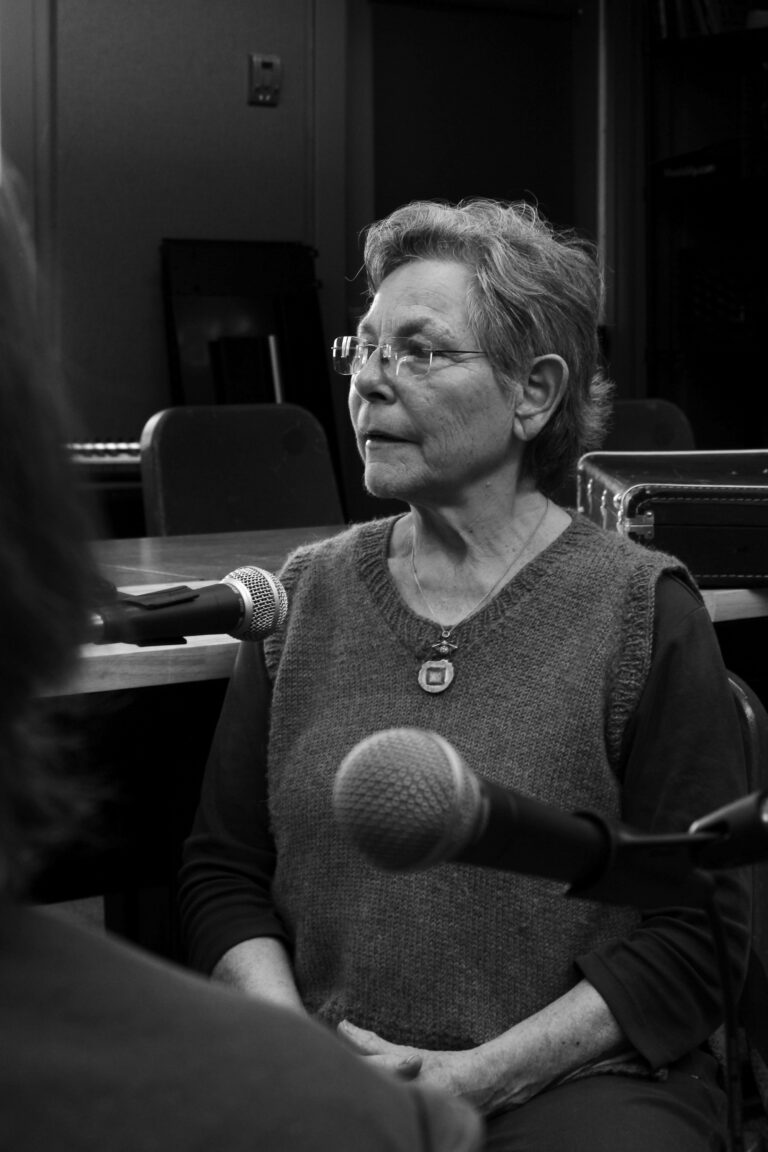
Blue Hill Peninsula Stories is a series of oral history interviews conducted by students in the George Stevens Academy “Audio Production 1” course, and archived and shared digitally on Maine Sound & Story as a community resource. Students interview local residents gathering stories about significant places and natural resources unique to the Blue Hill Peninsula community. Each year, a theme is identified to focus the stories and create cohesive narratives around important local issues such as sea level rise, food scarcity, changing weather patterns, and access to the working waterfront.
For 2026, the theme was “Back to the Land,” inspired by the movement in the ‘70s that brought a significant number of new residents to Blue Hill and the surrounding towns. Focusing on the unique experiences of homesteaders and “Back to the Landers” around the peninsula, these interviews reflect the subjects’ lives as they sought peace through self-sufficient living and working the land.
This project is a partnership between George Stevens Academy, the Blue Hill Public Library, and Maine Sound + Story, and was funded through a generous grant from the Maine Community Foundation.
[00:00:00] Shea Emerton: what is your name and how would you like, describe yourself?
[00:00:04] Deborah Wiggs: My name’s Deborah Wiggs. I describe myself now as an elder, which is kind of blowing me away because I never expected to be an elder for some reason.
I am 76. I came here when I was 28, so I’ve spent most of my life here. I’m a farmer who’s, in the process of retiring, hopefully. And I’m looking forward to the next phase of not working so hard and making my life more spacious.
[00:00:43] Shea Emerton: What was your move like coming to Maine?
[00:00:47] Deborah Wiggs: I was 28 years old and I was part of a group of women that formed in New Haven, Connecticut. During the beginning of the women’s liberation movement is when it was a thing that was happening that was very powerful at the time that women who, or- I’ll speak for myself. Growing up in a very traditional household and being on a very traditional path, lots of women like me in our twenties were deciding that we did not necessarily wanna take that path.
We wanted another path. And for some, at that time in history, it was becoming okay to do that. So what that meant for me was meeting with a group of women who were dreaming about starting a women’s community in the country. We didn’t exactly know where; it was just not gonna be in the city. It was gonna be in the country.
And we talked about it for a long time. We talked about it so long that at one point I took a trip to California to see if that’s where I wanted to settle. I was drawn back to my group of friends because we had history together and I saw that we could do what we were trying to do. We had to take our giant leap of faith, which we did.
We were a group of maybe up to 10 women at one point, but three of us packed up a car and headed north and started checking out different states. We checked out New York State, we checked out Vermont, we checked out Massachusetts. We took a summer jaunt. I had very limited funds, so I could not do this for long.
It was a summer thing. And we landed up in Western Massachusetts in the backyard of an alternative conference center for probably a month and a half and decided that was a pretty cool place. They were doing some interesting conferences. We were all anti-nuclear activists and we checked out what was happening in that area and discovered that there were too many nuclear power plants basically being built around there. The anti-nuclear thing was a big deal for us. We were all very involved in stopping Seabrook nuclear power plant from being built. So we drew 30 mile circles around all the nuclear power plants on basically on the east coast, in the northeast where we were searching and decided not to settle anywhere downwind of 30 miles from a nuclear power plant. We knew what we were attempting was gonna be a lot of work and we didn’t want to settle somewhere that felt so endangered. So that started bringing us up to Maine. We had heard about another women’s community that was already functioning in Orland or Penobscot? I can’t remember, somewhere on the Castine road. And we thought, well, they’re functioning up there. We might as well head up in that direction. We would have some support. How we landed up in Blue Hill, I attribute to just luck, pure luck. It was at the time that a lot of the back to the lander activity was going on.
I don’t consider myself a back to the lander. That’s not what I was doing, particularly. Even though I was moving to the country, I was gonna grow food. I was gonna build my house. I had never heard that language before. I was trying to make community with other women and it was really exciting that that was already starting to happen in this community.
It took us about a year to find land. We found a piece of land in East Blue Hill and it was 130 acres. We could only afford, amongst the entire group, 30 acres of that. So one of the women convinced her parents that it would be a great investment, which it was, and they bought the remaining section of it and we were on that 30 acres. And we started to build houses. The only structure on the land was a very old, what was it, 13 by 19 cabin that I landed up living in for 10 years. It had no power; it had no water, and the road was, you know, a dirt road off the dirt road that was the road (laughs) in East Blue Hill. So, it was pretty remote.
It had served as a hunting camp. Hunters would just squat there basically during hunting season. So this group of women moving onto this piece of land in East Blue Hill ruffled some feathers. It was different. People didn’t quite know what to make of us. We clearly were doing a women’s project.
Some of us were lesbians, some of us are straight. Some of us were figuring out what we were. We didn’t have a lot of the language that is now, that’s much more fluid. It would’ve been so much easier to identify who we were. But, that’s the way it was. Many of our neighbors embraced us and we attracted a bunch of attention.
So, women from New Haven in the summertime would always come visit us. We definitely created this bubble there that I felt always like reverberated out this energy of ‘what’s going on down there at the end of the road.’ So, I had to have a job. I needed to work. I wasn’t independently wealthy, so I took a job.
My first job was in the woods on a tipping operation, helping to cut brush for wreaths. And one of the other women that moved here with me, we both did that together. That was our first job in Maine. We were not on the land yet. We were renting a place in Sedgwick at that time. We were learning how to use a wood stove.
We were learning what Maine was all about. I was trying to understand the dialect, which I had a really hard time doing when I first landed here. I then took a job at the hospital, which lasted for five years. They hired me on a grant that somebody wrote there to hire, how did they put it- an untraditional person for a job that they, like they hired me in the maintenance department. They had never had a woman in the maintenance department (laughs). That was very different. Blue Hill Hospital was the largest employer in the town. At that time, it was an independent hospital.
It was a wonderful, full service hospital that treated everybody. It had maternity. And it was a family. So many local people worked there, and it was a great place for me to meet many people in Blue Hill and for people in Blue Hill to meet me and demystify – who was that person?
So I would wear white overalls to work every day, and I was the hospital painter. I painted pretty much the whole hospital. It was new at the time. It was the cement hospital. That was built since I lived here, and they just tore it all down again… (laughs). We won’t go there. That’s a different interview.
But it was a really great job. They offered to send me to boiler school; (that) was when I realized that was not my career path. I didn’t really wanna do that. That’s when I left and helped to start a local restaurant in town. Meanwhile, we were building our women’s community. There was now one yurt that got built by one of the women.
That was the first house that got built. There was my funky old cabin that now had power to it. And one of the other women – she hired people to build a house, a very rudimentary, simple house for her. So during that time, one of the local families, started harassing me. It was (a) really hard time.
It was a very hard time for me personally. It was scary time. My theory about why it happened is that the woman of the family was very unhappy. Her husband was an alcoholic and she had been trapped in whatever her scene was for many, many years, and for some reason, I felt like she sicked her son on me and made my life really, really difficult.
He threatened me with a gun. He threatened me with a car. He made my life very scary and I started talking to my neighbors and to people at work. I still worked at the hospital at this point, and I got so much support from local people. I was a good worker. People got to see, there was nothing strange about me.
I was a hard worker, just like most of the Maine people are. I think people got really angry that this young man was harassing me. I went to the sheriff’s department and they knew I was being harassed and basically their advice to me was that I was being bullied and that I should find some big friends and scare them away. My well got poisoned.
It was bad. It was very, very bad. And as it came to pass, I had help from some men who had returned from the Vietnam War and were very messed up from being in the war. They needed to shoot guns for therapy and they heard that I was being harassed. They lived in Surrey and they came over and they were the scary people that I was advised to make friends with (laughs).
So, eventually, the harassment stopped. During that time, I landed up taking him to court. His extended family turned out to support me. He was not supported. The family did get isolated and I felt like they did back off from doing what they were doing. We’re talking almost 50 years ago now.
I think it’s 46 years ago. There’s so much water that’s gone under the bridge now. I helped start the radio station. I started the restaurant, I was been involved in the food co-op, all of which the so-called back to the land people brought into Blue Hill. I mean, I feel like the whole, that whole movement, all of our different stories.
There was so much going on and so, you know, we all see each other now, like at the library and at the Y and at the all the places. We’re all like amazed that we’re this old now (laughs) and we pulled off what we did. So, I eventually met a man who came and moved onto the women’s land. That also caused a lot of ripples and waves, but that’s just what happened. And we then did this project of starting Clayfield Farm, which we’re now in the process of trying to transition to young farmers. The farm was started on totally forested land that we cleared and we flattened and we planted and we’ve nurtured along after all these years, and it’s a very productive small farm now.
Yeah, it needs some new farmers ’cause it’s too much work for us to pull off now. The only other person of the original women is one other woman, who is a very dear friend of mine, who is a Summer person now. She lives elsewhere in the Winter, but she tries to make it here every summer. And the spirit of our land is very much intact.
It feels like a community. It’s not the community that we envisioned when we started, when we were 28 years old. But, it’s still very much a community where we rely on each other. We interact with each other all the time. It’s different, but there it is. That answer your question?
(Everyone laughs)
[00:14:13] Shea Emerton: A couple of them, I think, actually.
So what was the community like when you came to Maine and how is it different now?
[00:14:19] Deborah Wiggs: Well, the community, meaning my community?
[00:14:23] Shea Emerton: Yeah.
[00:14:24] Deborah Wiggs: The community I came with or the bigger community?
[00:14:27] Shea Emerton: Both.
[00:14:27] Deborah Wiggs: Okay. So, three of us moved here.
People saw us as Jewish lesbians. What’s changed is there’s one person who’s married to a man and our community still has women that identify as lesbians and that’s still strong. Anybody who had a hard time with that would not be comfortable in the community, but it’s a very accepting of whoever we are, whoever we love, it’s okay. As long as we focus on the good of our community. It’s also way broader and when we first started, our discussions were, well are we gonna build our own houses? Were we gonna have one house? Were we gonna cook meat in the common kitchen? It came down to some very small stuff and it became obvious over the years that we all wanted our very own homes to do what we chose to do, but to be self-reliant and interdependent on each other. The larger community, there were no Jews and very few lesbians, very few queer people. In fact, queer was not even a thing. It was lesbians and gay men. That was the only possibility you could be. Queer was not a- you know, that just wasn’t part of the vocabulary then.
We were different. When we were harassed, we were harassed for both of those things. It was anti-Semitic and homophobic harassment. If I had not felt the support of my community and people, like for instance, there was the minister of the Baptist Church, whose name was Peter Gray at the time- Baptist Church, very conservative church.
He heard about us and he called and said he wanted to meet us. He didn’t get what lesbians were. He thought it was all about sex. He just didn’t understand what women trying to build a life without men, basically, was about. And he came over and he was so open and he was so incredibly compassionate and kind. This was during the time I was being harassed and he basically said, “If you ever need help, please call me.” And so that was the level of support I felt from unexpected people in the community. That’s why I stayed. Otherwise, I would’ve been outta here because it was very scary, also, what was going on- to have this young man aiming at me with his car and bringing guns where I could see them.
It was a scary, scary time.
[00:17:24] Shea Emerton: Do you know, or like, suspect that the man who was harassing you was because of where you came from and being in a community, what it’s like?
[00:17:36] Deborah Wiggs: I think it was ’cause of his mom. I think his mother had given up her life and she saw women having a really good time doing what we wanted to do, letting go of the rules that she might be living under.
I mean, I just suspect this, and this is why I suspect it. Later on, after her husband died, she changed enormously. There was a group of women that called themselves the ‘Red Hat Ladies.’ I don’t know if anyone’s ever heard of them.
[00:18:14] Shea Emerton: I have not heard (laughs).
[00:18:15] Deborah Wiggs: Right. I don’t see it anymore around, but it seemed like it was a phenomenon and maybe the ’90s?
[00:18:24] Galen Koch: Yeah.
[00:18:25] Deborah Wiggs: That women who had lived in the mold that they were supposed to, like all of a sudden realized they didn’t have to, and they wore red hats and they went out and they kind of partied together and she became one of them. And she tried to make friends with me, actually. In the late nineties , because she lived in East Blue Hill, we found ourselves in community events sometimes together.
And I always felt, and I feel to this day, I never got an apology from that family. They never apologized to me for what had happened. She has since died. The son is still alive. He does not live in East Blue Hill anymore. I don’t know if he would know me and I don’t know that I would recognize him at this point.
But, she changed at the end of her life, which I’m very happy for her that she got to realize some kind of inner liberation at the end of her life. But that’s… I feel like she was the impetus, that she was very angry and her son was very young and stupid.
[00:19:36] Shea Emerton: I don’t know if you’re okay with still like talking about it, but I don’t remember if you had mentioned, did the man that harassed you ever got (sic) like any consequences?
[00:19:47] Deborah Wiggs: No. I took him to court when he threatened me with a gun and he got slapped on the wrist basically, and right after that, my well got poisoned.
[00:20:09] Shea Emerton: Wow.
[00:20:10] Deborah Wiggs: Yeah, it was a hard time. It was a really, really difficult time. I got very strong from it. I got a shotgun. I lived all by myself, a lot of the year, in this remote cabin, and a friend of mine gave me his shotgun and showed me how to use it.
And he said, “Oh, anybody just hears this cocking, you know, the cock of a big shot, they’ll leave, and then when the Vietnam veterans actually came…
So, they came one day, the people who were harassing me there. It was not just this one guy. He got some of his friends in on it. They had dumped a car on our land, spray-painted it with antisemitic and homophobic slogans, and left it.
So, the vets came and they brought their very high power guns that shot lots of big bullets and they asked me if I knew how to use my shotgun. And we went out to the car, they taught me how to use the shotgun, and they shot- completely obliterated the car and left the shells of the semi-automatic guns they were using. (Laughs) It was so outta mind. It was, anyway, they left all the shells around and next time this young man came in, he saw that and he collected the shells and he took them to the sheriff and said he was being harassed. Now the sheriff knew me and he knew what was going on and he knew what advice he had given me.
So he came to my cabin with the shells and he asked me if I knew anything about it and I said, “Nope, don’t know a thing.” And he said, “Good.” And then they went to his home and told him basically never to come in my road again or else he would be in big legal trouble. So it took that, which is I think kind of extreme, but that’s what it took.
I also, around that time, not long after that, I did hook up with a man (laughs).
Anyway, the harassment finally stopped. And also, I think the father died, the woman kind of came to her senses. I mean, it was a really bad, unfortunate time. But, I feel like I came out of it stronger. I felt very grateful to the community at large for the support I felt.
I’ve just plugged into the community as much as I can for all these years and I feel very much part of the community now. And I mean, now times have changed so much. Everything is so different. I mean, it’s cool to be queer now. It’s just not a thing. You know, it’s just different.
It’s so very, very different. Thank God! (laughs) Women can marry women. Men can marry men. I mean, thank God all that has changed. You know, we are at a point in history now that all that is like are we gonna be able to hold onto what we’ve managed to pull off? But yeah, that’s (sighs) .
[00:23:52] Galen Koch: Shea, can I interject just for a second?
[00:23:54] Shea Emerton: Yeah.
[00:23:54] Galen Koch: I’m just wondering, Deborah, if you could kind of go back to the restaurant, like you shifted from the hospital to the restaurant. And you keep mentioning a man came on your land, but like, when did these things- a good man that you fell in love with?
[00:24:09] Deborah Wiggs: So another thing that we all, a lot of these new people that came and started was contra dancing. The tradition of contra dancing in Blue Hill, which is where I met my husband. And I became one of the organizers for the contra dance in Blue Hill. The first Saturday night of every month for many, many years, we organized a contra dance in Blue Hill that was very well attended.
Phil, who I eventually married, traveled from Rockport to the Blue Hill contra dance and that’s where we ran into each other. That was around the same time that pie in the sky was starting. And I hooked up with a woman, Anita Babson, who is a local gal. She grew up in Blue Hill. She’s got Deep Blue Hill roots.
So as a partnership, the two of us started this restaurant, which was great because we had one person who had deep roots in Blue Hill and one person that was very involved with the new community coming in. And it was a great recipe for a success and we wanted to start a restaurant that we could afford to eat in, and we wanted it to be a community place.
We wanted everybody to feel welcome. So between us, we were cooking healthy food. It was pizza and natural foods. That was the kind of food we served, but no one was allowed to call it health food that was like verboten. Nobody could call it health food. It was healthy food, it was high quality food. You could get tofu pizza and you could get sausage pizza, and that was really different for Blue Hill and it was hugely successful.
I am not cut out for restaurant work and after seven years I was like ready to be out of restaurant work. It was way too stressful for me. We looked to sell it and we successfully sold it to someone who had big ideas about starting a franchise, and he was kind of mentally unstable and he ran it into the ground within a year.
So, too bad (laughs). So, too bad.
[00:26:25] Shea Emerton: Okay.
[00:26:25] Deborah Wiggs: Yeah. Did that answer?
[00:26:27] Galen Koch: Yeah. Just some of those timeline things. It’s funny ’cause I feel like Pie in the Sky did have this sort of cultural imprint on Blue Hill, and I’m wondering if you could speak to why.
[00:26:38] Deborah Wiggs: Well, Pie in the Sky, and WERU, and the Food Co-op.
And also, the Left Band Café was also part of it. It was a time of such vibrancy in Blue Hill. Blue Hill was really like cooking with steam at that time. The radio station was in South Blue Hill at the hen house, not where it is now. They were all like really vibrant entities.
So, when I moved to Blue Hill, you couldn’t buy tofu; you had to order tofu and get it the next month. We had a pre-order co-op when I got here. That was a big part of my diet. I once went into Bob Banister’s store and I convinced him that if he carried tofu, people would come buy it.
And he did. He finally started carrying it so we could get it. But the co-op was just a huge boom to people who wanted to do the cooperative effort. A lot of the new people who came really were into cooperation, into collectivity , and we were very optimistic.
We were trying to build a new world. We were trying to be anti-corporate. We wanted to do food not for profit. There was a lot of philosophy behind the people who wanted to come and live more simply. I mean, I think we all did have that in common. We wanted to simplify our lives far from simple living ; no running water and no electricity is simple in one way, but pretty complicated in another way, (laughs) in other ways.
Yeah, we were just choosing kind of an alternative way than the way that we had grown up and the corporate way. It was really choosing a different way to live in the larger aspect, not just going back to the land, but in almost every way. There were no computers.
There were no cell phones. (Laughs) there were three television stations, if you had television. I mean, if you don’t have electric, no television, but everybody got their news from three television stations. It was such a different time. You know, we felt like we had stopped the Vietnam War.
We had changed the direction of nuclear power production. We felt extremely powerful, that we could change things and could create new visions of how life could be. We had all Es sued. The suburban successful; it was countercultural is what it was called at that time.
Counterculture (laughs).
[00:29:49] Shea Emerton: With the like electronics and technology, do you think it’s changed, like for the better?
[00:29:56] Deborah Wiggs: Huh. I mean, in some ways I love my cell phone. I do, I love Instagram. I do! It’s a little embarrassing to say it, but, yeah, there are things that are great. You know, the idea of being able to stay in touch and see pictures of my dear friend who is, when she’s not here in the summer, she’s in California, we’re very connected, even though we’re not in the same place. I do understand how a lot of young people- I see people totally into screens all the time, and I see people walking around wherever they are, just submerged in the screens. I do not think that’s a good idea. I think that being involved in nature and in the present moment and culture that involves, you know, music and art and doing all that stuff is really, really important. Having face-to-face communication with people, being able to be with friends and in a real tactile way and not on screens. So yes, good, a lot of bad, some good (laughs). I don’t like sitting in front of a computer. I do have a computer. For a long time, I didn’t think I would need a computer at all, and I didn’t even wanna learn how to use one.
And my husband was the one that said, “I think you’re gonna need to know how to do this, Deobrah. You better really get on board. And so I did learn how to use a computer and I think cell phones are a frigging miracle. (laughs) I’m new to a smartphone, so I’m still really enamored with what I can do. (laughs)
[00:31:45] Galen Koch: That’s great.
[00:31:45] Deborah Wiggs: Yeah.
[00:31:47] Galen Koch: I have a question about the farm business and kind of technology. Did that change over time? Starting the farm and then growing capacity and did that shift kind of how you, I don’t know, thought about your relationship to growing food or the relationship to selling food?
[00:32:08] Deborah Wiggs: So after the restaurant, I started a private cooking business. I studied macrobiotic cooking. I started cooking privately for people and I did that for a number of years. My business would be, you know, not so busy in the Winter and extremely busy in the summer. Summer people would, you know, start calling me in the Spring and say, “Make sure I’m on your list.”
And I realized one spring I did not wanna spend any more time in the kitchen. I was spending too much time in the kitchen. And that’s when we started seriously farming because I realized while I was doing the private cooking, I wanted to use the best possible produce.
And in order to be able to do that and keep it affordable, I had to grow it. I was completely devaluing my work of growing the food, (laughs) but that way I could grow some really high quality ingredients for the food I was making to deliver to people. So I realized that I liked the farming part. I liked the growing part.
I love to cook. I still love to cook and I do it all the time, but I really love growing things. So it went from supplying my business to then supplying neighbor(s). It just sort of started to radiate out and as we developed our farm, we also kept one outside job between us.
Phil is a piano tuner, so he was very independent and could keep doing that. I slowly gave up my cooking gigs and stayed growing things. So what our intention was, was to build the farm. And so as long as it didn’t cost us money to farm, ’cause it has the potential to do that, we focused on being able to live on the salary that was coming in from the outside and to grow the farm and it would support itself.
And then we got to the place that we got good enough at it that we could start selling. We were able to be commercially viable. Oh, and also the co-op. The co-op’s philosophy is to buy local food and the more local you are, the happier they are to receive it. And so basically we could sell whatever we grew, still grow, to the co-op and they’re happy to buy it. The last few years, we’ve been trying to get smaller because it was getting to be too much. We have just mostly focused on flowers and lettuce and growing. I mean, we grow everything else also, but basically for ourselves. And we usually have young people living on the farm as apprentices. We have two dwellings on the farm.
One is the yurt that Helena built that now is a farm building, so we have two dwellings that apprentices can live in. So we’ve been really lucky since we can house young people. We’ve always been able to have people around who were wanting to learn how to farm, and so we would always grow enough food to keep everybody involved with the farm in food all year round.
But the kids that are on it now that are in the process of transitioning, they have very big plans for expanding the farm this year, starting now. We’re in the midst of a very big change on the farm, which is exciting and scary. It’s another big adventure.
[00:35:56] Galen Koch: That’s great. It’s a legacy.
[00:35:58] Deborah Wiggs: Yeah. We really want it to stay in farming. That’s the bottom line. We want it to stay in farming.
We have just a few more minutes and then it’s the end of the school day. So Shea, do you have any other questions, like another question you wanted to ask?
[00:36:12] Shea Emerton: There’s one; it’s like somewhat on the topic of it being busy during the summer.
Do you think that with like the back to the land movement, that it inspired people to start coming to Maine, like during vacation, like the summer breaks and…
[00:36:26] Deborah Wiggs: um,
[00:36:27] Shea Emerton: or do you think it’s always…
[00:36:28] Deborah Wiggs: I didn’t notice that. I think the people that came wanted to make it here. I’ve seen many, many, many more people came than are here now.
Many people came to Maine in those early days and it was too remote. It was too uncomfortable. It was too dark, it was too hard. It was just too hard. And they left. Many women came to our community thinking they would like to join, and many of them left. There’s a few that live around here now that settled in. But, I think that’s true- almost all of the ‘back-to-the-land,’ I always put it in quotes, (laughs) back to the land people probably all have friends and acquaintances who thought Maine would be a great place to live and it wasn’t. It’s not right for a lot of people; it was so right for me. I knew right from the beginning. I started putting roots down early on, and I feel like I have put down really deep roots, but it’s not for everybody.
Maine is not for everybody. When it’s Spring, the rest of the New England, we’re gonna be deep in mud and then we get black flies, right? (laughs) It’s not for the weak of heart. Yeah.
[00:37:57] Galen Koch: Thank you so much. Is there anything else that has come up for you that, as you’ve been talking, that you didn’t get to speak on?
[00:38:05] Deborah Wiggs: I’m sure I’ll think of something that is really (laughs) glaring.
[00:38:08] Galen Koch: We’ll
do a follow up, also. I’m gonna stop the recording.
[00:38:11] Deborah Wiggs: Okay.
[00:38:11] Galen Koch: That’s good.
[00:38:12] Deborah Wiggs: That was a lot of info. (laughs)
[00:38:14] Galen Koch: That was great.
In this interview, Deborah Wiggs reflects on her journey from Connecticut to rural Maine in the 1970s, where she joined a group of women seeking to build an alternative community rooted in feminism, cooperation, and self-reliance. She describes the influence of the women’s liberation and anti-nuclear movements on her decision to leave behind a conventional life and settle in Blue Hill. Wiggs recounts the challenges of establishing a communal homestead on remote land in East Blue Hill, including learning to live off-grid, finding work, and navigating hostility toward lesbians and outsiders in a conservative rural community. She also shares painful memories of harassment and violence she endured, while emphasizing the support she received from many local residents who ultimately helped her remain in Maine and become part of the wider community.
Wiggs also discusses the cultural vibrancy of Blue Hill during the back-to-the-land era, including the creation of community institutions such as the food co-op, WERU radio, contra dancing, and the restaurant Pie in the Sky, which she co-founded. Reflecting on decades of farming at Clayfield Farm, she explains how her interests evolved from cooking to growing food and mentoring younger farmers. Throughout the interview, she considers the broader meaning of the back-to-the-land movement, describing it as part of a larger countercultural effort to reject corporate consumerism and create more cooperative, intentional ways of living. She contrasts the challenges and optimism of the 1970s with contemporary life, discussing changes in technology, queer acceptance, community values, and the rising difficulty of building an affordable rural life in Maine today.
