
record details.
| interviewer(s). | Anika VarnumGalen Koch |
| affiliation(s). | George Stevens Academy |
| project(s). | Blue Hill Peninsula Stories: Back to the Land |
| facilitator(s). | Galen KochPhelan Gallagher |
| transcriber(s). | Galen Koch |
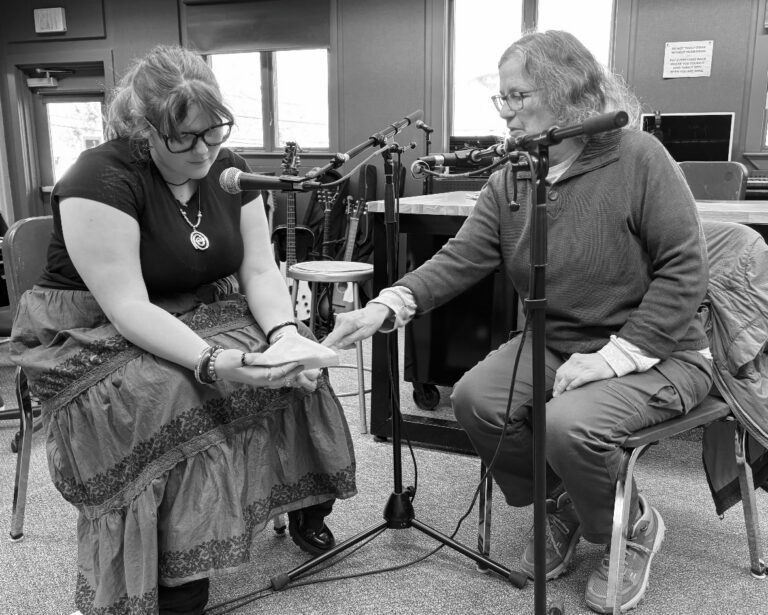
Blue Hill Peninsula Stories is a series of oral history interviews conducted by students in the George Stevens Academy “Audio Production 1” course, and archived and shared digitally on Maine Sound & Story as a community resource. Students interview local residents gathering stories about significant places and natural resources unique to the Blue Hill Peninsula community. Each year, a theme is identified to focus the stories and create cohesive narratives around important local issues such as sea level rise, food scarcity, changing weather patterns, and access to the working waterfront.
For 2026, the theme was “Back to the Land,” inspired by the movement in the ‘70s that brought a significant number of new residents to Blue Hill and the surrounding towns. Focusing on the unique experiences of homesteaders and “Back to the Landers” around the peninsula, these interviews reflect the subjects’ lives as they sought peace through self-sufficient living and working the land.
This project is a partnership between George Stevens Academy, the Blue Hill Public Library, and Maine Sound + Story, and was funded through a generous grant from the Maine Community Foundation.
[00:00:00] Galen Koch: Anika, I might chime in with follow up questions, but Anika’s in charge. I’m just recording and making sure things sound good. You can get close-ish to that mic if it works.
[00:00:09] Jo Barrett: Let’s let the mic get close-ish to me.
[00:00:11] Galen Koch: Yeah, I’ll move the mic towards you.
[00:00:14] Jo Barrett: So that’s slip form foundation. You make these forms and you put in stones from our own land, and then you fill in with liquid concrete and then put in more stones. So you save a lot of money on the concrete and you get to take a lot of the materials from your own land. Plus it looks really nice from the outside instead of just straight up concrete.
[00:00:35] Anika Varnum: Yeah, no, that looks really cool.
[00:00:37] Jo Barrett: There it is finished.
[00:00:40] Anika Varnum: And that saves you a lot of money?
[00:00:41] Jo Barrett: Yeah, because concrete’s expensive. It’s not just about money either. It’s about providing as much of our own stuff as possible. Anything that you could buy, whether it’s a material good or a service, we tried to do for ourselves a lot of those things so that we were more independent. So there it is. So my late husband, he had been saving up lumber for years for this house…
[00:01:12] Anika Varnum: And just keeps on growing.
[00:01:15] Jo Barrett: Yeah. So it was passive solar. That’s Turkey killing day. That’s me prepping some currants for both jelly and wine.
[00:01:30] Anika Varnum: So you use them in both jelly and wine?
[00:01:32] Jo Barrett: Yeah. You use the juice, you extract the juice from them. Stomp them in a five gallon bucket with very clean feet. Thank you very much. And strain the juice out and then take some of it and make jelly out of it. My husband made wine out of it, so we had beef cows and a milk cow. You already saw the milk cow.
[00:01:50] Anika Varnum: Yeah.
[00:01:52] Jo Barrett: The sheep were mostly for meat, but I did learn how to spin and I spun, but it was a little too sit in a chair for me.
[00:02:00] Anika Varnum: Never really was like, “This is what I wanna do!”
[00:02:04] Jo Barrett: Yeah. So this is Pansy the Goat and her baby and that’s Chrissy Allen, as in Mrs. Allen.
[00:02:12] Anika Varnum: Yep.
[00:02:13] Jo Barrett: And her brother John and her cousin Andy. And that’s Iris the goat with her twin babies.
[00:02:22] Anika Varnum: You killed the animals for like food, right? Did you name every single one even though you knew you were going to be kill them?
[00:02:28] Jo Barrett: So I named the pigs. I started out naming the pigs after my brothers and my brothers-in-law, well, actually, I started out with food names like Salt, Porky, Ham Bone.
And when I ran out of those, I started naming them for my brothers and brothers-in-law. They didn’t like that?
[00:02:46] Anika Varnum: No.
[00:02:46] Jo Barrett: I thought it was funny.
[00:02:47] Anika Varnum: Honestly, I think it’s funny too.
[00:02:49] Jo Barrett: Thank you very much.
[00:02:50] Anika Varnum: Back at the beginning.
[00:02:51] Jo Barrett: Now we’re back with the, so that much cheese, which is about five pounds, is from five gallons of milk.
[00:03:01] Anika Varnum: You can get just that much.
[00:03:02] Jo Barrett: Yeah.
[00:03:03] Anika Varnum: That’s a lot. That’s insane.
[00:03:05] Jo Barrett: Yeah.
[00:03:06] Anika Varnum: How big was this room? Did it like fit everything? You like all food things or did you have…
[00:03:12] Jo Barrett: oh, my husband had these five gallon carbuoys of wine just stacked, like this was about the- how big was that room? I don’t know. It was maybe like 10 feet deep and yeah, maybe, 12 feet wide and it had a big center section of shelving and then shelving down both walls and on the ends. I’m at the very end of one of those.
[00:03:38] Anika Varnum: Squeeze as much as you can in.
[00:03:40] Jo Barrett: When we were feeding a lot of people at the farm, I put up about maybe 400 some cans of relish and pasta, sauce and jam and pickles and all that stuff.
[00:03:51] Anika Varnum: Those are really cool photos. Thank you. Okay. Then I guess I’ll just get into my questions.
[00:04:00] Galen Koch: And Anika, before you do, even though it’s awkward because we’ve already been hanging out but if you could just introduce yourself for the audio, that would be great. And just say who you are and where you’re from, that kind of thing.
[00:04:11] Anika Varnum: How would you describe yourself?
[00:04:16] Jo Barrett: Independent, active, curious, hardworking.
[00:04:28] Anika Varnum: That’s good. those are all very good describing words. Yeah. Yeah. Okay. Are you from Maine or did you move here?
[00:04:39] Jo Barrett: Yeah, I was born in Castine Hospital. My family lived in Penobscot.
[00:04:45] Anika Varnum: So you lived here your whole life?
[00:04:46] Jo Barrett: No, when I was eight, my parents moved us to Ohio and we came back the summer I turned 16.
[00:04:55] Anika Varnum: Per your parents or per like your choice?
[00:04:58] Jo Barrett: Oh, my parents. We got to Ohio and said, “Oh, what have we done?” And kept trying to get back to Maine. And then my sister pitched a fit. She was five years older. “You dragged me out here from Maine and now I’m happy here. What are you doing? You’re going to be ruin my life.” And we all, we had boxes packed. And so they said, “Okay, we won’t go.” So then years later we did actually get back here.
[00:05:25] Anika Varnum: Yeah. Which. It probably makes you feel like better that you’re back where you were back at Maine.
[00:05:30] Jo Barrett: You know what? There’s nothing like leaving Maine to make you love Maine more.
[00:05:34] Anika Varnum: This is true. This is
[00:05:35] Jo Barrett: true.
It’s so true. Yeah. But I did have friends here from when I was little and we came up every summer. So even though I came here to GSA as a junior, I already knew a bunch of kids. So that really helped.
[00:05:53] Anika Varnum: Yeah. Sorry. Can you tell me a memory you have from your early days of being a Back to the Lander?
[00:06:02] Jo Barrett: Well, one of my memories is when my kids were young and I was really starting to get good at gardening and, keeping animals. We would at dinner in the evening,
[00:06:16] Galen Koch: Oh. What was that?
[00:06:18] Anika Varnum: That was the bell for our next period change. .
[00:06:20] Galen Koch: Sorry about that. We’ll have you can start over on that Jo. Sorry. Thanks.
[00:06:25] Jo Barrett: Oh, when my kids were young, and I was getting really good at gardening and at, keeping animals for meat, we would look at the table at our plates at dinner and identify what on the plate
[00:06:43] Anika Varnum: came from our own little farm.
Did that like help? Like you obviously had your kid, did that help you like your kids identify things as I got older to help around and stuff.
[00:06:57] Jo Barrett: I think so. The kids were pretty psyched about it. I remember Chrissy, Mrs. Allen, I would park her and a little friend that I was taking care of on a bale of hay with a popsicle or something, and let them just watch the goats or something like that. And my son would take goat milk in a thermos to school until the kids started teasing him about it. And then it was like, no deal. I’m buying milk.
[00:07:26] Anika Varnum: Do you think like your kids ever got bullied for coming from a family that like-
[00:07:31] Jo Barrett: He did. Yeah, I thought I would call that bullying. They would say his name in a, like a goat voice. Not good.
[00:07:39] Anika Varnum: That’s not nice at all.
[00:07:41] Jo Barrett: No, it was pretty hard on him.
[00:07:45] Anika Varnum: How would you describe the Back to Land movement, in your own words?
[00:07:51] Jo Barrett: The Back to the Land movement is something that I witnessed, not that I experienced, because I was here and I was always really into the land. As a kid I would take my dogs and head out to the woods, and my mother was a gardener, so I saw that going on and I just was outside a lot as a kid and on my own those eight years that we lived in Ohio. My parents worked weird shifts at work. And so I was on my own pretty much from age, I don’t know, nine or 10 until we moved back to Maine when I was 15, about to turn 16. So I just was living by my own devices, not, abandoned or neglected or anything, but just my older siblings were all busy and off doing things and my parents were either at work or sleeping because of their strange shifts. So I was on my own.
[00:08:50] Anika Varnum: Do you think like growing up outside really determined, like how you decide to live your adult years?
[00:08:59] Jo Barrett: Absolutely. Yeah. So I split my professional life between teaching and farming and teaching and homesteading. And when I was a teacher, I had kids outside a lot. I mean homesteading, I will say that I think people misidentify producing your own food as homesteading, but so is everything that you could pay to have done that you do to me is an act of homesteading. So if you mow your own lawn, if you bake your own bread, if you do your own taxes, no matter what it is. If there’s a service you could pay for that you provide for yourself or a good, like food or clothing, that you could pay for that you provide for yourself that’s an act of homesteading, in my definition of homesteading.
[00:09:58] Anika Varnum: Yeah. Do you think and I’ve lost it, hold up. Different question.
[00:10:05] Galen Koch: Wait, Anika, I have a follow up for that one. What are, what is on that list? What’s more of the things that you were doing in your own life that was homesteading?
[00:10:17] Jo Barrett: I’ve made a lot of my own clothes. I did like crude building. My husband knew a lot more about building that house, but I was able to put on shingles and I was able to like refurbish the copper water tank that we had that ran off our wood stove. I don’t know. I’m sure I’m not thinking of the them all.
[00:10:49] Galen Koch: But, were you- what about like with food and things like that, were you preserving things or processing vegetables and livestock and that kind of thing?
[00:11:02] Jo Barrett: Yeah, I was just telling Anika that we, I put up. During the height of our farming years, when we were feeding apprentices in the summers I was putting up, I was putting up about 400 jars of things from pasta sauce to pickles to jam to but I was also freezing things and drying, dehydrating things. And we had a 20 foot long greenhouse that was part of our living space in the winter where we grew tomatoes and greens and herbs. I have a seven foot by eight foot version of that in my little house on Union Street now, but I grow a lot of salad and herbs, and I do grow sun gold tomatoes in there now. You know Addie Allen? Yeah, well she cleans them off every time she arrives at my house, just like locusts.
[00:12:02] Anika Varnum: Is it, does it like, bring you joy that this is like the third generation, Addie is like the third generation from like where you are, like Addie, that she like enjoys doing stuff like that.
[00:12:12] Jo Barrett: Yeah. I gotta say it does. Good catch. Yeah.
[00:12:16] Anika Varnum: Yeah. Do you think using your hands is a big part of the Back to Land movement?
[00:12:22] Jo Barrett: I do, yeah. I never thought of it that way, but yeah.
[00:12:27] Anika Varnum: Do you think that people who like wouldn’t like- how did I word this? Do you think you would have to work with your hands to be able to do it or you could do it without working with your hands?
[00:12:39] Jo Barrett: According to my definition of homesteading, it’s doing for yourself anything that you could pay for, whether it’s a material thing or food or entertainment. Most of it, I think would involve using your hands, but I mean doing your own taxes, I guess you’d still have to be at the keyboard, but not technically manipulating anything with your hands, like spinning wool or something, spinning yarn.
[00:13:15] Anika Varnum: When you first started off homesteading and everything did you ever think, “This is going to be too difficult for me, I think I might stop doing this and just start buying it.”
[00:13:27] Jo Barrett: No, and a lot of people did do that and I watched a lot of the Back to the Landers who moved here be so pure. They really gave themselves a lot of hardship and they made their learning curve impossible. And I watched some of them burn out and stop. But what I did was I did a little bit until it was like muscle memory, this is just part of who I am. And then I would add something. And so my homesteading became more and more and more, where I shifted things from the, “I’m paying for this” to “I’m doing this for myself” side of the ledger. I added things as I was comfortable adding them.
[00:14:16] Anika Varnum: And that made it a lot more easier, you would say?
[00:14:19] Jo Barrett: Yeah. Now I’m old and I’m scaling back. I’m making my garden smaller. Instead of having pigs and chickens and cows and sheep. I have three hens, three hens and a little dog, and instead of, like 400 acres of land, I have 2.4 acres of land that I’m responsible for. So it’s all scaled down, but I still provide some of my own food and a lot of my own labor in various ways, but I’ve adapted it to a 71-year-old body.
[00:14:59] Anika Varnum: You just gotta adapt to like your living situation. Yeah. Do you think it’s possible to approach a similar lifestyle in today’s world?
[00:15:11] Jo Barrett: Definitely. I think it’s possible and I think it’s important.
[00:15:17] Anika Varnum: Do you think that like the current generation would be able to do this if they had enough passion?
[00:15:27] Jo Barrett: Absolutely.
There are still people here, first of all, who could help them figure it out. When I was at the farm and we had apprentices in the summer, some of them would never do anything it was just a summer adventure for them. And some of them really were as interested in the homesteading aspect as they were in the commercial farming aspect.
They just wanted to learn how to do things for themselves. As a matter of fact, in the very late 1990s and in the early 2000s I taught at Liberty School, which was a Democratic independent high school up where Bagaduce music is now. And I taught, I created a course called Back to the Land, and it was part history and part practical, so we learned the history of Back to the Land movements throughout the history of our country and how they coincided with economic downturns.
And then when jobs were plentiful and wages were high, people were like, “Yeah, okay, I’m going to be go to work and pay for things.” But we also, part of getting credit for the course was creating an inventory, the things that they did for themselves and the things that they paid to have done and to move one item from the “paid to have done” into the “I can do it myself” column. So kids learn to make their own bread. They learn to knit. They built various things. some of them adopted some chickens and kept them. So yeah, they put their toe in that water.
[00:17:22] Anika Varnum: Do you think money is a reason why people are straying from a lifestyle like this?
[00:17:28] Jo Barrett: Historically, in this country, low wages often prompted people to try homesteading. So it wasn’t a barrier. It was actually a driver being low on funds. Yeah. “Like, oh my gosh, I’m paying $12 a loaf for homemade bread.” Maybe I should learn how to make homemade bread. That kind of thing.
[00:17:52] Anika Varnum: So you think it pushed them more than
[00:17:53] Jo Barrett: Yeah, I do. I think economic downturn spurred an interest in that because there wasn’t that shiny big paycheck, that was luring them during the economic high times.
[00:18:06] Anika Varnum: Yeah. Would you rather do simple tasks with your hands than leverage technology to make things more easier and efficient.
[00:18:15] Jo Barrett: Yeah. Yeah. I think there’s something about working with our hands that helps us have a deep connection to the food or the skirt or the sweater or the New painted trim or whatever it is. I think when you have a connection to those things that you made happen yourself, I think there’s a really deep satisfaction and a feeling of self-worth that is really not something you can buy.
[00:18:55] Anika Varnum: Do you think people tend to lean towards more technology- more towards technology nowadays because it seems easier.
[00:19:05] Jo Barrett: I don’t know. I think people lean toward more technology today because that’s the way it is with humans. The more technology advances, the more they embrace the advancements. I think it’s just human nature. I don’t know about easier. For me it’s not easier. Wow. I get so frustrated.
[00:19:25] Anika Varnum: You’re much more comfortable working with your hands than…
[00:19:27] Jo Barrett: Yeah.
[00:19:28] Anika Varnum: Trying to deal with the technology.
[00:19:29] Jo Barrett: Yeah. I am, but, again, I’m old.
[00:19:33] Anika Varnum: I wouldn’t say that old.
[00:19:36] Galen Koch: Anika, I’m wondering if you have- or if we can go back just to some of the basic questions.
I think it’s just, saying like your name and who you are and then, maybe just like the, you’ve mentioned the farm a lot, but I don’t think you’ve said: What is the farm? How did it start? Some of those kind of more basic story questions.
[00:20:02] Jo Barrett: Okay. I’m going to be say my name.
[00:20:04] Galen Koch: Great.
[00:20:05] Jo Barrett: I’m Jo Barrett and I grew up in Maine most of my life with a short eight year time when I was away.
And I live right here in Blue Hill now. My trajectory through my adult life was that when I was young and single, I lived with a woman who had a place that had a garden spot. And for her birthday one year I got a truck full of cow manure and put it all over that garden and we planted it and she had never had a garden in her life. And that was her birthday present from me, and she thought it was fabulous.
Then I got married and we lived on a one acre piece of land and we had a garden, and then we moved to a little farm on Morgan Bay Road in Surrey, so that’s when I started getting livestock. I started with goats for milk. Chickens for meat. My husband hated laying hands because he had to clean the chicken coop every weekend of his childhood. Boo-hoo. And so he said, “No laying hands.” I said, “All right.” So we had meat, chickens, and turkeys, and the garden and goats for milk. And then I graduated to cows for milk. Then I left that homestead because of divorce, and I ended up staying at my family’s camp where I grew lettuce in two window boxes because I was in the Piney Woods on Toddy pond, and I had to keep moving the window boxes to follow the tiny patches of sun that occurred throughout the day through shining through the tall pine trees. So that was a low spot.
And then, I ended up marrying Dennis King, who with his brother Ron King, had King Hill Farm in North Penobscot, which is now being run by Amanda Provencher and Paul Schultz, Gus Schultz’s parents. So those- a lot of those pictures you saw were at King Hill Farm. So there you had a commercial farming operation and a homesteading operation. And my husband Dennis and I always said, “The farm is really just a homestead that’s gotten out of control.” But really I thought of it as two very separate things.
We made sure that our store room was full of jars of food and our freezer was full of food before we sold it. We had some farming friends who would sell all of their peas and they wouldn’t freeze any of them. They sold them all and then they would buy peas from the store in the winter. And my husband and I thought that was just backwards, that they should fill their freezer and sell the rest. So that was just an outlook, a way of seeing things.
[00:23:17] Anika Varnum: Yeah. What would you say is the difference between homesteading and yeah,
[00:23:26] Jo Barrett: Commercial farming?
[00:23:26] Anika Varnum: Yeah. Yeah.
[00:23:30] Jo Barrett: Well, it’s the difference between just providing for your household’s needs and raising things to sell. Your household’s needs maybe it’s refinishing an old table that you might have needed to renew. It has nothing to do with food but you’re refinishing it. You could have paid somebody to do it, but you’re doing it yourself, so that your hands and your brain are becoming part of that project. And every time you look at that table, you know you did it instead of, “Oh, I paid somebody to do that.” So homesteading is way, way, way more than food is what I’m trying to say.
[00:24:21] Anika Varnum: Yeah. Do you think homesteading really like shows, like brings pride out of you? Like it makes you very happy to know that you can look at something and be like, “Oh yeah, I did that, I grew that, I made that.”
[00:24:36] Jo Barrett: I think I’d use the word satisfaction and yes, very much.
[00:24:43] Anika Varnum: Yeah.
[00:24:43] Jo Barrett: Yep.
You do become a little bit of a food snob though. Like I make my own ketchup and I made so many bad batches of ketchup from different recipes and I finally found one and my sister, who doesn’t quite get it, said, “Why? Why do you make ketchup?” (because it’s a lot of work), “When Heinz has it down to a science?”
And I said, “Oh, sis. If you have to ask that question, you’d never understand the answer.”
[00:25:16] Galen Koch: Did she try your ketchup? Has she ever tried it?
[00:25:18] Jo Barrett: Yeah, she did. I don’t know. No, some people really like it. My grandkids didn’t want it, and now they kinda like it now that they’re teenagers.
[00:25:26] Galen Koch: That’s great.
[00:25:27] Jo Barrett: Yeah.
[00:25:32] Anika Varnum: What do you think young people should take away from this movement and how can we apply it.
[00:25:40] Jo Barrett: I think you should understand that everybody has a lot of choices when it comes to how to live and just what’s right for you right now or in your twenties may not be what’s right for you in your thirties and forties. And that you should allow yourself the latitude to practice any degree of self-sufficiency that works for you at the time and not feel guilty about either way.
Just figure out like what degree- what level of self-sufficiency is right from your- like when I was your age, I was collecting wild edibles and getting a big kick out of that, and I wasn’t so much producing things as I was foraging for things. And that was a lot of fun, too. But I think that young people should understand that they have choices and it isn’t all or nothing. It’s only a matter of degrees. Just gotta find the right degree for you at the time.
[00:26:50] Galen Koch: Anika, I have a question if I can, but in you mentioned that you were already homesteading or had that notion and then, don’t identify yourself as a Back to the Lander because you were already in Maine.
And other students are interviewing some of the folks who did end up moving here. And I’m just curious if there was like a moment in time for you when you started to notice that people were coming or if it was more gradual than that, or just what the experience was like with that movement itself and living on the peninsula.
[00:27:26] Jo Barrett: Yeah, so I graduated from here in 1972 and that there was a huge influx, beginning about 1970. I think my brother-in-law, Ron came here right about 1972. He was a textile design artist in New York City. And he came up here for a Haystack school and he fell in love with the area and he bought a derelict farm, 160 acres, only five of which were still cleared, vandalized farmhouse, and that’s King Hill Farm now.
And he and his brother, my late husband, cleared the fields back to the original 40 acres, the original stonewalls. And they did that over a 20 year period, before it was all back to the original farm. But I’m sorry, I’m getting away from your question.
[00:28:23] Galen Koch: No, that’s great. That’s fascinating, but there was an influx of people?
[00:28:26] Jo Barrett: Right, the influx of people. So, I had all these notions already of going out in the woods and finding my own food and my mother had her garden and that was a big influence. And so my father’s whole family is from Maine. But my mom grew up on a mountaintop in West Virginia and her family- she was in a family of 13. And so they were like homesteaders, the men in the family did work for, like a natural gas company that was nearby, but they provided so much of their own food, made their own butter, made their own ketchup, made their own everything. I’d be, working away, like I’m about your age and I’m trying to figure out how to do this, for myself and whatever it was, whether it was, how to preserve peaches by drying them or whatever, and she’d say, “Oh gosh, I wish you could talk to granny,” her mom. I didn’t pay any attention. My mother was like, “I’m outta here. I’m off of this farm. You’re never seeing me again,” kind of attitude when she left. But she said, first of all, my grandmother from West Virginia would’ve been very proud of my interest in these things. And like I remember some years after I was your age, I had a sick goat and I wanted to treat her myself if I could. She said, “Oh, Granny would’ve known what herb to give her.” That kind of thing.
So yeah, that’s another part of homesteading, too, is doing your own veterinary work as much as you can. Giving your pigs a shot. Wow. That’s a riot. So yeah, I was watching these people arrive, back to your question, Galen, and a lot of my friends were like, “Oh, strap hangers, trust funders.” And I was having a really different attitude, a really different reaction to these people. It was like, these people are interesting and not long out of high school I got a job, a part-time job at Farmstead Magazine, which was being published in the seventies as part of this whole movement. And I just- the people I met at the magazine, I just remember having this feeling like, these are my people, even though I was a Maine native, but I just- I was really interested in what they were doing and in their attitudes, like politically. So to me it was really exciting to see this influx of people with other ideas than all the ideas I’d grown up with.
[00:31:22] Anika Varnum: Yeah.
[00:31:26] Galen Koch: What Anika did you hear in there that we haven’t talked about?
[00:31:31] Anika Varnum: Okay. Was there any, like time, you said you did your own veterinary work for your animals. Was there ever a time where an animal was so sick where you were worried that if you tried to do something it would hurt the animal more than help?
[00:31:45] Jo Barrett: So many times. Oh my gosh. There was a vet in- it was Little River Veterinary Clinic, I think it’s down south of Belfast. He was really good with farmers and homesteaders, and I had him on the phone. Now this is no cell phone. This is a phone that’s attached to the wall in the farmhouse. This is when Mrs. Allen was probably about five years old.
And I had a goat who was having trouble having her babies, and I knew I had to go in and get those babies. So I had him on the phone in the house. I had to run out of the kitchen, down this long hallway, past the two empty rooms, past the whole big wood shed past the outhouse, past the grain room and into the stall where the goat was.
And so he’d say, “Do this.” I’d say, “Okay, hang on.” And I’d set the phone down on the counter and run out to the barn and slime my arm all up with mineral oil or whatever, soapy water, and go inside there and feel around, and then run back in then, “Here’s what I’m feeling.” He’s like, “Okay. Try to determine if that’s a nose or a hoof.” Run back. Yeah.
So I delivered the babies successfully, but you know you do lose some, you do lose some. There was a sheep I was treating and she was just sick. I was delivering her babies. And, I went to just hang on to her back and that whole clump of wool came out and she was way sicker than I even thought. And she was just trying to have those babies and she didn’t have the energy, so I had to go in and pull them out. But, we had to trick another mother into adopting them because she was on her way out.
[00:33:40] Anika Varnum: Yeah, I’ve heard of the trying to get the, like babies too, the mother to adopt the babies because sad passing.
[00:33:48] Jo Barrett: Yeah. I can tell you how, but you probably don’t need that.
[00:33:53] Anika Varnum: Come on.
[00:33:56] Jo Barrett: So you’ve- you get the mother who just had her babies recently, and if you can find the placenta, you rub it all over the adopted baby and you tie the mother’s head in the corner for a few hours until that baby has nursed successfully from her so that when you let her loose and she turns around to smell that baby, it smells like her because it has urinated after drinking her milk and it smells like her placenta, too. Most of the time that’s successful.
[00:34:26] Anika Varnum: Has there ever been a time where it hasn’t been successful?
[00:34:29] Jo Barrett: Yeah. Then you feed them with a bottle and it’s such a pain.
[00:34:34] Anika Varnum: Is there, if it wasn’t successful, has the other the mother ever been like violent towards…
[00:34:40] Jo Barrett: sometimes mothers reject their own babies for reasons we don’t understand. Yeah. When you’re dealing with whatever, it doesn’t matter, animals or plants, you’ve never seen it all. There’s always something that’s befuddling
[00:34:57] Anika Varnum: Such a silly word.
[00:34:59] Jo Barrett: Yeah.
[00:35:00] Galen Koch: I think that, I’m always curious about- it’s so different than the experience of not having that, like raising animals and the life death cycle that you are in, when you are… and just what that, if that has meaning for you or also what it was like just raising kids with that? Like it’s a different experience than a lot of people get if you don’t have, if you’re not living in a homesteading situation.
[00:35:35] Jo Barrett: So Chrissy adopted a chicken that couldn’t really hold itself up well, couldn’t walk well, and she had it in a box in her bedroom and the chicken died and she was very broken up. And I said to her, “These things happen. This chicken probably had something terribly wrong and it was never going to live.” My husband said, “Well, you know Chrissy, if you’re going to have livestock, you’re going to have dead stock.” I’m like, “Oh, okay.” A famous, truism in our family.
[00:36:26] Anika Varnum: You know what? That definitely didn’t scar her or anything.
[00:36:30] Jo Barrett: I know. You’ll have to ask her.
[00:36:33] Galen Koch: We have time for a few more questions. Do you have anything Anika that’s on your mind?
[00:36:37] Anika Varnum: I actually do.
[00:36:39] Galen Koch: Great.
[00:36:40] Anika Varnum: You were homesteading before you had your kids.
[00:36:42] Jo Barrett: Yeah.
[00:36:43] Anika Varnum: When you had your kids, did you ever worry that like you wouldn’t be able to keep up with everything you do for homestead and taking care of the kids and raising them?
[00:36:54] Jo Barrett: I was such a bundle of energy. I was out in that barn while everybody else was asleep. I had already fed everybody, freshened their water, and had them out in the sunshine. I saved the stall mucking and stuff for after, but then I would come back in and get everybody up and get them off to school. And it depended on what my teaching schedule was. Sometimes I’m out in the barn milking with a total set of coveralls and my hair all up over under a hat, so I don’t go to school te to teach smelling like cow poop. It was actually a bit much, I was putting in 13 hour days and I- there was this old codgeer who drove by in his dump truck a lot to go to his gravel pit. And one day I was out in the yard sitting in a lawn chair reading a magazine, and he said to me, “I’ve never seen you sit down.” I’m like, “Oh yeah. Once in a while.”
[00:38:00] Anika Varnum: Do you think like you were overworking yourself?
[00:38:04] Jo Barrett: Yeah, I definitely was.
[00:38:06] Anika Varnum: Do you think that’s some of the reason why you had to, when did you like start scaling down on things?
[00:38:11] Jo Barrett: Oh, just in the last 10 years.
[00:38:14] Anika Varnum: Do you think scaling down was probably the good idea? Do you think you should have done it sooner, or do you think you did it at the right time?
[00:38:23] Jo Barrett: Yeah, this is not about homesteading, but, my late husband had a very, massive stroke in 2009 and he lived for another eight years, so my life suddenly was very taken up with his needs. And so that’s why I moved us from King Hill Farm into the village so that we could be near the doctors, near the drugstore near people. I never wanted to be near people, and now I love being near people, but that it was better to be amongst people when I was dealing with his issues.
[00:39:02] Anika Varnum: Make it more comfortable for him.
[00:39:04] Jo Barrett: Yeah. It wasn’t just that I was going along my little rosy path of homesteading and having these revelations about needing to scale back. My husband needed me.
[00:39:15] Anika Varnum: And So you did what you thought was best?
[00:39:16] Jo Barrett: Yep.
[00:39:18] Galen Koch: That’s great. We have another interview shortly.
[00:39:22] Jo Barrett: Yep.
[00:39:22] Galen Koch: But I like to always just wrap up. We didn’t tell you this in our interview lesson, but just asking you if anything’s come up as you’ve been telling these stories, anything that you’ve thought about that we didn’t- you didn’t get to share a memory or a thought about homestead.
[00:39:43] Anika Varnum: I need dirt on Chrissy Allen. Sorry. Yeah.
[00:39:45] Jo Barrett: Do you want some Chrissy Allen dirt?
[00:39:46] Anika Varnum: Yeah.
[00:39:47] Jo Barrett: So when she was a teenager, she did not really appreciate what we were doing there. And she would rather have hamburger helper than, homemade whatever-whatever. And then she started working at pretty fancy restaurants for well-known chefs in the area. And guess what? They thought that the stuff that my husband and I produced was like the best, and they were so complimentary about our produce and our meat, and suddenly she saw us through that lens and started to appreciate it. “Yeah, girl! We’ve been right here doing this the whole time.”
[00:40:30] Anika Varnum: One way to turn it around.
[00:40:31] Jo Barrett: Yep. Yeah. Feel free to mention that to her.
[00:40:35] Anika Varnum: Yeah. Yeah, I will, don’t worry. Yeah, soon as she gets back.
[00:40:38] Galen Koch: That’s great. Thank you so much. I’m going to be stop this now and…
In this oral history interview, Jo Barrett reflects on her lifelong connection to homesteading, farming, and the Back-to-the-Land movement in rural Maine. Speaking with student interviewer Anika Varnum and documentarian Galen Koch, Barrett describes building a self-sufficient life through gardening, livestock care, food preservation, home construction, sewing, and other forms of hands-on labor. She recounts raising animals, preserving hundreds of jars of food annually, teaching homesteading skills, and balancing farming with motherhood and teaching. Barrett discusses the philosophy of homesteading as more than food production — a broader commitment to self-reliance and doing for oneself what might otherwise be purchased. The interview also explores Maine’s Back-to-the-Land movement of the 1970s, the influx of newcomers to the Blue Hill Peninsula, generational attitudes toward self-sufficiency, and the emotional realities of caring for livestock and family. Throughout, Barrett emphasizes adaptability, satisfaction in manual work, and the enduring value of practical knowledge and connection to the land.
