
record details.
| interview date(s). | March 5, 2026 |
| interviewer(s). | Corwin AllenGalen Koch |
| affiliation(s). | George Stevens Academy |
| project(s). | Blue Hill Peninsula Stories: Back to the Land |
| facilitator(s). | Galen KochPhelan Gallagher |
| transcriber(s). | Galen Koch |
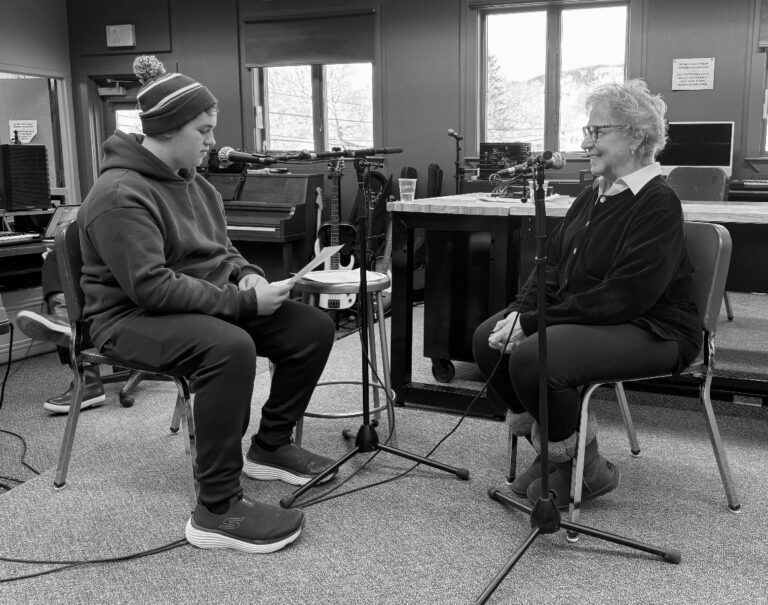
Blue Hill Peninsula Stories is a series of oral history interviews conducted by students in the George Stevens Academy “Audio Production 1” course, and archived and shared digitally on Maine Sound & Story as a community resource. Students interview local residents gathering stories about significant places and natural resources unique to the Blue Hill Peninsula community. Each year, a theme is identified to focus the stories and create cohesive narratives around important local issues such as sea level rise, food scarcity, changing weather patterns, and access to the working waterfront.
For 2026, the theme was “Back to the Land,” inspired by the movement in the ‘70s that brought a significant number of new residents to Blue Hill and the surrounding towns. Focusing on the unique experiences of homesteaders and “Back to the Landers” around the peninsula, these interviews reflect the subjects’ lives as they sought peace through self-sufficient living and working the land.
This project is a partnership between George Stevens Academy, the Blue Hill Public Library, and Maine Sound + Story, and was funded through a generous grant from the Maine Community Foundation.
[00:00:00] Galen Koch: Okay. I’ll have you Marjorie, tell us what you had for breakfast.
[00:00:05] Marjorie Yesley: What did I have? Oh, I made fresh challah. Which is bread that I’ve been making since I was 20, so I had that with avocado and let’s see, tea with milk, not with lemon or sugar. And that’s what I had for breakfast.
And you, what’d you have ?
[00:00:27] Corwin Allen: I don’t usually eat breakfast because I have to get out of the house pretty quick to get to school.
[00:00:32] Marjorie Yesley: Don’t you get hungry?
[00:00:35] Corwin Allen: Sometimes, but usually I only get really get hungry like around lunchtime, so then I can. Wow. Yeah.
[00:00:44] Galen Koch: All right. We’re ready to go.
[00:00:46] Corwin Allen: How would you describe yourself?
[00:00:50] Marjorie Yesley: Let’s see. I’m an old, I’m an elder. I’m an elder lady. I have been in this area for 50 years now, so I kind of consider myself a mainer. My children grew up here, went to GSA, graduated from GSA, so I guess that’s- that’s me.
[00:01:18] Corwin Allen: Yeah. I’d consider that to be a Mainer
[00:01:21] Marjorie Yesley: You would?
[00:01:21] Corwin Allen: Yeah. 50 years.
[00:01:23] Marjorie Yesley: 50 years.
[00:01:23] Corwin Allen: Longer than I’ve been here.
[00:01:25] Marjorie Yesley: Yes, but, sometimes even if you’ve been here for 50 years and your children grew up here, you’re still not considered- you’re considered maybe from away, but I don’t know.
[00:01:41] Corwin Allen: Could you tell me about your decision to move to Maine and like how confident you were about your decision?
[00:01:49] Marjorie Yesley: That’s an interesting question. I was part of a group that met in Cambridge. Most of us met in Cambridge. Some were at university. I had been traveling for a year through Europe and Asia, and Israel and I came back to Cambridge, got a job at MIT [Massachusetts Institute of Technology] where my former husband was a student. So I met him and then he had a roommate, and then his roommate had a friend, and his roommate’s friend had a girlfriend who had a friend and that’s how some of us got to know each other. So that was in 1972-1973 in Cambridge. I stayed in Cambridge and I kept my job for a few years after that and some of those original people rented a farm in St. George where I would go up and visit and spend some time on the farm there. And they worked various jobs and then we all decided to buy land, which a couple of the guys had come up to Sedgwick to pick blueberries one summer because they needed a job. And then we found somebody who was willing to sell us 70 acres on the top of a hill without a road, without electricity, with no water. So we bought 70 acres of land. We arrived in 1974 with an old bus that we literally pushed up the hill, got it up there and never left the hill after that because there was really no road and we could only do that in the summer.
So that’s pretty much – Some of us knew each other, some of us didn’t. There were a couple of guys that were – didn’t want to be drafted. They walked down a road where the farm was in St. George and they said, “Hey, can we stay here for a while?” They became part of the original 13 or 14. So there were originally, I think 13 or 14 of us, that bought the piece of land together.
[00:04:09] Corwin Allen: So you said that they – that like some people did it so that they could like not do the draft. Some people did it for just to I’m guessing like escape, just like traditional, like what was considered to be traditional life. What was like the main thing that inspired you to move to Circle Farm in Maine?
[00:04:34] Marjorie Yesley: I think a lot of that was we had bought land together, and starting families. Many of us, we had a whole, we had three or four children born within five or six months of each other, and it just seemed, at that time, a very – it was a wonderful neighborhood for the kids. So they would go out the door and they were surrounded by their friends. It was safe. No one was, worried about the things that you worry about in the city. So the reason that I came, I think, was because I felt it was a good place to raise a family, and the community was actually very welcoming. There were some people who were very welcoming. Who said, “This is great. We’re having young people come in. Young people who have had pretty good educations. Who are honest people, hardworking people. We were hardworking. Even though the jobs that we took were not what we were used to. I was used to working at the Dean’s office at Harvard, and there I was out with a hammer shingling a house or helping – we had a little construction company – helping in one way or another just to do things that I had never thought of, never thought of doing. So we all had similar reasons that we didn’t want to be in the city anymore, but also quite different.
[00:06:12] Corwin Allen: What was it like raising your children on Circle Farm with all the other families close by?
[00:06:18] Marjorie Yesley: That was the best part. That was the best part because they were – they considered themselves brothers and sisters, I think. It wasn’t easy because it wasn’t until I had two babies – there were no disposable diapers. We had no water. We had no electricity. We traveled to Ellsworth to use the laundromat.
But the kids would wander, when they were little old enough to do it, they would wander around on our piece of land. They knew where they could go, where they couldn’t go. And so they grew up basically with all these brothers and sisters. And I think they never felt unsafe at all. They would wander in covered with mud, literally, they would make a puddle. They would take the mud and just cover each other with mud and of course we had really – they would then, we’d have to go walk to the pond to get the mud off. So the stories are endless about what it was like to have them grow up at first without any electricity, no television, no radio.
I played the piano so they heard music a lot. My kids heard music a lot. And actually Johanna who went to GSA [George Stevens Academy] was in high school and was in the Bangor Symphony because GSA was so accommodating in so many different ways.
[00:07:52] Corwin Allen: What’s your favorite memory from the early days when you moved here?
[00:07:58] Marjorie Yesley: I think – one of the things we did was we had this old school bus, it was the only structure we had. After we built – we built an outhouse for all of us. So we had an outhouse and we had a bus. We took out all the seats in the bus so that we could all sit inside in a circle. So some people thought – and we called ourselves Circle Farm – so some people thought it’s because we were always sitting in a circle discussing things and I thought it was like endless. So we go talk about this and then we got the same thing over again in circle, circle, circle. So my memories of things like that, of us all being together, we all had – we had, as I said, we had an outdoor – somebody had given us an outdoor stove and we would bake using this outdoor stove and wood. And we each had to grind grains for 20 minutes a day so that we could make the bread, that we would have something to eat because there was no farm, there was no, no crops that we were growing at that point.
[00:09:14] Corwin Allen: What was something that you expected to be a big change in your life that ended up being something small and unnoticeable?
[00:09:25] Marjorie Yesley: I think what – what I liked most was how friendly people were to us. We were young. When you’re young, you think you know everything, and then you realize we didn’t know what we were doing.
We were taking a big chance. We were very accepted by just about everybody in this town, in Blue Hill especially, and there were so many encouraging people. The schools liked our children, they were good students. The library was always one of my favorite places. And the first time I went to the library was the first summer we were here and I didn’t have any children and I walked into town just a couple miles away and I walked in there and there was no public bathroom.
I said, “I need to find a bathroom.” And so the only public bathroom was at the library and they were great. So the library became the place that I spent most of my time in and I’m still very involved, 50 years later, I’m still very involved with the library. But the library and the schools were so welcoming with our children and I was very surprised about that because they were very different.
And this was a community that was a very tight community and very – not everybody was the same, of course not, but they were willing to have more and younger, different kinds of people come in and be part of the town. And I think also because, as I said, we had a small construction company at the beginning, it meant that we were buying supplies from the stores in town, so we were supporting the local economy and vice versa. So it was a good combination.
[00:11:36] Galen Koch: Corman, can I give a little, just somehow to move a question to move from, they’re in the bus, and then Marjorie has mentioned they had houses. But there was a change there, right? So maybe you could just answer that and then you could ask follow ups based on that. But what happened?
[00:11:59] Corwin Allen: Yeah.
[00:12:00] Marjorie Yesley: Would you like to know what happened?
[00:12:02] Corwin Allen: Yeah, I guess I can ask a question to get that going. So you started out on a bus and then you like had a construction company that you like worked with and ran. And so did that start with you, like building your own houses and then realizing that you liked doing that and so then you helped other people with it? Or did it start out with like you just doing that for a source of income and then the skills you got from that went to building your own houses?
[00:12:40] Marjorie Yesley: Good. Good question. I think just as you just said, the skills that we learned doing that we needed to do something. And we needed – it was summertime so there’s always a need for crews of people to help build things. So the skills that we had – some of the people, the original Circle Farmers had good skills. I had none. I could play the piano and that’s not something that you need to do when you’re building or anything like that.
So what we did is, over time – so the first years, or couple of years, there was a teepee, one couple lived in a teepee. There was a house that was – had timber frames but was all plastic. There was a little shed that became a house and that family had a couple of children. And we – what we did, what I did, is we had a – we rented a small cabin while we built the house up on the land. And it was very – we had to take down a tree in the woods. We had to- took about 10 of us to pull the tree out of the woods to shape it into a beam that runs 18 feet, which is the length of our house, the original house. So we learned how to do stuff because we had to and we didn’t have much money. And we had to work, make the money, buy the supplies, and build the houses. So some of the people were very skilled. I learned how to shingle. I laid the floor. I wasn’t so good at some of the other stuff, I don’t like to be high on ladders. But all those things we had to do when we were building our houses and they were simple houses, but very nice, but very, very nice.
So it was a learning experience for everybody. And I think, my children – I remember when we decided that we were going to bring electricity up onto the hill and it was a big expense at the time, and I just thought that if I had my own washing machine, my life would change. Which it did. Which it did. That was the most important thing for me because when you have two babies, all you want is the washing machine you don’t really care about the other. So our bathroom was so small that the toilet had to be kitty cornered and one leg was in the bathtub. It was so small. It was a closet. It was supposed to be a closet. So we had – we got used to just doing things in a different way that I never thought that I would have to do.
[00:15:35] Corwin Allen: In your experience has like technology of the more modern era, as you said, like clothes washing machines and like dishwashers, ovens, that kind of stuff. Do you think that’s been, like, has that added to your Back to the Land farming experience without taking away like the natural aspect of things?
[00:16:08] Marjorie Yesley: I have to say that I am not a very tech savvy person, nor have I wanted to be. I’m a kind of person that likes to sit and read books, play the piano when I could, read out loud to my children. So I think that in a room full of people, I might be one of the least savvy about it, not because I think it’s bad, but because I love to read. I love to listen. I’m a very fast typist but I prefer the human element and maybe that is something that I learned when all you have is a human element, when you don’t have the other things that are just very different, but it’s not learning to look somebody in the eye, talk to them. And I remember, when my children were young and we were getting the Bay School started and one of the things that we would do every morning is we would have the children walk in, look us in the eyes, shake our hand and say, “Good morning, Marjorie.” “Good morning. How are you?” Look them in the eyes, shake their hands. And I think that to me is something that has been lost. But it’s not- it’s probably not going to be coming back to that, especially with so much of the technology that’s very useful now, but is not the human aspect that most of the Back of the Landers felt that was the most important thing. It was person to person. A special place. Food that was important to how we lived our lives and how we wanted our children to be raised. And when you have grandchildren and you see how the next generation goes, as your grandmother has been a part of your life – the changes, so many of them are wonderful and so many of them are difficult to see, especially after all the things in the last five years that have happened. It’s very different, very, very different.
[00:18:35] Corwin Allen: What do you think, in your experience, is the hardest part of joining the Back to the Land movement now, like compared to when you joined, like if a young adult tried to do it today, what would make it more difficult than when you did it?
[00:19:00] Marjorie Yesley: I’m not sure that I think it would be more difficult. When we were doing the things that we were doing I was a young female and many of the things that I did in my young life, like traveling to Europe for a year by myself, on my own, were difficult things to accomplish. And it was an accomplishment. I think for, especially a lot of the young woman that I knew at that time, it was difficult to be heard. It was difficult to do the things that we wanted to. And I don’t see that as a problem so much now. I think that – I don’t think that the problems of going Back to the Land are problems. I think that it’s not many people want to just live off of the land anymore. Life has expanded. The ability to go in space. I remember looking up at the sky when the astronauts landed on the moon and thinking, “Oh my, oh my, oh my!” I remember the day. So things like that are so and we take for granted that young women and young men can do pretty much anything now which, when I was young, was not the case for the young women.
And there were groups of – there were groups of women that came on their own that wanted to just do those things on their own without having to be told. When we started, we had I thought about being a commune, about building one large place for all of us to live communally. And then I realized soon that I didn’t want somebody telling me what to do all the time, that if I wanted to do something, I was going to do it, and I was not going to have to bend my will toward doing something that I didn’t want to do. That was different than I believe than it is now.
And I think that many of us who came up here, especially the young women who came up here, wanted a way of expressing themselves in their own way. Not being told that they have to do this way or that way. Or, “No, you can’t do this because you’re a female.” And I had that experience when I was younger.
[00:21:46] Corwin Allen: What led you to identify with Back to the Land movement instead of just being just a farmer independent of any like movement?
[00:22:00] Marjorie Yesley: The group of us were not – we were not farmers. We did not plan to be farmers. We did not plan to live off of the land. We planned to have gardens, and this was different for everybody. There were – we knew that we would have to earn livings in some way. We knew that… That would not be possible to grow enough on our land to support families. We also knew that we would have to have other jobs, which was fine with me. One of my first jobs was at Kneisel Hall, having been raised playing the piano my whole life, it was a very easy and wonderful job for me to have, and I loved being there and I was very accepted there. And I had the qualifications to – I think I became the administrator at one point, so it was a very good thing. But we did not come here to just live off of the land. There were people that did, but our group was not quite – we would never call ourselves farmers. Maybe some people would’ve called us hippies. Maybe we were, or this or that or the other thing. But we were a very diverse group – very different, different religions, different education, different ways of approaching life in Maine. It’s 50 years later and we still consider ourselves family and our children also. So that was a very good part of it.
And I always like to tell the story about why I am not a farmer because I planted a garden and one of my friends came over and this was our first summer up on the land living there in our new house. And, I had beautiful rows and she came and she started picking up all, pulling up all the little roots that were coming up. And I said, what are you doing? She said, these are all weeds. I had pulled up all the sprouts of all the vegetables and left all the weeds because they were the only things that were growing well. So that was my farming, not a farmer.
[00:24:19] Corwin Allen: So you mentioned like how you, like none of you really farmed in the very beginning. Is that just because you just needed to do other work just to kinda give yourself a little kickstart or boost before you could really get into like more large scale farming.
[00:24:39] Marjorie Yesley: None of us ever became large scale farmers. We had little – the first summer we had a communal garden, but it didn’t feed us. It’s hard to live off of – there were 13 of us. We were young, we were hungry. It’s very hard to have a garden that would feed all of us. And that was never really- so we started spreading out. And that’s why we had started doing different things at different times in different areas and it was nice because Blue Hill and the surroundings really offered us so many different opportunities. There were groups and there are groups that move here to farm, but we weren’t – we realized that our land would never support us as it was then. And some of the people that eventually left have become farmers, but those of us who are up there have nice little gardens.
[00:25:45] Corwin Allen: So from what you’ve been saying, it sounds like it’s just a little neighborhood that you all started and share together. Is that true?
[00:25:54] Marjorie Yesley: That’s what it is now. Absolutely. Because as I said, we thought maybe we’d be a commune, but that didn’t work. Maybe we’d be doing this. That didn’t work. So what we are is we’re just an extended family. We can depend on each other. There’s been, of the original people, three or four of the homes are still – have never changed. We’re all still there, a couple of the homes have changed and different people have come in, and that has changed, also. So they were not part of the original- so they’re not family like these – like some of us who have been together for 50 years living in the same 70 acres, sharing so much. And we do share. We have a road now that we have to maintain, so we share that. But we all have our own deeds to our own pieces of land now. So it’s a different thing. But I would say that also our children think of the other kids that were growing up as just part of their family. And that they could call on them at any time, for any reason, even if one lives- my daughter lives in Oslo, Norway, my son lives in Providence, another lives in California. No, they’re all over. But they would call on each other.
[00:27:23] Galen Koch: Corwin, can I ask a follow up? But I’m wondering, you mentioned, were you all part of a group that got the Bay School going? Is that what you meant by when it started or- what was that?
[00:27:36] Marjorie Yesley: Okay. I had met Jan Emlen in Cambridge before I had children. I met them at a barn dance also, I think originally I met them at a barn dance in a different part of Maine. And talking with Jan, she had this idea about starting a school up here. And, so when it did become time, she started the school. I was one of the first, I think, presidents of the Board or whatever. It was really, it was a group, it was wonderful. It was absolutely wonderful. we were in an old house on Beechland Drive and there were times when at six o’clock in the morning, I would have to say, “Okay, kids, I have to go and start the fires at the school.” Because we had wood stoves during the winter. Then it expanded a little bit into a barn, also there. And again, we had wood stoves, so we had to do them. We had some chickens. There were all kinds of things. So there were a group of us who were getting, who had children there. Actually my son, who’s now 50, was the first group that started in kindergarten and went through eighth grade, then went to GSA. So it was started by Jan and it has grown tremendously. It was an idea that worked very, very well. But it started in a barn, it started in a barn. And I remember driving down to Boston and finding these old school desks for $2 each and loading up the pickup and driving them back up here and then finding the teachers that were interested in it and the other families, excuse me, that we’re also interested in this kind of education.
It was not a strict Waldorf school, which if you know anything about Anthroposophy it had different things that we did not do. But it was a wonderful community of students and they liked it very, very much. So I did not start it but I was part of the- Jan started it, but I was one of the original families, one of the original people involved, and then did different things for it.
[00:30:15] Galen Koch: Did it feel in some ways that sort of education, like related to that intellectual or philosophical project you working on anyway.
[00:30:26] Marjorie Yesley: That’s a very good point. I think that those of us who were moving here from other places had very specific ideas for education and what we wanted our children to experience, and we wanted a full education. And I think the emphasis on arts and literature, mythology, history, mathematics in the way it was taught was a continuation of an excellent way for these kids to be in an atmosphere that was so supportive and so artistic and colorful and full of song and they were outside a lot. It was a very- it was a real gift. It was a real gift. And now to see all the students that have gone through and to see how well it’s thriving and also how engaged the kids are with the other kids, with the consolidated schools, all the other, all the other schools in the area also, I think, the influence goes both ways.
What the schools were doing- what the public schools were doing and what the Bay School were doing melded very, very well and so it was a very good- and also with GSA, because they were very accepting of the kids and the consolidated school also, we did our best to have it help everybody. And I think it did. I think it really did.
[00:32:02] Galen Koch: How are your questions looking, Corwin? Do you have some on there that you haven’t had answered?
[00:32:10] Corwin Allen: I think everything’s been covered. Yeah.
[00:32:13] Galen Koch: I have some more, because we have a little more time.
[00:32:17] Marjorie Yesley: Okay.
[00:32:18] Galen Koch: But just thinking about, just like the legacy of people moving here at the time that you moved here and how you feel that has- what effect that has had on the community because it was more than just you and Circle Farm. There were a lot of people.
[00:32:41] Marjorie Yesley: Yes. There were.
[00:32:41] Galen Koch: Who were coming at that time. Do you feel like you can see how it’s had an effect on the community?
[00:32:48] Marjorie Yesley: It’s interesting to think about who has influenced whom? Okay. So I think that when we moved here, I know that I was struck by how friendly people were. The Astbury family, the the Candages, Peter Clapp the Clapps. I hired Leslie to be a photographer at Kneisel Hall when she was just a kid. I think that they were- I can’t say that we’ve made – it’s just been a melding. It’s been a very, I think a very nice – there was never any animosity, that I know of. I certainly didn’t experience it. I think, because we all were sustaining ourselves. We were not causing problems in the community. We were not a strain on resources. We were helping. We were adding rather than subtracting.
And I think that when you have people who are different that move into a community, the most important thing is to be accepting and to listen. We will listen to and we listened. Sometimes what we heard didn’t fit with what we wanted to hear, and sometimes I’m sure it was vice versa the same way.
But when I think of the families that really accepted us and wanted us to be here and were grateful for expanding. And because there had been summer communities, there have been great, some of the greatest musicians in the world have come to Blue Hill to be part of Kneisel Hall. Some of the greatest artists are in this area, also. So it’s an area that somehow why this little, tiny peninsula has been such a magnet for greatness is just astounding. So we were just a small part of that, and I can’t say that it was insignificant, all of the changes that we brought to this community. But on the other hand, what the community opened up to us and it was just solid. It was just a solid – it was a gift to be – we had no idea. And I don’t think any of the people that moved here during for the Back to the Landers or the hippies or what, they had no idea what a gem of an area this is. And it is. And everybody would be able to have such an opportunity to be part of a small community, but make a difference both ways. Yeah.
[00:35:45] Galen Koch: Yeah. That’s lovely. And are you still in that same house?
[00:35:49] Marjorie Yesley: Yes. But the house has grown from 18′ x 24′ then a porch became a bedroom and we had four kids coming in and out and, it was a whole different. Yes. But, yes. And the original beam that we pulled out from the tree that we pulled out of the forest is still there. Holding up the house. So you’re all welcome to come and see it and hope you do.
[00:36:19] Galen Koch: That’s amazing. Thank you so much, Marjorie. Yeah, we’re at the end of the school day. We have to wrap. Corwin, great job.
In this oral history interview, Marjorie Yesley speaks with student interviewer Corwin Allen and documentarian Galen Koch about her experiences as part of the Back-to-the-Land movement in rural Maine during the 1970s. Yesley recounts moving from Cambridge to a communal settlement known as Circle Farm in Sedgwick, where a group of young people purchased undeveloped land and learned to build homes, raise children, and create a cooperative rural life with few resources. She describes the challenges of living without electricity or running water, building homes by hand, and balancing idealism with practical realities. The interview explores themes of community, shared childcare, alternative education, gender roles, and personal independence within the Back-to-the-Land movement. Yesley also reflects on the founding of the Bay School, the welcoming nature of the local Blue Hill Peninsula community, and the lasting friendships and intergenerational bonds formed through the Circle Farm experience. Throughout the conversation, she emphasizes the importance of human connection, creativity, education, and adaptability in shaping both family life and rural community culture over the past fifty years.
