
record details.
| interview date(s). | March 19, 2026 |
| interviewer(s). | Max CookPhelan Gallagher |
| affiliation(s). | George Stevens Academy |
| project(s). | Blue Hill Peninsula Stories: Back to the Land |
| facilitator(s). | Galen KochPhelan Gallagher |
| transcriber(s). | Annie Bennett |
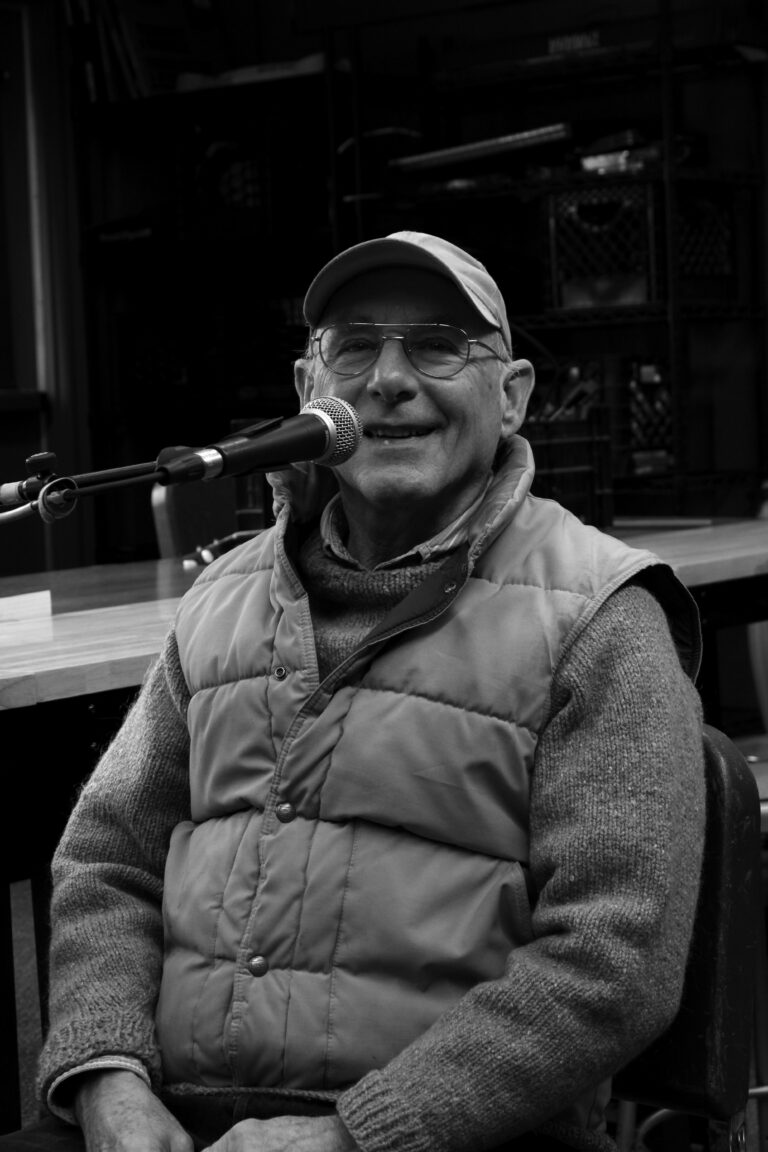
Blue Hill Peninsula Stories is a series of oral history interviews conducted by students in the George Stevens Academy “Audio Production 1” course, and archived and shared digitally on Maine Sound & Story as a community resource. Students interview local residents gathering stories about significant places and natural resources unique to the Blue Hill Peninsula community. Each year, a theme is identified to focus the stories and create cohesive narratives around important local issues such as sea level rise, food scarcity, changing weather patterns, and access to the working waterfront.
For 2026, the theme was “Back to the Land,” inspired by the movement in the ‘70s that brought a significant number of new residents to Blue Hill and the surrounding towns. Focusing on the unique experiences of homesteaders and “Back to the Landers” around the peninsula, these interviews reflect the subjects’ lives as they sought peace through self-sufficient living and working the land.
This project is a partnership between George Stevens Academy, the Blue Hill Public Library, and Maine Sound + Story, and was funded through a generous grant from the Maine Community Foundation.
[00:00:00] Phil Norris: I have a tree nursery, too, going in East Blue Hill.
[00:00:07] Phelan Gallagher: What do the apples think about this weather?
[00:00:11] Phil Norris: They’re really not doing anything right- we’re maple syruping right now. We’re tapping maple trees right now, and they, it was running really good for a while there, but now this cold weather, nothing’s really happening. But, it’ll start again as soon as it warms up.
[00:00:26] Phelan Gallagher: Gotcha.
Yep. Max, this is looking good. I’m gonna have you, you can start with our sound check questions.
[00:00:33] Max Cook: Okay. So what’d you have for your breakfast?
[00:00:36] Phil Norris: I had coffee and a sweet potato. That’s totally it.
[00:00:42] Phelan Gallagher: That’s awesome.
Unique. I’m feeling good about these levels. So honestly Max, we can get, we can jump right in.
And, Phil, just so you know, Max is like prepared and has a great list of questions. I’m gonna kind of hover just in case I have any insights and we’ll do like 45 minutes, if you’re cool with that- like a pretty sizable length so that
[00:01:01] Phil Norris: Oh, okay.
[00:01:01] Phelan Gallagher: So that he has a lot of material to work with.
[00:01:03] Phil Norris: Okay. So I wanted to structure this interview from starting from your early life and pursuing forward. Just so we can, so we can like, experience that.
Sure.
[00:01:13] Max Cook: So I was on your website looking into more about you and I noticed it said you were bitten by the plant bug at 16.
Could you describe that a little bit?
[00:01:21] Phil Norris: Yeah, I would definitely call myself a back to the lander. And it started actually when I was 15. I lived in New London, Connecticut, and my great uncle Lawrence Bunner, he was a plant guy. He was the lighthouse keeper at the Harbor Light in New London.
And his yard was full of ornamentals and just crazy stuff, you know, golden chain trees and, yuccas and, you know, you name it, he was growing it, but no food crops. So he bought an acre of land, in the neighboring town of Waterford, and he made a big garden there. He was always bringing corn to my mother’s house and all sorts of vegetables.
And I thought, “Wow, this is pretty cool.” Word got back to my uncle, my great uncle, and, he said, “Would you like to have, I can till up a planter ground for you?” And I said, “Sure.” Well, I turned 16 in February and I forgot all about the garden, but he didn’t forget about it. And one day he came and got me and he brought me out to his lot in Waterford.
And it was like a smaller garden; it was like 12 by 12, and he handed me a bunch of seeds and, but he was a very taciturn guy. He didn’t like to talk, so he just, he didn’t gimme any instruction. He just said, “Here are the seeds.” And so I got my driver’s license and I had my own Volkswagen and so I was driving all around and totally forgot about the garden for about, I don’t know, two or three months. And I was driving past and I went, I saw the little lane going down, a grassy lane, going down to his plot. And I said, “Oh, the garden!” So I drove down there and it was totally grown up in weeds. He hadn’t done a thing to it. He had left it totally up to me, and it was about waist high in weeds.
And I, I went in and I was walking around in there and you couldn’t see, you know, I had planted carrots and lettuce and it was just nothing. And then my foot hit something. It was a giant zucchini (laughs). I harvested it and I was going, “Wow, this is great.” I laid it on the passenger seat in my Volkswagen and drove home and, and I went to my great-uncle’s house and he came to the door and I showed him and he laughed.
And then somehow I got the idea that I had let it go too long, but I brought it home and my mother cooked it up. And, that was the beginning. That was the beginning of me. I was on a path to being a farmer, and that’s what I did.
[00:04:00] Max Cook: Yeah. Going through the careers. I’ve actually, I wrote down some careers down that you did, you had a degree in plant science.
[00:04:06] Phil Norris: Right.
[00:04:07] Max Cook: You were a house carpenter.
[00:04:08] Phil Norris: Yeah.
[00:04:09] Max Cook: You were a boat builder.
[00:04:10] Phil Norris: Yep.
[00:04:10] Max Cook: Piano tuner.
[00:04:11] Phil Norris: Yep.
[00:04:11] Max Cook: A tree warden.
[00:04:12] Phil Norris: Yep.
[00:04:14] Max Cook: Arborist,
[00:04:14] Phil Norris: yeah.
[00:04:14] Max Cook: A folk dj and also a farmer. With so many options, how were you able to choose which one to choose, or did you say, “let’s just go with all of them?”
[00:04:24] Phil Norris: I went full speed ahead on all of them.
That’s how I’ve always done it.
[00:04:28] Max Cook: was there like any plans or…?
[00:04:31] Phil Norris: I don’t, I’m not sure how to answer that. I think you’re asking me basically, is my life planned? I don’t know. Probably not (laughs).
[00:04:41] Phelan Gallagher: What about- I, I feel like maybe what Max is getting at, too is like-
as a young person, these guys are in high school and they’re getting, you know, everyone’s like, “What are you doing after high school? What’s your life?”
[00:04:51] Phil Norris: Oh yeah. Yeah.
[00:04:52] Phelan Gallagher: So like how did you conceive of that as a young person who had all these different interests?
[00:04:55] Phil Norris: Okay. Somewhere along the line, somebody told me,
“Do what you love and don’t worry about the money. The money will take care of itself.” And for me, that was true. I just did what I loved. And, you know, all those things, you know, dealing with trees, farming, is what I loved. And, you know, I never made a million dollars, but that wasn’t the point, right?
[00:05:17] Phelan Gallagher: Mm-hmm.
Can I ask one more follow up about this? ’cause I’m, I’m kind of, I am in- I relate to this, too, like Renaissance, you know, people that are, who just have different interests and I think our society is like, “Pick one.”
[00:05:30] Phil Norris: Yeah.
[00:05:30] Phelan Gallagher: In your mind, are they, is it like connected in some kind of organic way, or do you sort-
[00:05:34] Phil Norris: oh, yeah…
[00:05:35] Phelan Gallagher: yeah?
[00:05:35] Phil Norris: Oh yeah. Oh, it’s all connected. It’s all connected. You know, the trees and the pianos, you know, pianos are made of wood and, apple orcharding, tapping maple trees, I don’t know. It’s all, it’s all connected to me. Now I’m 75 and my wife and I are moving away from farming and we found a couple of young farmers in their twenties to take over and they are; they’re taking over at the farm and that, that’s great for us.
[00:06:08] Max Cook: So you’ve mentioned that, you know, you lived in Connecticut. Was there any, like- what made you move up here in Maine?
[00:06:16] Phil Norris: It felt like, for a young person growing up in Connecticut, it didn’t feel like the right place that, you know… the whole south coast of Connecticut, they’re paving over the whole countryside and I wanted to get back to nature a little bit more. So Maine was calling me. I spent some time in New Hampshire and… it was actually when I was 16, in 1967, I came up to Maine and did a course at Hurricane Island Outward Bound School. And that changed me completely that I kind of fell in love with Maine back then.
So it was always drawing me towards it.
[00:06:55] Max Cook: Mm-hmm. And on the back to land movement, Mr. Gallagher said something that you went into philosophy, so I wanna ask you about that. Would you say it was a philosophical or more of a religious movement?
[00:07:06] Phil Norris: Oh, definitely philosophical.
Yeah.
[00:07:08] Max Cook: And could you like expand on that a little bit?
[00:07:11] Phil Norris: Well, you’ve probably heard of Helen and Scott Nearing.
[00:07:14] Max Cook: Mm-hmm.
[00:07:15] Phil Norris: Right? They lived in Harborside and they were the mother and father, let’s say, of the back to the land movement, and I went to hear them one time. They were giving a talk at Franconia College in New Hampshire.
They were just inspiring. I grew up kind of a suburb kid and they just had a whole new philosophy that just really rang true for me. That’s how I got started philosophically. They wrote a great book called Living the Good Life, and that was instrumental in getting me on the path that I’ve been on.
[00:07:50] Max Cook: What were some of the key points? What were the key points about that book that really drove that home to you?
[00:07:55] Phil Norris: They had a lot of really unusual philosophies, like the way they planned their day. They would work only a half a day, you know, for what they called bread labor.
And then they would have every afternoon off to, you know, read books or whatever. And they fasted once a week. On Sundays, they didn’t eat. And he lived to be, I think he was 101 or something when he died, or, yeah, they were just inspiring.
[00:08:28] Max Cook: So did you know anybody else, like friends or families who really also kind of like enjoyed this movement and who would’ve joined you or did join you?
[00:08:36] Phil Norris: Well that was the seventies. That was late seventies. And there were a lot of people coming up to Maine and identifying as back to the landers. So, I really moved up here to Rockport in 1978 and I was single at that time.
But I very quickly connected with a lot of other back to the landers.
[00:09:02] Max Cook: There’s a lot of community living. Did you ever participate in any of that?
[00:09:07] Phil Norris: No, not really. No.
[00:09:11] Max Cook: Do you have any stories from friends or people you knew?
[00:09:14] Phil Norris: Yeah. Oh yeah. Do you know about Circle Farm in Blue Hill?
[00:09:17] Max Cook: Yes, I’ve heard of it.
[00:09:18] Phil Norris: That was the same generation of people. Let me see, what would I tell you about them, about Circle Farm? There were quite a few of them living out- they were back to the landers, trying to live off the land. They had good blueberry ground up there and so they were harvesting blueberries for money and you know, jobs like carpentry or around Blue Hill and… I don’t really have any other stories, I don’t think about it.
[00:09:43] Max Cook: What was the most challenging part of becoming a back to lander?
[00:09:48] Phil Norris: I think it was making ends meet, getting the money. Most of the, back to the landers, they farmed but then they had other jobs, and that’s what I did. And for years and years, my wife Deborah and I, we’d work two days a week, Tuesdays and Wednesdays, and then we’d be off making money. Of course we were working on the farm other days, but those two days, Tuesday and Wednesday, that was totally devoted to farming and that’s how we did it.
[00:10:22] Phelan Gallagher: Can you, and I might have missed this, Max, but I don’t think we got into this too much, Because you guys were on Clayfield farm over in East Blue Hill, and how did that come to be? Did you move up and find that parcel? Were you and Deborah together? Just give us a little backstory on that.
[00:10:35] Phil Norris: Yeah.
Okay. I graduated from the University of New Hampshire with a degree in plant science and came up to Maine and I actually bought some land over in Penobscot. It was 50 acres, paid $ 17,500 for it. That was back then, land was a lot cheaper. But that never worked out really to be my farm. It just wasn’t right.
And then I met Debra at a contra dance at the Blue Hill Town Hall in 1985, and she had a piece of land out in East Blue Hill. And that’s when I thought, “Okay, this is gonna be the farm.” And it’s clay; it’s clay soil. It’s not the best growing medium, but it turned out to be okay if you drain it, you have to put in French drains everywhere and put in a lot of organic matter and a lot of lime and then it was a good growing medium.
And so, Deborah and I got married in 87 and we were gardeners at that point, just had a big garden, but we kept expanding and I think by ’92, we made our first commercial sale to the Blue Hill Food co-op. And then we started to call ourselves a farm and it just made sense to call it Clayfield Farm.
[00:12:01] Phelan Gallagher: Well outta curiosity, what happened with the piece in Penobscot that you were… it just didn’t feel- was that like a quality of land thing or a community thing or?
[00:12:10] Phil Norris: Well, the real story is that I bought this land and the most important part was near the road because that was gonna be our market. We were gonna put up the vegetable stand and just before the sale went through, the guy had it surveyed and it turned out that he had described it all wrong. The boundaries were not where he described, and it just wasn’t nearly as good a piece of property. It wasn’t right for what we had in mind, so we ended up buying it anyway and then selling it later on, but it just didn’t work out to be the farm.
[00:12:53] Max Cook: Mm-hmm.
[00:12:55] Phelan Gallagher: Could I follow up too about like music and the back to the land scene and, you know, I guess the contra scene is sort of part of your background. How were those two scenes related and obviously you met Debra there. It seems like it was a part of that community.
Can you talk about that?
[00:13:13] Phil Norris: Yeah. Well, that story is that I’ve always been musical and I played in a contra dance band. And when I was living in Rockport, before I met Deborah, I was running the [unintelligible] Corner’s dance once a month. And Deborah over here in Blue Hill was running the Blue Hill Town Hall contra dance once a month.
And we’d never met. But when we finally did in ’85, we had a lot of good connections. And so that’s what got us together, that whole music scene. And I think that’s probably what led me into piano tuning, my musical ability. I’ve always had a good ear.
[00:14:03] Phelan Gallagher: That’s interesting.
And you picked up the piano tuning, was that like a side hustle? Like this is another form of-
[00:14:07] Phil Norris: Exactly, exactly. And that was a good job. That was a well paid job.
[00:14:13] Phelan Gallagher: Yeah. And flexible.
[00:14:15] Phil Norris: Yeah. I got to work for myself.
[00:14:17] Phelan Gallagher: Work schedule too, is cool. I’m curious more about that.
I mean, the overlap of the contra and the back to the land, you know? Cause I mean, I don’t think they’re necessarily exclusively the same thing, but…
[00:14:31] Phil Norris: oh, they are close, I think. I think that crowd, the contra dance crowd, they tend to be a lot of back to the landers and often you’ll be dancing with somebody on the dance floor and they smell like they haven’t had a bath for, you know, a week.
And it’s true they haven’t because they’re living, you know, in a little cabin somewhere and they don’t have running water, which is what Deborah and I did back then, we lived in a little cabin in East Blue Hill. You know, it was a 13 by 19 cabin, and I lived there for four years with Deborah and we didn’t have any running water, but we survived (laughs).
When Deborah moved there, there was no electricity. She had a propane light, a
fixture that she would light for her lights.
[00:15:19] Phelan Gallagher: You guys built that or she built that little cabin?
[00:15:21] Phil Norris: That was there. That’s a very old cabin from like 1830 or 1840. It was a guy named Simeon Grindle. He was one of the early settlers of East Blue Hill.
[00:15:32] Max Cook: So you look at all these challenges you guys have faced through, all these difficulties and struggles, what kind of pushed you guys? What allowed you guys to persevere through that and say: “We’re committed to this, we’re gonna stay doing this, we’re gonna keep doing this.”
[00:15:44] Phil Norris: Oh, well, let’s see. I guess I’d have to include my relationship with Deborah. That was the most challenging part of my whole life. Dealing with, you know, the Colorado potato beetle. That was a cinch compared to dealing with Deborah (laughs). You talk to married people and that’s what they say, you know, it’s a challenge. It’s always work. It’s hard work to have a partner and coexist. But, Deborah and I have been doing it now over 40 years. We’ve been duking it out (laughs) and we’re a very productive couple, we know that. We’re both, you know, kind of live wires in our own community.
[00:16:32] Max Cook: And do you guys have kids?
[00:16:35] Phil Norris: No kids.
[00:16:36] Max Cook: Okay.
[00:16:37] Phil Norris: Just a lot of animals: horses, chickens, dogs.
[00:16:43] Phelan Gallagher: I got a question about- so I grew up near where Phil’s farm is, Max. I don’t know if you know that. But, so East Blue Hill’s, kind of backstory… I’m curious like Jay Carter Road . There is a scene down there and I remember being a kid and going down there and I think my parents were like, “Don’t go all the way to the end,” or I don’t know what was going on.
I know Joel and, you know, his father who had the big parcel there at the head of the Bay. What were your interactions like with the kind of locals that you guys were encountering? And I know some of those were probably positive and some less positive. Are there any that stick out in your mind of people that were either kind of like helpful or…
[00:17:26] Phil Norris: Yeah. So, Deborah and I met at the contra dance in 1985 and I moved in with her that summer and immediately found this really incredible, tight-knit community there who just accepted me with open arms. And I had never seen anything like that before. You know, when I was living in Rockport, there was nothing- no community like that.
And within one month I knew that I was home.
[00:17:59] Phelan Gallagher: Wow. What do you attribute that to?
[00:18:02] Phil Norris: There’s just a really special community in East Blue Hill. The East Blue Hill Library and the post office was always a center of social activity.
[00:18:16] Phelan Gallagher: And did you guys feel welcomed? Like obviously there was this crew collectively that came or arrived together. And there was the comradery and the, you know, sense of shared purpose or identity there. But, I’m curious too about the locals. Not trying to dig up dirt, but I know that that wasn’t always- sometimes I feel like we’re hearing the version of these stories that gets a little romanticized, like maybe in that new documentary, too.
[00:18:40] Phil Norris: Uhhuh.
[00:18:40] Phelan Gallagher: It’s like, “Oh, the locals were just like fascinated and thought that we were cool and wanted to help.” And I’m like, somewhat… but also there must have been other interactions. I’m just curious.
[00:18:49] Phil Norris: when I first moved to East Blue Hill, going out with Deborah, her neighbor, Kathy Long and Tommy Long,
they had a sheep farm. So Debra was gonna bring me over to introduce me to the neighbors and they were cleaning out the manure. They had the sheep in the barn all winter. And so it was quite high with sheep manure.
They were mucking it out with forks. And so they handed me a fork and we all worked together and I was a pretty good worker at that point. And so, I think I passed the test. They said, “Okay, this guy’s all right.”
[00:19:33] Phelan Gallagher: Hey, Max, I’m gonna pop back in in a second. If you haven’t gotten into it yet, get Phil to talk a little bit about WERU.
[00:19:41] Max Cook: Sure. Tell me a little bit about WERU.
[00:19:46] Phil Norris: I moved here in 1985 from Rockport, Maine, and in 1988, there were a bunch of people that wanted to start a radio station in Blue Hill and they were doing concerts to raise money to start this station.
And on May 1st, 1988, the station went on the air out of the hen house, a great big old, hen house in South Blue Hill. And I was one of the very first DJs. It was all volunteer at that point. Noel Paul Stookey really provided the, he owned the building and he provided the seed money for us to buy equipment.
And at that time, they were really short of volunteers and so I was doing three radio shows a week, Tuesdays, Thursdays, and Saturdays. And then as more people came on board, I was able to give up the Saturday slot. But I kept the Tuesday and Thursday slot for many years.
So, every year at Thanksgiving I would do my radio show and I’d play this 18 minute long song called “Alice’s Restaurant.”
Have you ever heard of “Alice’s Restaurant” by Arlo Guthrie? It’s very humorous. And Deborah would join me on the air. So I think I’ve been a dj on ERU for about 40 years and learned a lot about the folk music scene. They have an amazing CD library over there at WERU, just any kind of music you could imagine is there in CD form and then down in the basement, it’s all LPs, vinyl records, lots and lots of them. And it’s still going on strong and now a whole bunch of young people are taking over.
[00:21:47] Max Cook: And you still occupy the Monday right?
[00:21:50] Phil Norris: Now I’m at on Mondays from nine to 10.
[00:21:52] Max Cook: Do you miss any part about doing it multiple times or are you just happy that…
[00:21:57] Phil Norris: No, I’ve got my routine now and a lot of people know that I’m always on the air at nine o’clock on Monday morning, so they tune in, you know, people that aren’t working at that time.
So I have a regular following of people that listen every week.
[00:22:18] Max Cook: So I’m aware that you’re a tree warden, right? Could you talk about the Dutch Elm disease?
[00:22:24] Phil Norris: Yeah.
[00:22:25] Max Cook: I read a little bit about that and I was kind of fascinated and just wanna ask you to describe that.
[00:22:28] Phil Norris: Yeah. That’s a fungus disease that’s spread by a little beetle.
It’s called the American Elm bark beetle and they feed in the tops of the elm trees and they make these feeding wounds. And this fungus, they carry the fungus on their legs and it enters the tree through the feeding wounds and it travels down the tree and it clogs up the vascular system of the tree and they die. It came over from Holland on a shipment of veneer logs in, I can’t remember exactly what date, but it started spreading and it was spreading to the East coast and I think it came into the Midwest and then it started spreading east and west.
But it didn’t get to Maine until the 1970s. And so in the mid 1970s, right around ’75, it was coming up the coast. All these elm trees in towns like Thomaston and Portland, they all had lots and lots of elm trees lining the streets, ’cause it’s kind of the best street tree. They’re just statuesque, they’re really great street trees.
And so all these towns, they were losing all their elm trees. They were all dying. And so, Blue Hill as a town, a bunch of citizens went before town meeting and they said, “Look, we’ve got this tree disease coming up the coast and if we don’t do something, we’re gonna lose all our elm trees. And there were over 500 elm trees in the downtown area. Blue Hill had always gotten really big into elm trees. They established a tree warden and they provided a budget and they started fighting Dutch Elm Disease and it’s a battle that went on for about 25 years with the former tree warden, and then she passed the baton to me. And I’ve worked at it for about 25 years and we’ve managed to save. There’s still, right out on the other side of this wall, there’s that great big old elm tree. That’s one of the ones that got saved. So there’s about 85 big giant elms left.
Unfortunately, though, you know, the three big giant elms out on the front lawn? One of them fought a battle with Dutch Elm Disease and lost. So that’s gonna have to come down probably this summer.
[00:25:14] Max Cook: I’m assuming you were tasked with helping organize and help maintain and control that disease?
[00:25:19] Phil Norris: Yeah. That’s been the majority of-
[00:25:22] Max Cook: What was kinda like the thinking process of that?
[00:25:25] Phil Norris: Well, they had tried a lot of different things to control Dutch Elm Disease. They tried a fungicide- injecting them into the trees back in the nineties and it didn’t really work. So, then the strategy was just sanitation. As soon as you find Dutch Elm Disease on a tree, you remove the tree from town, get it out of town as quickly as possible. Once we spotted it, try to get the tree out within 48 hours. And that worked, and we did that for years and years until 2023 when we had a major outbreak of Dutch Elm Disease and we lost some of our real giants. But we were warned because Castine, the year before, had lost 29 elm trees that year, and so we knew that we were next. And sure enough, in ’23, we lost a bunch of them. And so now we’ve been injecting the trees with a fungicide. It’s a better fungicide that seems to really work this time. So, we think we can save the rest of the elm trees.
[00:26:38] Phelan Gallagher: Do you know the 2023, is there anything that’s attributed to that? Like climate wise or something? Or is it just…
[00:26:47] Phil Norris: The disease always kind of came in waves. It’s like the brown tail moth. A wave came through a couple years ago and it got really bad and now there’s none.
And so, it is pretty unpredictable- Dutch Elm disease. It might be because the climate is warmer. I don’t know.
[00:27:11] Max Cook: Going back on the back to land movement, are there aspects of it that are still alive today, even in the younger generations of it?
[00:27:19] Phil Norris: Yeah, definitely. We always try to have young apprentices on our farm. For years and years, we’ve done that. And they’re usually in their early twenties; they’re usually 20 or 21 or 22. That seems to be the age. There’s a lot of young people that don’t wanna go to work for a corporate job. They want something more meaningful in their lives.
They wanna try working on a farm for a year and so that’s what we’ve done. We usually say one year apprenticeship and we provide a place for them to live and all the food they can eat off the farm and they work two days a week and the rest of the time they’re free to get a job.
And then we’re still doing that. We’re still actually looking for a couple of different apprentices for this coming season. So if you know of anybody… and we found out that that age group, they’re just so open to learning. You know, they’re like sponges and we have a lot to teach them.
And usually after two years, they know pretty much what we have to teach them. And so we push them out of the nest and (laughs).
[00:28:40] Phelan Gallagher: What was the process like? You said you’re handing off the farm to a younger couple. What was that process like?
[00:28:45] Phil Norris: That’s been very difficult.
We found a young couple now that are taking over the farm and I think it’s gonna work, but there were two trials before that that didn’t work, for various reasons.
So we’ve been advertising, you know, on our website, on the Clayfield Farm website. We’ve been advertising for somebody to take over and we finally found this couple from Alaska who
don’t seem to be intimidated at all by a Maine winter (laughs).
[00:29:17] Max Cook: Makes sense.
[00:29:18] Phil Norris: And they’re good. They’re taking over.
[00:29:22] Phelan Gallagher: I think something, Max, that we could keep pulling at is like the younger generation,
[00:29:27] Max Cook: like your generation, you would say was a really big back to land movement push.
[00:29:32] Phil Norris: Right.
[00:29:32] Max Cook: Do you think we’re gonna see that again sometime soon? Or is that just gonna be more waves of that. Not like a full-
[00:29:41] Phil Norris: I think it’s gonna be like the brown tail moth. I think the young people (laughs) are gonna come in waves. I’m sure there’ll be another back to the land movement. Yeah.
[00:29:54] Phelan Gallagher: What’s your words of wisdom for the younger generation having lived this life out, and I’m always curious about that. What do you think the future of the back to the land movement is, so to speak, or your words for the younger generation that wants to live this way.
I mean, the world has changed too, so some of the things have to at least be done a little differently maybe.
[00:30:13] Phil Norris: Yeah. But, the world still has to eat. People still have to eat. There will always be a need for farmers. And the more local, the better. We sell our stuff to the Blue Hill Food co-op and so it’s all local.
It’s grown locally and it’s consumed locally. There’ll always be a need for that.
I have a lot to teach young people. Over the years, I’ve known what kids really wanna learn and there is a philosophical part of it that that they’re really interested in.
And, they tend to be environmentalists, you know, environmentally conscious and they are usually good at thinking outside the box. The kids that go to work for a big corporation, they have a certain mindset and these kids usually have a completely different mindset.
In some ways it’s the same philosophy that we had back there in the seventies, you know, the back to the land movement. I guess I could say it never really stopped, even though there was a big wave that came in the seventies.
[00:31:44] Max Cook: What was kinda like the one lesson you’d teach to the younger generation now?
[00:31:48] Phil Norris: See, I’ve been thinking about that. I don’t think there is just one lesson there. There’s a whole bunch of them. One of the most important things is a quote by Goethe. Have you ever heard of Goethe?
He was a German philosopher, and he wrote a little piece about commitment. He said that once you finally commit to something, no matter what it is, then heaven and earth moves with you and all manner of unforeseen things will just pop up and help you along. And I believe that totally. Once you really commit, something happens in the universe and things go your way.
[00:32:37] Max Cook: And you saw that with other aspects of your life?
[00:32:39] Phil Norris: Yeah. Yeah.
[00:32:40] Max Cook: Planning with your relationship and, you know, challenges you faced. Yeah.
[00:32:44] Phelan Gallagher: This is good. I mean, yeah. There’s not like a specific time that we’re going for. So maybe we’re getting there, but I’m trying to think of other things . You guys talked about WERU little bit when I was outta the room, so that’s good.
[00:32:55] Phil Norris: I wanna just say something about plastic.
I’m old enough to remember when plastic wasn’t such a big thing and there were agricultural methods that didn’t involve plastic and didn’t involve pesticides. Now the whole agricultural economy has moved towards plastics and pesticides and these young farmers that are taking over Clayfield farm, they wanna get away from plastic. They’re worried about microplastics in the environment.
And so we’re not using black plastic anymore. Deborah and I used black plastic ’cause it was so good for heating the soil and it was pretty hard to grow tomatoes without black plastic. But now the climate’s getting warmer and they’re gonna use other methods. They’re making wooden seedling flats instead of plastic and they’re not gonna use black plastic anymore on the fields.
[00:34:03] Max Cook: Yeah, I’ve seen that a little bit. Farms will, especially like smaller farms, will go into that direction where they’ll be a little bit more environmentally aware and friendly.
[00:34:16] Phil Norris: Yeah.
[00:34:17] Max Cook: One thing I saw was low tilling or no tilling.
[00:34:20] Phil Norris: Yeah.
[00:34:20] Max Cook: How does that affect the environment and like why are some farms moving in that direction?
[00:34:25] Phil Norris: There’s an energy savings by not tilling; you’re spending money on gasoline or diesel fuel to till the soil.
Also when you till up the soil, the top layer gets oxidized. You know, the sun, the air hit it, and the organic matter oxidizes and disappears. And so the no-till method involves putting mulch on. Every year you put another layer of mulch and the subsoil never gets turned over.
Earthworms and insects aerate the soil. You know, they make pathways through and so it’s a workable way to do it. It’s not easy with clay, I have to say. But, it’s doable if you have enough mulch.
[00:35:16] Phelan Gallagher: Is that a method that you guys are doing?
[00:35:18] Phil Norris: We never did it. Deborah and I have never done- we like to fluff up the clay.
[00:35:23] Phelan Gallagher: Yeah.
[00:35:23] Phil Norris: Because clay compacts. Yeah. The rain compacts it, and then if you till it up, you fluff it up and it’s a wonderful growing medium. Oh, I know there’s some Back to the landers
coming in. Kathy and Jack Burnett. Hi.
[00:35:39] Phelan Gallagher: It’s like an old reunion.
[00:35:40] Phil Norris: Yeah.
[00:35:40] Phelan Gallagher: Well this has been really good and I think we are nearing the end. I was gonna ask you,
just your experience growing apples and
[00:35:47] Phil Norris: Oh!
[00:35:47] Phelan Gallagher: What have you learned and what does it mean to you, being a part of the lineage of apple growers?
[00:35:53] Phil Norris: A big part of my interest is apples. We have about 50 apple trees on the farm. When I first got interested in apples, I talked to other apple farmers and they said,
“There’s no way you can do it organically. You have to use chemicals to spray on apples. You know, this is the one industry that you just can’t do it.” And I said, “bullshit.” So we haven’t; we don’t use and we just have to accept a different standard of quality that probably only 50% of the fruit we harvest is considered marketable.
And the rest , it’s good for animal feed or, you know, making pies , or stuff like that. And, then there’s always the strange year where the usual insect pests aren’t around, which was last Fall. And so we had so many perfect apples this year. We had a walk-in cooler full of beautiful, perfect apples.
And so that was done with no spray whatsoever.
[00:37:10] Phelan Gallagher: That’s awesome.
[00:37:11] Phil Norris: So it can be done.
Yeah. Well, we usually end too with just-
[00:37:17] Max Cook: just like anything else you wanted to say before we’re done,
[00:37:20] Phelan Gallagher: anything we missed?
[00:37:22] Phil Norris: Nope.
[00:37:23] Max Cook: Okay.
[00:37:23] Phelan Gallagher: Thanks Phil.
In this oral history interview, Phil Norris reflects on a lifetime shaped by farming, music, forestry, and community. He traces his passion for plants back to a teenage garden planted with his great-uncle in Connecticut, an experience that set him on the path to becoming a farmer. Inspired by the philosophy of Helen and Scott Nearing and their book Living the Good Life, Norris moved to Maine in the late 1970s as part of the back-to-the-land movement. He describes how his many occupations—including farmer, arborist, piano tuner, tree warden, and folk radio host—grew naturally from his interests and were united by a desire to do meaningful work rather than pursue financial success.
Norris recounts building Clayfield Farm with his wife Deborah, transforming challenging clay soil into productive gardens, orchards, and maple stands while balancing farming with other work. He discusses the supportive community he found in East Blue Hill, his long involvement with WERU Community Radio, and his work preserving Blue Hill’s historic elm trees. Reflecting on the future, Norris emphasizes the continued importance of local agriculture, environmental stewardship, and mentoring young farmers, expressing his belief that the back-to-the-land movement’s core values remain alive in new generations.
