
record details.
| interview date(s). | March 18, 2026 |
| interviewer(s). | George BernardPhelan Gallagher |
| affiliation(s). | George Stevens Academy |
| project(s). | Blue Hill Peninsula Stories: Back to the Land |
| facilitator(s). | Phelan GallagherGalen Koch |
| transcriber(s). | Annie Bennet |
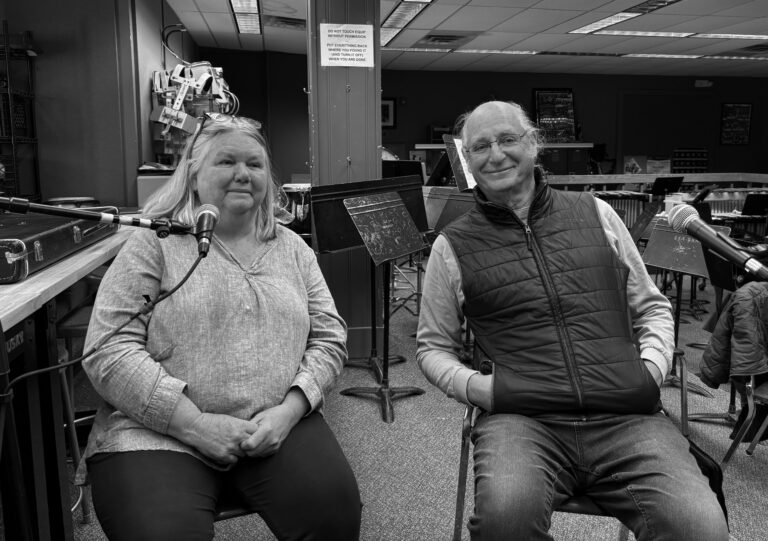
Blue Hill Peninsula Stories is a series of oral history interviews conducted by students in the George Stevens Academy “Audio Production 1” course, and archived and shared digitally on Maine Sound & Story as a community resource. Students interview local residents gathering stories about significant places and natural resources unique to the Blue Hill Peninsula community. Each year, a theme is identified to focus the stories and create cohesive narratives around important local issues such as sea level rise, food scarcity, changing weather patterns, and access to the working waterfront.
For 2026, the theme was “Back to the Land,” inspired by the movement in the ‘70s that brought a significant number of new residents to Blue Hill and the surrounding towns. Focusing on the unique experiences of homesteaders and “Back to the Landers” around the peninsula, these interviews reflect the subjects’ lives as they sought peace through self-sufficient living and working the land.
This project is a partnership between George Stevens Academy, the Blue Hill Public Library, and Maine Sound + Story, and was funded through a generous grant from the Maine Community Foundation.
[00:00:00] George Bernard: So why choose Maine of all places where it’s all forced? Why not choose like a flat open state, like Iowa or something like that?
[00:00:12] Nancy Berkowitz: Well, I came to Maine because I had been living in Massachusetts, so it was kind of close. That’s why I chose Maine. And I chose Maine because I had gotten a job.
[00:00:27] Warren Berkowitz: Yeah. I was living in Massachusetts at the time and I was reading about people in Maine doing small farming and homesteading. And so I came up to Maine to visit and also the prices of land was (sic) attractive at that time in the mid seventies. Things were very inexpensive here compared to Massachusetts because I had visited out in Western Mass and things were a lot more expensive. But that was rural there, too.
[00:00:58] George Bernard: Alright. What was your role in the Good Life Center when you first got here?
[00:01:03] Nancy Berkowitz: Well, I ended up working with Helen and Scott Nearing in 1977. I started working for them and I ended up working for them and living with them and (that) continued after the Good Life Center was set up; it was before that.
The Nearings had a homestead that thousands of people would come to visit. I lived out in a little cabin out in Harborside and I started working for Scott primarily in the garden. So I learned a lot of organic gardening from him. And then after I helped take care of him when he was dying at a hundred years old.
And then I ended up working with Helen until she died. And then the Good Life Center started in 1995 after she died. And I’m still working there.
[00:02:03] George Bernard: What’s your role now? Like are you the leader or…?
[00:02:07] Nancy Berkowitz: No, no- I’m hardly, um- (laughs), I’m the historian.
[00:02:11] George Bernard: Ah, yep.
[00:02:13] Nancy Berkowitz: I hold the history.
[00:02:15] Warren Berkowitz: So about 20 years ago, the Good Life Center was set up in 1995, as Nancy said, and they were stewards and it was set up as a nonprofit.
So we had a board of directors. And about 20 years ago, approximately, things got funky with the board of directors and some people were kind of misusing the place. I was asked to come back at that point and help the board of directors and at that point that coincided with me retiring from my job.
And so I took over the manager job of the Good Life Center to kind of restore it and help the board get back on track.
[00:02:55] Phelan Gallagher: Alright, let’s ask a follow up about that, George, just because you got into the Good Life Center, which is great and like what could you ask them about? Like, what was your best experience working at the Good Life Center?
[00:03:09] Nancy Berkowitz: The amazing thing about the Good Life Center is people come from all over the world because they have heard about Helen or- and Scott, or never heard about Helen and Scott and just happened to be in Brooksville. And so you meet people from all over the world, which is really interesting and we’re open from June till October.
And so you never know what’s gonna happen that day. And it’s- so, it’s kind of fun working out there; just sometimes nobody comes and that’s a really nice day. There’s a big garden and so you’re just out there in nature. It’s right by the ocean. It’s really pretty. But then when people come, it’s really exciting to meet people.
Some people say, “Oh, I’ve, you know, I heard about this and I’ve been wanting to come for years,” and so they’re really excited and happy. And people come from Korea, South Korea; there’s quite a following in South Korea. So every time a family from South Korea comes, it’s really special to talk to them. And I don’t know, that’s the most exciting part is the people.
[00:04:21] Warren Berkowitz: And I would agree. I mean, the people come and it’s often like-minded people who come for either a homesteading experience or they’re about to be homesteaders or they are homesteaders and they wanna learn a little bit more about the Nearings. But there was also a whole political side to Scott Nearing that draws people to come and talk about Scott’s political philosophies and things like that.
And Helen had a whole spiritual background that also attracts people. So, there’s the physical part of the Good Life Center, but there’s also the spiritual, political part that really inspires people to live better lives, being part of the Good Life Center.
[00:05:04] George Bernard: What’s the deal with, what’s the South Korean connection?
[00:05:09] Nancy Berkowitz: I, this happened-
[00:05:10] Warren Berkowitz: Very interesting.
[00:05:12] Nancy Berkowitz: Either right around the time Helen passed on or somehow her books got translated into Korean and there was a spiritual teacher there who really liked their teaching. And so the people who come have all read books and this is really a pilgrimage for them.
And they come just to touch the stone walls and to look around and see the house; it’s really moving for them and we’ve had people who have flown to Boston, driven up to Harborside, and then back to Boston. That was what they were doing. They were coming to see the Good Life Center.
It’s really humbling and wonderful.
[00:06:08] George Bernard: My name’s Nancy Berkowitz and I describe myself as an elder. I’ve been here 50 years and I ‘m kind of crazy and kind of fun (laughs).
And I came to Maine by myse- without Warren. Warren and I did not, we met here.
[00:06:31] Warren Berkowitz: We met here in Blue Hill.
[00:06:32] Nancy Berkowitz: In Blue Hill. But yeah, that’s who I am.
[00:06:35] Warren Berkowitz: My name’s Warren Berkowitz. I think describing myself, I’m a teacher. I had a long career in education, social studies education, special education administration for many, many years. And I think my role at the Good Life Center and- even in retirement.
I coached here at George Stevens. My role as a teacher is just who I am. I’m very good at it and it just seems like that happens a lot to me. I end up being a teach- in a teaching role.
[00:07:08] Phelan Gallagher: just each of you guys go back for us, what were you doing at that time? And then what was, how did you end up here?
[00:07:16] Nancy Berkowitz: Okay. After I graduated from college, I worked and lived on a friend’s goat farm in Canada and that was a crazy, fun, collaborative experience. And then I moved to Massachusetts after that and I did have a kind of a crazy boyfriend worked on a big estate in the north shore of Massachusetts and ended up leaving there and going to Florida to be with a friend from the goat farm who was living in Florida. And when I was in Florida, I worked at a fasting institute because I was a vegetarian and there was a book there called Living the Good Life and I read that book and said, “Oh, I wanna meet these people.”
And it was Helen and Scott Nearing because they used to go to the Fasting Institute.there was a World vegetarian conference in Orono and I came up to Orono to work at the conference and then met Helen and Scott. And then the next summer, I ended up- oh, then I- I lived in Massachusetts, back in Massachusetts again in a communal household, and my thought was I really wanted to work with people and live in community with people.
So that was a time when lots of people were looking to live together, either in communes, cooperative housing, having jobs where you work and live together. And so that was my goal and that’s, that’s how I got to Maine, from reading Helen and Scott’s book. And then I’m like, “Oh yeah, I’m come to Harborside.”
[00:09:12] Warren Berkowitz: I was living in Massachusetts at the time, central Massachusetts, a fairly rural area. I was teaching at a school for kids that were… had a lot of, trouble with the law and emotional difficulties. We had a really tight knit group of teachers and workers there, and we were all kind of into looking into alternative ways to live.
We had gone through the Vietnam War protests. We had gone through the Civil Rights Movement; so we were all looking for alternatives, and I started reading a magazine called “Mother Earth News,” which still exists today, and every issue, there was an article by Helen Nearing about her life in Maine, and I was reading it and I got very intrigued.
I started reading their books and I said, “Well, I really need to come up to Maine and meet these people,” which I did. I traveled up here, I met them, hung out at their house with them, and the following year, with another couple, we moved to Maine; we moved to Castine, Maine, sold all our worldly goods- you know, basically hopped into an old car and drove up here together and ended up camping in someone’s backyard in Castine.
About three weeks into it, the other couple left- went back to New York. He was a college friend of mine. There I was in Castine and I started looking around, ended up renting a place in Cedgwick, and then buying an old farmstead in Blue Hill. So I really came up here because of Helen and Scott Nearing and their homesteading experience.
But it was also, there was a good sense of communal here. There was a real community of people, like-minded people like myself that were moving to the Blue Hill area and to Maine in general. And so, you really felt like you were part of something. You were looking for something and that was a, a simple way of living, which the Nearings demonstrated and you were doing it along with a lot of other people.
[00:11:18] George Bernard: Alright? Wouldn’t it be easier to like be a lobsterman or a fisherman since we live on the ocean, rather than be like a farmer?
[00:11:29] Nancy Berkowitz: No, I grew, I grew up landlocked. No, that doesn’t appeal to me being out in the ocean.
[00:11:35] Warren Berkowitz: Yeah. Never considered being a fisherman. Like I said, I was a teacher. I got a teaching job. When it came to Maine, I wasn’t really a farmer either. I was more of a homesteader, had a big garden, things like that.
[00:11:48] George Bernard: I feel like you were also kind of asking that maybe from the perspective of like, how did this, why did the Nearings because like we were talking about this place is a, is a fishery, you know, historic.
[00:11:59] Warren Berkowitz: Yes.
[00:11:59] George Bernard: But it’s not like an agricultural hotbed necessarily. So like, do you know how, why the Nearings ended up there?
[00:12:05] Warren Berkowitz: That’s a good question.
[00:12:06] Nancy Berkowitz: They were lifelong vegetarian. Well, Helen was a lifelong vegetarian, and Scott was for over half his life. So, you know, coming here to be a fisherman was not their thing.
And they had lived in Vermont and the ski industry came into their small enclave and took over. And so they just were looking for a little interesting place. And they were just big, big gardeners, organic gardeners. So, the coast of Maine was a nice place to do that, and farming on our peninsula, yeah, some people do it, but there’s better soil (laughs)
[00:12:51] Warren Berkowitz: inland,
[00:12:51] Nancy Berkowitz: inland from Maine, you know. It’s hard; it’s hard to farm.
[00:12:57] George Bernard: Why did you move to Blue Hill? Of all places. Why not like Portland or Bar Harbor?
[00:13:04] Nancy Berkowitz: Ooh, I, when I first came to Bar Harbor, I’m like, “oh,” I did wanna live in Bar Harbor and now I never would live in Bar Harbor, but 50 years ago, Bar Harbor was kind of sweet.
Yeah. And I lived in the harbor side. There was nothing there. There’s still nothing there. The little store that I used to go, they’d have brown bananas and little pints of ice cream. And I lived without electricity for a couple of years, no running water or electricity.
And then I did live with electricity and stuff, but Blue Hill, the store was Merrill & Hinckley. There was a tiny little IGA store, around the corner by the fishnet. So, yeah, we grew our own food. We went to Ellsworth like maybe once a month, maybe went to Bangor twice a year.
[00:14:06] George Bernard: Do you sell any of the excess produce that you make?
[00:14:10] Nancy Berkowitz: No. At the Good Life Center, we’ve already always given any excess away. We’ve given it to people who visit. We’ve given it to the simmering pot. Sometimes we’ve given it, sometimes the food pantry. But it just depends on the season, too.
Sometimes we have a lot of extra and sometimes the people who live there, they eat it.
[00:14:34] George Bernard: Could you tell us about how you guys met up?
[00:14:37] Nancy Berkowitz: Oh yeah. There was a big movement to stop the nuclear power plant in Seabrook, New Hampshire. And there was a group in Maine in Blue Hill called the “Blue Muscle Collective” at Rufus [unintelligible] house.
And that’s where we met.
[00:14:56] Warren Berkowitz: Yeah. We were part of that whole movement.
[00:14:58] Nancy Berkowitz: We went to see Brook.
[00:15:00] Warren Berkowitz: Yep. There was a nuclear power plant in Wiscasset, Maine at the time as well. So we would go down there and protest. And then, the Seabrook plant, it was coming online and, all over New England, all over the East coast, really, there were groups being formed. We formed this group in Blue Hill and that’s where we met.
[00:15:22] George Bernard: Why protest the power plant? Was there like some bad administration there that you were there for, or was it more environmental concerns?
[00:15:30] Warren Berkowitz: Well, it was environmental concerns.
The concern with nuclear power was that the waste is radioactive for hundreds and hundreds of years, and they’ve really never come up with a solution of you know what to do with it. It really is a terrible way to generate electricity since it has this lasting environmental hazard that goes on way past, you know, our life span.
So it’s just a really poor investment.
[00:15:57] George Bernard: Alright.
Do you have any tractors or other heavy equipment for farming or do you do it all with your hands and tools?
[00:16:05] Nancy Berkowitz: At the Good Life Center, we never used a tractor. Didn’t have a tractor.
[00:16:10] Warren Berkowitz: Or at our home.
[00:16:11] Nancy Berkowitz: Yeah. We didn’t have a tractor.
[00:16:12] Warren Berkowitz: Just did hand tools and things like that.
[00:16:16] Nancy Berkowitz: Yeah, a Rototiller once in a while.
[00:16:18] Warren Berkowitz: Once in a while, rototiller. But basically it’s- once you get your soil going, after a number of years, you don’t really need a lot of equipment.
[00:16:27] George Bernard: Alright. We were kinda curious too, as a class, like how much of that’s a part of ideologically a part of the back of the land movement versus just like a pragmatic decision.
[00:16:36] Nancy Berkowitz: Oh, everybody had a tractor. (laughs)
[00:16:37] George Bernard: Everybody had a tractor.
[00:16:38] Nancy Berkowitz: But, but Warren, didn’t know how to fix ’em. Like you needed to know how to fix your tractor and not everybody; people would get a tractor and then it would sit because they don’t know how to fix it.
[00:16:50] Warren Berkowitz: Yeah, I mean, tractor was really handy If you’re cutting wood in the, in the woods and think, you know, firewood and stuff like that, certainly.
[00:16:57] Nancy Berkowitz: But a tractor sits around a lot.
[00:17:00] Warren Berkowitz: So I, I had pickup trucks and I had an old Volvo wagon that I took the back out and used that as a pickup for many years, hauled wood from all over the place and manure and things like that in that old car.
[00:17:15] George Bernard: Yeah. You did sell the homestead right? At least that’s what I heard.
[00:17:19] Nancy Berkowitz: Yeah. About eight years ago.
[00:17:20] George Bernard: Yeah. How did you get into the homestead?
[00:17:22] Warren Berkowitz: Yep. Well, like I said, we had, I had moved to the Blue Hill area and I was looking for land and found a place that had a lot of land and an old farmhouse with a barn. So, that was a good investment. So that’s how I got started with that; I never really farmed it.
We had a lot of gardens. We had some animals over the years, goats and chickens, and a pony at one point. But we never really farmed it. So it was mostly growing, growing food for ourselves and cutting firewood for ourselves. So we never really generated money off the land. It was more like a very inexpensive piece of land that we lived on.
I always had a job off the property as well.
[00:18:12] George Bernard: Alright. Is that the reason why you sold it? To get some more money to move to the Good Life Center?
[00:18:18] Warren Berkowitz: We don’t live at the Good Life Center, we just work at the Good Life Center. I sold it because it was an old farm and I was getting older and the maintenance was getting very difficult.
So we ended up moving to Blue Hill to a more modern house right in the town of Blue Hill. And we sold the old farm.
[00:18:37] Nancy Berkowitz: Well our house is still 75 years old (laughs). I wouldn’t call it a modern house.
[00:18:42] Warren Berkowitz: Well, compared to the other one it is.
[00:18:44] Nancy Berkowitz: But yeah, our old house was 150 years old, so yes.
[00:18:49] George Bernard: Our house was built in the 1850s, so I know how that feels.
[00:18:51] Warren Berkowitz: Yes, exactly. That’s when ours was built, in the 1850s. Yeah. (Laughs).
[00:18:57] Nancy Berkowitz: So we have, yeah,
[00:18:58] Warren Berkowitz: a lot less maintenance on the new house.
That’s why we moved
[00:19:01] Nancy Berkowitz: A lot less land and Warren likes to walk around town, so.
[00:19:08] George Bernard: There, we’ve heard that described as the back to the town movement.
I think this is Rich, uses this, this phrase.
Do you guys identify with that? Like, is there a feel- is there some part of that decision that also that is still part of your, kind of back to the land. I’m not even really sure what I’m asking, but like, do you know like what is back to the, does back to the town mean something to you guys?
[00:19:30] Warren Berkowitz: Oh, I think it means retirement. Yeah. I mean if you look at the people who have done it, it’s because they had a homestead. They worked hard at it, you know, made it what it was. As you get older, your energy wanes. And so coming back to the town was kind of part of retirement for us.
And I think probably for most of the people that left farms, I mean, I can think of several that you’ll, you’ll interview. They left kind of farmstead or farming and now live in, you know, kind of a more, suburban type situation. Yep. Less work.
[00:20:06] George Bernard: That’s all the questions I have for you. Do you have any final thoughts you would like to give us before we end this interview?
[00:20:17] Nancy Berkowitz: Okay. Let me think.
[00:20:18] Phelan Gallagher: One thing that I would love to hear more about is like, we’re trying to I think, create some sort of a definition of the back to the land movement.
Or some kind of shared understanding of that.
[00:20:28] Warren Berkowitz: Yeah.
[00:20:29] Phelan Gallagher: And it’s proving like many things, you know, there’s just like a lot of different ideas and interpretations of that. So I’d be curious to either hear like what your personal definitions of that are.
[00:20:39] Warren Berkowitz: Mm-hmm.
[00:20:40] Phelan Gallagher: Do you describe yourself as back to the lander? And if so, like what’s your definition of what that means?
[00:20:46] Nancy Berkowitz: Yeah, I, I could have a lot of different, I mean, the thing about as you live your life, there’s lots of different definitions of who you are at different parts of your life, you know?
I’m definitely still a hippie. I’m definitely still a back to the lander. I’m definitely still a homesteader even though some of the definitions have slipped away. I like to grow vegetables because that’s, I, I was taught by the best vegetable person, Scott.
I love to still garden and even though I’m not as crazy like I used to be about it, I do less, smaller, but I still feel really grounded in that part of myself. Yeah, I like to recycle. I like to upcycle, you know? I don’t know. I like to, I like nature a lot. I like to teach my grandkids about nature and gardening and have them plant peas with us and harvest things with us and yeah.
Yeah, I feel like I’m still a back to thelander.
[00:22:06] Warren Berkowitz: If you look at the history of the Back to the land movement in the United States, it always follows some type of political, social, economic upheaval. Post Civil War, post World War I post Civil Rights, Vietnam War era, which is what we were involved in, so,
[00:22:29] Nancy Berkowitz: and now there’s another movement.
[00:22:31] Warren Berkowitz: Yeah. And so 40, 50 years later, there’s another movement of organic farmers. So it’s usually in response to something. Okay. And that’s what I feel- you know, my going to a rural area, my looking for a simpler life, looking for a life closer to nature- was in response to all the pollution, all the environmental concerns that I grew up with.
I grew up in New York, right outside New York City. I mean, I was surrounded by environmental hazards, and so when I became an adult and started teaching about these things, I realized that not only did I wanna teach ’em, but I also wanted to live a better life, a more simple life. And obviously the Nearings were role models for that.
I think that’s what fueled the movement. And if you look at Maine, all the back to the land movement, the common ground fair,
So the organic gardening movement, which Helen and Scott were icons of, is in direct response to corporate farming, chemical farming, fertilizer, pesticides, all that stuff that we grew up around.
And so that’s how we reacted by moving back to the land. That’s what that was all about. So that’s, that’s how I identified as both a cultural, social, and also an environmental movement.
[00:23:58] Phelan Gallagher: Alright. Do you have any closing remarks before we wrap up? Can I ask you guys to, to articulate like, the Good Life Center is interesting because it… you know, in the same way that the back to the land definition can be a little squirrely or, or multifaceted.
Like that feels like it could be the case with the Good Life Center, too, where it’s like organic gardening, but also this philosophical piece.
[00:24:25] Warren Berkowitz: Mm-hmm.
[00:24:26] Nancy Berkowitz: You describe what the Good Life Center is?
Is it all of those things? Is one of those at the fore?
[00:24:32] Warren Berkowitz: Well, I think at the forefront is the organic gardening, but it is- covers all those aspects of vegetarianism, kind of political economic justice, which is what Scott was involved in. So it’s multifaceted for sure, in terms of its mission statement.
What we do is we have speakers, we have people come and live there that entertain the visitors, like Nancy said, from all over the world. And, we hold kind of workshops to teach simple homesteading skills. So it’s a combination of all those things, I think. And it’s a nonprofit and, we just have a small group of people that contribute to it and try to keep it going.
And so we promote the legacy of Helen and Scott Nearing through all those activities.
[00:25:24] Phelan Gallagher: Curious also about, the changing times, like how you were describing that this is sort of crops up as a reaction to cultural moments, right?
Which makes total sense. Could, could you guys also share your perspective on like, how is it, is it, so, is it really cyclical or does it feel different? Like, I guess a question for these young guys is like how can they, if they identify with these values and this kind of movement,
[00:25:52] Warren Berkowitz: right,
[00:25:52] Phelan Gallagher: how can they apply it in the modern era? And I’m curious from your perspective. You know, has that changed? Is it, is it the same that it always was? You’re just kind of, it’s a little counter-cultural, but you can do it. Or is it like getting harder, you know, um, how is this generation gonna face? What are their challenges in, in implementing this type of a lifestyle?
[00:26:12] Warren Berkowitz: Sure.
[00:26:14] Phelan Gallagher: In your opinion.
[00:26:15] Nancy Berkowitz: I think the cost of living is the craziest, hardest thing. But it’s always, it is kind of always been like that. There’s always the haves and there’s always ones who have less. And the ones who have the most, they wanna keep it. And that is the challenge.
The challenge is when we were doing it, there was a movement of people who were searching. I don’t know enough young people at this age to know if they’re searchers. We were definitely searchers. The back to the land people- people were looking and affluence was not our goal.
And that’s the difference. I think this whole billionaire, trillionaire crap and the affluence that’s out there is just- it’s really hard, watching my children who are adults watching my adults and my grandchildren navigate the world. It’s a totally different world, and right now it’s a crazy, crazy world.
So, I don’t know. I don’t know what, what’s coming next.
[00:27:32] Warren Berkowitz: I think definitely the cost of living is an impediment to going back to the land, just the cost of land and to set up a small farm or homestead is way different than it was for us, I think. But I think for your generation, because of the way you were brought up, food is very important.
Good food is very important.
So I think that’s the motivation is food for your generation. And going back to the land, I think for us it was a little more political and, economic, but it is a cyclical thing.
And if you look back in history, you’ll see the cycles. They’re pretty clear.
Every 40, 50 years there’s a back to the land movement.
[00:28:18] Phelan Gallagher: I guess the last thing that I can think of that I’m curious about on the same thing and the same theme, some of the Back to the Landers, it feels like it was really about being off grid, fully, like kind of-
you know, there’s the version that’s like the homestead in the woods. Off the grid. We’re gonna just haul water, chop wood, do everything versus, you know, and, and where you guys were on that spectrum with Warren, you having kind of like a institutional job,
[00:28:42] Nancy Berkowitz: Like how much of it is like removing yourself from, you know, society in a certain way or something.
Versus, versus finding a balance, you know, a mix, maybe working, having a job a nine to five
[00:28:56] Warren Berkowitz: yes.
[00:28:56] Phelan Gallagher: But also kind of trying to grow your own food and, and,
[00:28:59] Warren Berkowitz: well, I think the key there is, I mean, we moved back to the land separately and then together, to be part of a community, not to be outside of a community or be outliers. So when we landed in Blue Hill, it was clear that Blue Hill was a wonderful community and that we wanted to be part of the back to the land, but we also wanted to be part of the Blue Hill community by having our kids in public school and coaching Little League and doing all those, you know, community things.
So for us, back to the land movement did not mean separating ourselves off the grid and away. That was never part of our vibe. Its just not who we are.
[00:29:43] Nancy Berkowitz: Yeah, I wanna, I wanna know, what do you wanna do, uh, with your wonderful life?
[00:29:48] George Bernard: I want to go into concept art for like video games and stuff and move to Japan, mainly because over there it’s smaller cost of living and also it’s modernized, so.
I don’t have to like, get into the dirt all the time
[00:30:03] Warren Berkowitz: Yep.
[00:30:03] George Bernard: And spend more time drawing.
[00:30:05] Warren Berkowitz: Cool.
[00:30:05] George Bernard: And, yeah, just like use my art skills to make, make things like games, TV shows.
[00:30:12] Warren Berkowitz: Excellent. Cool.
[00:30:13] Nancy Berkowitz: Yeah, our son and daughter-in-law just went to Japan for a few days and they loved it. They said it was so beautiful and just a really different, different place.
[00:30:25] Warren Berkowitz: Mm-hmm.
[00:30:25] Nancy Berkowitz: Well, good luck.
[00:30:26] George Bernard: Thanks.
[00:30:26] Warren Berkowitz: Cool. Yeah, that is.
[00:30:27] Phelan Gallagher: I didn’t know that.
[00:30:28] Warren Berkowitz: I think that’s wonderful. Yeah. It’s great goal.
[00:30:31] Nancy Berkowitz: Yeah. And where do you live?
[00:30:33] George Bernard: Casting.
[00:30:34] Nancy Berkowitz: Mm. That’s where Warren,
[00:30:36] George Bernard: where were you casting when you first?
[00:30:38] Warren Berkowitz: Uh, up by the fourth there in someone’s backyard. The friends that I moved up with, her brother had attended Maine Maritime, so we had a connection there.
And we didn’t know anybody else in there. And then they left. I’m like, “oh, well.” Yeah.
[00:30:56] Nancy Berkowitz: Warren forgot to say he lived in a teepee too. Oh, yeah. I, I, I stayed in a teepee once too. Yeah. Know. You know, that’s a whole other thing.
[00:31:03] George Bernard: Thank you for your time.
[00:31:04] Nancy Berkowitz: Well, thank you, George.
[00:31:06] Warren Berkowitz: Thank you. Yeah. Good luck. And take care. Bye. Nice meeting you.
This interview features Nancy and Warren Berkowitz reflecting on their involvement in Maine’s Back-to-the-Land movement and their long connection to the Good Life Center in Harborside. Inspired by Helen and Scott Nearing, both moved to Maine in the 1970s seeking a simpler, community-centered, and environmentally conscious way of life. Nancy describes working closely with the Nearings and eventually becoming the historian of the Good Life Center, while Warren discusses how his experiences during the Vietnam War era and his work as a teacher shaped his interest in homesteading, organic gardening, and rural living in Blue Hill.
Throughout the conversation, the Berkowitzes discuss the values and realities of the Back-to-the-Land movement, including communal living, environmental activism, self-sufficiency, and participation in local community life. They reflect on anti-nuclear organizing, raising families while homesteading, and the challenges younger generations face today, especially rising land costs and changing economic pressures. They also describe the Good Life Center as a place that preserves the Nearings’ legacy through gardening, workshops, education, and conversations about sustainability, social justice, and simple living.
