
record details.
| interviewer(s). | Phoebe CarterGalen Koch |
| affiliation(s). | George Stevens Academy |
| project(s). | Blue Hill Peninsula Stories: Back to the Land |
| facilitator(s). | Galen KochPhelan Gallagher |
| transcriber(s). | Annie Bennett |
Blue Hill Peninsula Stories is a series of oral history interviews conducted by students in the George Stevens Academy “Audio Production 1” course, and archived and shared digitally on Maine Sound & Story as a community resource. Students interview local residents gathering stories about significant places and natural resources unique to the Blue Hill Peninsula community. Each year, a theme is identified to focus the stories and create cohesive narratives around important local issues such as sea level rise, food scarcity, changing weather patterns, and access to the working waterfront.
For 2026, the theme was “Back to the Land,” inspired by the movement in the ‘70s that brought a significant number of new residents to Blue Hill and the surrounding towns. Focusing on the unique experiences of homesteaders and “Back to the Landers” around the peninsula, these interviews reflect the subjects’ lives as they sought peace through self-sufficient living and working the land.
This project is a partnership between George Stevens Academy, the Blue Hill Public Library, and Maine Sound + Story, and was funded through a generous grant from the Maine Community Foundation.
[00:00:00] Phoebe Carter: All right. So we’re just gonna jump right in.
[00:00:02] Karen Frangoulis: Okay.
[00:00:02] Phoebe Carter: So can you just describe yourself, however you would tell someone who you are?
[00:00:07] Karen Frangoulis: Okay. I am 85 years old and I moved here when I was 32, to Blue Hill from most recently Connecticut. We moved from Connecticut to Blue Hill. We bought a farm and it was my husband and three children and I totally jumped into farming and we had a barn. The place came with a big barn and we filled it. We got pigs, chickens, goats. We might have tried one lamb once, didn’t work too well, and we had a cow at one time and that cow had a calf, pretty exciting. Unfortunately, it’s a busy road in Blue Hill and somebody left the barn door open on a snowy night and I don’t know how many of the animals just walked out.
The beautiful calf got hit on the road and killed. We were into raising and eating animals and chickens, pigs and all that. But, we weren’t into eating that calf, so somebody came and got- it was a heifer calf. You know, I never raised animals before, but that’s the idea- to have a female.
And so that was not to happen (laughs). And actually we were raising it for the Heifer Project, and what happens is they give you a mature animal. It gets bred. Maybe that one came to us bred; I’m not sure. And then you raise it for six months, something like that. And this was a beautiful confirmation; that’s what they call it in the farming industry.
Anyway, living on a Maine farm and raising my children there was like a dream for me. I loved it. It seemed so wholesome. They would learn all these skills and they would be… In Connecticut, it was suburban Hartford, kids didn’t have good things to do. So, they did things that weren’t so good, sometimes. You know, they were easy prey to get in trouble.
So, two boys and a girl. Catherine was about four or five; I think she was five or six when we moved. And, the boys were just under teens. So, up to no good if allowed, you know, or if in the wrong environment. So it seemed so wholesome and good. So we just moved into this big old farmhouse. we sold our house in Connecticut.
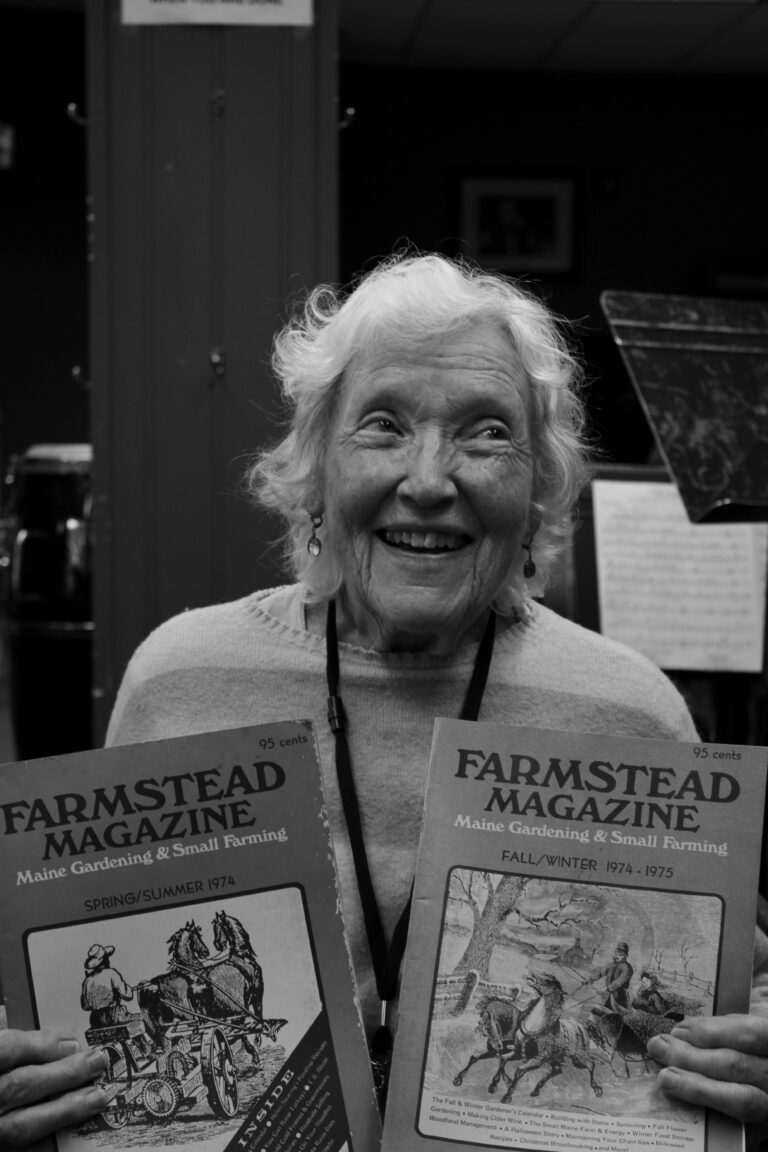
That was the first house we ever had and we filled the barn with animals and I learned about milking goats and having a pig and having it slaughtered. This is very funny. We published a magazine called Farmstead and I brought two copies to refer to.
My husband had- and he was only in the picture for about two years. He wasn’t totally gone, we were divorced. So then I was on my own and I actually loved farming.
[00:03:58] Galen Koch: So you said you actually loved farming…
[00:04:00] Karen Frangoulis: yeah, I loved it. I just loved it, everything about it. The good wholesome food, I’m a cook and a caterer. I became quite a few different things, occupation wise.
Babysitter for many children, 50 all over time. Never at one time, of course. But
I think the most children I ever had in my house at one time might’ve been five, but usually I preferred to have it be one or two, and I had my own daughter. She was young.
All right. So you said that you kind of just jumped right into the farm.
[00:04:39] Phoebe Carter: Did you have prior skills before coming to Maine or did you kind of just learn it as you went?
[00:04:44] Karen Frangoulis: I learned it. I think what the expression is- by the bootstraps up, something like that. My husband was not into it. So, he was out of the picture and I was the farmer. And I wasn’t as good with the gardening aspect, but I was good with the animals.
So we had goats that we could milk. We did have pigs and they had to be slaughtered, but there was a place you take ’em. I’m trying to remember, but I can’t quite remember if we had pigs when I was on my own. I think I stuck to the chickens and I did learn about turkeys and chickens and goats.
I did learn how to slaughter them when necessary or when it was time for that. I just love the wholesomeness. I’m a professional cook actually. But, I’ve had about five occupations. So catering is one; babysitting, done a lot of childcare. And I worked at Noel Paul Stookey’s New World Media Recording Studio. I don’t even remember what I did when I was there, but I know I did stuff. I typed up ads and I just loved the whole thing about it.
I love Noel and all the music. I sing and play the guitar- only functionally, you know, not professionally. So when there was a folk event down at the town park in Blue Hill. I was usually a volunteer there to sing, you know, to have a little… I don’t know, 10 minute set, whatever.
[00:06:41] Phoebe Carter: ’cause coming from Hartford, Connecticut to rural over into Blue Hill, it’s very different , especially community-wise. How was that like?
[00:06:53] Karen Frangoulis: How was the community aspect?
[00:06:55] Phoebe Carter: Yeah.
[00:06:56] Karen Frangoulis: Wonderful. I did come from a small town outside of Hartford, called Middlefield, Connecticut. They had the first folk festival which brought people from miles around. I mean, they were hitchhiking; they were camping out on the grounds right in that little town, and then they shut down the festival because I think they were, I don’t know what the problem was. I think they were worried about drugs and, you know, that made it worse. The fact that you didn’t have any music and these people were camping out, but we were able to walk over there.
It wasn’t far from where we lived. We lived on a hillside. The reason we left there was because my husband George , he worked for American Education publications. That doesn’t need to be in print, but he worked for a publishing company. And before that, he worked for a drug company, doing advertising in Philadelphia.
And when you live in that community, suburban, it’s not a good environment for kids, really. There’s not that much for them to do, but you move to a farm here in Blue Hill and there’s a lot to do. And my boys, and then my daughter, learned to milk goats and then a cow. We had a cow from the Heifer Project, so they give you a cow and they breed it; they have it bred, and then you give them the first heifer calf.
And we had a beautiful heiferWell, one night somebody left the barn door open and the gates and it was snowy, nine o’clock or something like that, very dark in the winter. And all these animals just trotted out the driveway onto the road and that beautiful calf got killed. And that was gonna be our payment for our heifer that we had from the co-op in Orland, home co-op. So they gave us another heifer to raise since we couldn’t give that back. And that was sad, and up until that time, when a goat died or the pig died…. well, in the very beginning we couldn’t slaughter it for our meat because we didn’t know how. But we did learn; we never did a pig. We always took the pig to a place near where they have the common ground fair.
(laughs) I was just thinking about that. The pig scene, the first year we built this elaborate, it’s in the Farmstead Magazine, by the way. One article in there, which I’ll open and refer to, but is about our first year of farming in Maine.
So the first year we built this elaborate walkway from the pens to the truck. And open the gate and the two pigs, big pigs- they need to weigh a couple hundred pounds anyway to take ’em to market. It’s not really market, but to slaughter.
And they went right up the ramp onto the truck, no problem, closed it up. The next year, we thought, well, we don’t have to work that hard. And we had some very different pigs and they had a very different idea about going onto the truck. And we had a rodeo show in our barn with our boys.
Our boys were teenagers. The older one said, “Why don’t we just kill them right here?” And well, we weren’t equipped to do that, you know, skilled or equipped. We finally got them on, but we were all exhausted. We had a rodeo show in our barn because we hadn’t set up that ramp where they just, they don’t see anything.
They basically need blinders on. A good ramp makes it so they can’t get distracted, or whatever it is.
[00:11:30] Galen Koch: Can I ask a question?
[00:11:31] Phoebe Carter: Yeah, go ahead.
[00:11:33] Galen Koch: You’ve mentioned the magazine.
[00:11:36] Karen Frangoulis: Yes.
[00:11:36] Galen Koch: Can you just talk about why and how you founded that ?
[00:11:42] Karen Frangoulis: Yes. The previous job that my husband had in Connecticut , it was called American Education Publications, and they put out the weekly reader publication. So, he knew a little bit about publishing. He also was not into the farming the way I was. We all moved to Maine with jeans, blue work shirts, good boots ready for the farm. But George, his heart wasn’t into it. And so he put on his suit and probably, I don’t remember the tie, but he put on a suit, you know, a shirt and a suit jacket and he went out and he sold advertising to print this magazine.
And I believe you have copies here because I came to one event and I saw them up. I previewed a couple of things- I think mainly my articles, you know, that (laughs) that’s the only thing that I’m interested in. But in getting ready for today, I read some articles that I never read before.
I was so busy farming and raising kids and animals and milking and making cheese and yogurt and all that stuff that I didn’t read the other things that were in here necessarily. I probably read one or two, but mostly I was concerned with my own article. We only had two issues the first year.
The first one is Spring and Summer ’74, and I was only 32. Well, that was 32, 2 years before that when we bought the place. It’s called our first year farming in Maine. It’s right at the beginning and that’s my daughter, Catherine, who now lives in Florida. And I think it’s really funny, and I didn’t know this till today, that my article is all about slaughtering animals and you know, all that stuff. Right next to it, which she would’ve died if she knew this, Helen Nearing’s rose hip recipes because she was a total vegetarian.
I think that’s very funny. But anyway, we didn’t really have any skills; I didn’t have any skills. George really didn’t have any skills or interest. I was totally gung-ho. More happens in this one. 43 is our friend Porky. We raised a porcupine. The boys brought him home. It was about that big in their hand. And of course, I made a nice little bed in a cardboard box and poor thing, it was probably a receiving blanket or something and totally got stuck in it. You know, it was like all tangled up. Porky, he didn’t like that.
The next year we had four issues. And then I think the year after that we had probably one for every other month. We certainly never had one every month, but it was a big production and it took place. in the midst of farming, which is a pretty involving thing because of having milk animals.
I was making cheese and yogurt and tons of milk was in the refrigerator going to waste. And then I had this article around the wood stove. So, I’d choose about six recipes that were appropriate for that time of the year. This one, which is Fall/Winter- “rice pilaf for six, Greek style baked chicken, dark cranberry pudding, black rye bread, apple strudel cake, and carrot cake.”
One of my occupations, besides raising children and animals, was as a professional cook. I catered, and I catered big events. I didn’t usually feel too good about more than a hundred people. That used to be sort of my comfort zone. But, one time it was more than that, might have been 150; it might have been 200.
I once made a cake that was so big ’cause I was a baker first, and then I was a caterer. And I just learned to do it by myself. It wasn’t any training that I went through, so I kept it pretty simple. But when we grew all of our own food, including the chickens and pigs, and even goats- when we had to ‘put down,’ as they say, one of the goats, nobody in the house wanted to have anything to do with it. So, I just packaged it up and put it in the freezer. And maybe six months later , I think I cooked up two roasts very slowly ’cause it’s like a beef; it’s a red meat. And even I didn’t have a huge appetite for eating Nancy (Laughs). We did name the meat because I thought there might be a difference. I knew the animal and
I thought, you never know. We had a huge freezer and I just put it in the freezer because nobody wanted to eat it. But about six months later, I took out two roasts and I thawed them and I put them in a, oh, maybe 300 oven for a long time, very slow cook. Then they looked so good. A little juice was coming out and any red meat you can have rare if you want to. So I sliced into it and it was delicious. So that was cool.
And I can’t remember what anybody else did, but it didn’t matter to me at that point, you know? ’cause we had plenty of food. I was canning lots of fruits. I would buy fruits and can that, and we did have rhubarb on our own property.
[00:18:26] Phoebe Carter: That’s beautiful.
so you said that you were a caterer. Was that like primarily in Connecticut?
[00:18:32] Karen Frangoulis: No. No.
[00:18:33] Phoebe Carter: So you did it up here as well?
[00:18:35] Karen Frangoulis: I did it up here.
[00:18:35] Phoebe Carter: Where did you find like catering jobs up here during this time?
[00:18:38] Karen Frangoulis: Word of mouth. I never advertised. All you had to say was, “I can do that.”
You know, like in the church, let’s say, I remember there was like a family meal, a harvest meal or something like that, and I took it on. Occasionally, I would have somebody. I did have people who worked for me. So for a real catering job, you know, they could make some money, not a lot of money.
I never charged that much for myself. So I can remember one of my regular helpers said to me, “You better up the price because I want more money.” I think she was getting $3.50 an hour. Then maybe I upped it to $8, maybe. She told me what she wanted and I said, “Okay, fine.” Because I just had to make out a bill for the people who we’re hiring.
But usually I also had to predict what it would cost. But it was all very informal and my friends would work with me and I would say, “You can wear whatever you like; just make sure it’s fresh and put on an apron.” And I had a bunch of aprons they could choose from.
I had about four businesses: I took care of children, I worked for Noel Paul Stookey as a secretary in the recording studio, and I cleaned houses. I was a secretary, totally untrained in Blue Hill, but it can happen, you know. And where was I?
My office was one of the bedrooms. So, the chair I was sitting in did not roll forward. You had to get up and move it and stuff like that. But, in the other room, and sometimes I’d be all by myself using a telex machine, and I don’t know if people even know what that is now, but I was communicating with somebody from Saudi Arabia. He was like a wheeler dealer.
I mean, that’s probably not a very good thing to say, but he was in the business of making transactions, connecting people in Saudi Arabia with people in the United States. And I don’t know, maybe they get a loan of money for something they were doing for a hospital they wanted to build, things like that were taking place.
So that was cool. That was pretty exciting. Here I am, somebody down in Blue Hill, up in their bedroom. You know, it was shag carpeting or something and nothing rolls towards, you know, the screen that you’re looking at or what you’re writing down. And then in the other room was this telex machine, and it was sort of like a walkie-talkie, but it also had a little ticker tape thing, the thing that came out that printed what you were saying.
I was there by myself, and the person that my boss dealt with was named [redacted] and I don’t know about liability if you can put his name in, but anyway, you know, you’d hear the machine go on and he would be pretty loud. I don’t know, he was yelling into his mic or something. He was demanding. “I want some answers for some things.” You know, and I said, “Pete is not here right now.” My boss was Pete Sutherland and they lived on Tenney Hill. So, I was in an upstairs bedroom. I had to go down the hallway to the telex machine, and then it had like a ticker tape that came out that had holes in it.
And I think you could reinsert that and it’d probably tell you what was being said. “I said that Pete wasn’t there,” my boss, and he said, “Well, then I’ll talk to you” (laughs). Oh my goodness, he had no idea where I was talking from. You know, I’m in an upstairs bedroom of an old White House, and out back, Pete and Elaine had a garden and occasional animal that they would have to run after.
It was all very down to earth. Then I got a job. From with Noel Paul Stookey.. So I was in the recording studio, and these were not long lasting jobs, but very down to earth. I wasn’t trained as a secretary at all and I didn’t have any excellent machine or anything like that, but the telex machine was pretty stimulating, if not worrisome. But I had to deal with it.
[00:23:36] Galen Koch: Can I ask a question? So, all this is going on, but you were farming the whole time during that?
[00:23:46] Karen Frangoulis: The whole time we had a big barn.
[00:23:48] Galen Koch: Yep.
[00:23:49] Karen Frangoulis: And, the barn had to get taken down at one point. It had already had a new roof on it.
As a matter of fact, my partner at the time, ’cause I got divorced and then I had a partner for five years and he was a good builder and he put a new roof on the barn. It was an old barn. I wasn’t that good of a gardener. But, I was good tending to the animals, like the chickens for their eggs and the goats for their milk. I definitely had pigs and you always have more than one. You always have two because they compete with each other, therefore they eat better.
And I always loved, my grandfather rented a house of his and a barn of his to a family who farmed. Whenever I visited grandpa, I would go to the barn and I’d see whatever was there. And I always loved seeing the goats when I went to the county fair or something like that.
[00:25:02] Phoebe Carter: Was there anything that you ever missed in Connecticut that you wished were up in Maine? Or was it very similar over here? Like did you miss anything?
[00:25:16] Karen Frangoulis: I did not. I jumped in with two feet, you know; I loved it. It was my thing. It was not my husband’s and it was not my boys’ and they had to take on responsibility.
But when I got divorced, my boys did this amazing thing. I think of it now; I should tell them that feedback. They said, “We will do all the chores this summer.” They were not that willing at other times. But that was really good. I was pretty destroyed. I was in pretty fragile shape. So if my boys visited their father, I could do a little screaming if I had to, but I wasn’t much of a screamer.
I’m not that kind of person.
[00:26:07] Phoebe Carter: There were definitely times that you were down, right? Like how did you come back from that? What helped you the most?
[00:26:16] Karen Frangoulis: Well, I took care of a lot of babies and children and I catered a lot of weddings , and I had these different occupations. So, I did work in the recording studio.
I don’t know. I’m trying to think of all the different things I did, but I was sort of willing to do a lot of different kinds of work. And my childcare took me to Montana, took me to Florida. People, I’d be taking care of their kids and they’d travel somewhere. I’d say, “Fine, I’ll be there.” You know, and they’d pay my flight. This one family in Montana said that I needed to be there for maybe a block of time, like, I don’t know how many weeks, maybe five weeks, something like that. They were balancing the whole thing because they had some regular people and then they had me. In the end, I think maybe it was harder for them to get the help that they wanted on a regular basis. But as long as I was there, I did everything. Yeah, it was pretty adventuresome because the lady that I babysat for was a wildlife person working in Yellowstone Park. So she had a little distance to drive. She was with these animals.
There were so many exciting animals there- birds, too, eagles. I love that aspect.
[00:28:06] Phoebe Carter: When you were traveling to Florida or Montana, how was the farm back in Maine?
[00:28:12] Karen Frangoulis: Well, that wasn’t the easiest thing because I had to get someone to be with my three children and to take care of the farm. There were various times when I think farming got discouraging or too difficult by myself
so I would hire someone to be there. I don’t know how they all were behaving, you know, my children and all that. There was a time when I thought I was going to move to Costa Rica. It was really a dream of mine. So, I cut down on the number of animals that I had. I was in that process a couple of times. And I went twice to Costa Rica and I loved it; and I could imagine how I could live there and what kinds of skills I had that would allow me to not take a job if you wanted to be…
Well, first of all, materially you could take whatever you wanted into the country, but you could not take it out of the country easily. So, you know, I’m a knitter and a sewer and I used to think about how I could put on a whole lot of clothes or, I don’t know. I used to have a lot of those kind of thoughts.
I would can a lot of food and I loved that process. I grew up in a family where my mother canned, my mother and father worked on that- canning rhubarb . They didn’t have a huge garden or anything. But I actually got into, when I moved to Maine, I knew people who canned fish so they could feed their cat all winter. I never did that, but I did can some chicken and I think I canned some beef ’cause we did have more than one cow.
I was in my glory, you might say. I am a cook, a professional cook, and I’m a professional childcare provider. Then I was a secretary for Noel Paul Stookey in the recording studio.
I’m a Gemini, so I like to do a lot of things.
[00:30:35] Galen Koch: I love that. We have time for a couple more questions.
[00:30:38] Karen Frangoulis: Okay.
[00:30:41] Galen Koch: Okay. Phoebe, if you have anything in your mind.
[00:30:44] Phoebe Carter: Yeah. So, being in a younger generation, I’m always looking out for like, what would you advise the younger generation?
[00:30:56] Karen Frangoulis: What would I advise?
I wish I’d had time to think about this…
To find things that you’re passionate about, that you really like to do, to learn skills that you don’t have. Maybe you’re interested, like I was to goats. So first opportunity, I bought one Buck goat, little Theseus, and we named him Greek name. You know, Frangoulis is a Greek name; I was married into that.
I was otherwise from English and Irish background. But I’ve always liked any things that were sort of exotic and unusual.
Have I diverged-
[00:31:53] Phoebe Carter: You are okay.
[00:31:54] Karen Frangoulis: from the topic?
I do recommend looking out for what things interest you, learning some new things until you latch on to what really speaks to you.
For me, I’ve been a cook since I was pretty young, ’cause I’m the oldest of five and my mother was a working mother. So part of it was necessity, but it was also a joy of mine to cook. And then I was the oldest of five and taking care of children came naturally and I became everyone’s babysitter, like first babysitter, ’cause they could trust that their child would be in good hands. I had one mother who was very devoted. And she dropped off her one first baby, and she sat out in her car, she told me later, and cried for a while before she could go to work (laughs). She had so much trouble with the separation.
[00:33:05] Phoebe Carter: Is there anything before the end of the interview- is there anything that you want to tell us?
[00:33:15] Karen Frangoulis: Yes. I think that one thing that I’ve learned is to meditate. I think there was only maybe one time that I actually wasn’t able to meditate because the situation was so intense. That had to do with breaking up, in my marriage. But to get a skill like that, to learn to be calm inside will allow you to do many more things and not be afraid.
It gives you inner strength to learn to meditate or just to learn to be quiet because it’s very un-American. I heard years ago when I learned to meditate, they said it’s very un-American. You know, it’s like (laughs) you’re supposed to be moving and talking and excelling or whatever, and that’s not really where it’s important.
That’s what I feel. So, as much as you can do to be calm, you will clear your brain. That’s what I would recommend.
[00:34:28] Phoebe Carter: That was beautiful. Well, that’s all I have.
Is there anything that you have?
[00:34:33] Galen Koch: Thank you. Well, I would love for you to just say your name-
[00:34:37] Phoebe Carter: Oh yeah (laughs).
[00:34:38] Karen Frangoulis: Yes.
[00:34:39] Galen Koch: before the end of the interview. And we always forget this, so if you don’t mind, Karen.
[00:34:44] Karen Frangoulis: Okay.
[00:34:44] Galen Koch: Your name?
[00:34:44] Karen Frangoulis: My name is Karen Frangoulis.
[00:34:50] Phoebe Carter: Thank you.
[00:34:51] Galen Koch: Wonderful. Thank you so much. I’m gonna stop this.
In this interview, Karen Frangoulis reflects on her move from suburban Connecticut to Blue Hill, Maine, in the early 1970s, where she embraced a back-to-the-land lifestyle with her husband and three children. With no prior farming experience, Frangoulis learned as she went, raising goats, pigs, chickens, and cows, making cheese and yogurt, preserving food, and finding deep satisfaction in the work of building a self-reliant life. She shares vivid stories about the joys and challenges of farming, including raising animals for food, publishing Farmstead magazine, and balancing homesteading with single motherhood after her divorce.
Frangoulis also discusses the many roles she took on to support her family, including caterer, childcare provider, secretary, and recording studio assistant. Throughout the interview, she emphasizes the creativity, adaptability, and resilience that sustained her through difficult periods. Looking back, she offers advice to younger generations: pursue what genuinely interests you, develop practical skills, and cultivate inner calm through meditation. Her story is a warm and candid portrait of a life shaped by curiosity, hard work, and a commitment to living close to the land.
